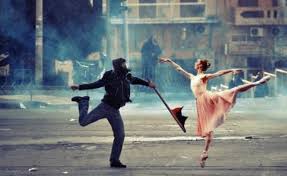
Art and Revolution

imgres

In a better world, there would be no need for artists to sign their work. Material support would not be tied to a competitive system, and confirmation would come from performing and making and doing, without the destructive, enervating conflict that comes from confusing satisfaction with one’s work with social approval and economic status. On that level, the distinction between craft and art would vanish—as the satisfaction that comes from work well done would fall equally to all who contribute to the benefit of the community. Art would not be a specialty of a few—but a gift nurtured and shared by everyone. Those more dedicated and gifted would serve to teach and empower others.

The capitalist systems of exclusion that corrupt the arts and those who are called to them—the gatekeeping function of galleries, critics, investors, and yes—schools of art, which combine to work from earliest childhood to destroy the seed of the imaginative impulse before it can germinate—which works to marginalize, impoverish or reduce to servitude all but the smallest number of those who survive the culling—having lost its economic and political purpose, would crumble and disappear.

Aroused from the drug of the Capitalist nightmare, every artist, poet, dancer, actor, musician… would be a revolutionary

Drawing the thread, stitching the world together, a line at a time.

images

Drawing calms me. It’s very physical; I don’t need the muscular strength of throwing pottery on a wheel (something I did full time for almost 10 years)–but requires every bit the control and coordination. There’s always an element of drawing in my painting–even in the most abstract pieces, and when I get away from that, something is lost in the finished work.
Even the trash assemblages are a form of drawing, not with marks on a flat surface–but in three dimensions, creating lines, geometric or chaotic forms, tonal variations.
My need for this–to return to drawing, day after day without breaks, has progressed–gradually at first, when I returned to making art in July of 2012, to the point now that if I go two or three days without drawing my level of physical anxiety increases and my thoughts spiral toward patterns of depression.
At the end of a day of shopping, cooking, preparing a canvas, taking care of this business or that–I may be exhausted, but I have to take the time–even if only a half an hour sketching figures from an anatomy book.
I didn’t realize until recently–how important this was for my emotional and physical health. It’s that integration of interior and exterior perception… stitching together the fabric of reality.
The metaphor calls to mind, my mother, who was deeply skilled at both drawing–and a seamstress/tailor. I stitch together those ancient bonds, as well, memories and the present. As with poetry. Word by word. Line by line.

Goby’s Journal: September 27 – October 4, 2015

rain-03

Goby's Journal
September 27, 2015

Spelling –she made them
	casting far
& broad

	The Seedlings

		interrupted by

	hope
with nowhere else to go

Grow them by the door step
	two by two, each of a kindness
we have not seen lo these many years

Poetry generates poetry, though I can not speak it
Every one of us, lost
		in our own mother’s tongue


Goby’s Journal
September 29, 2015

Days without sun
There was the Black Stallion before he became famous 
	
	in my dream 

	I rode a bicycle down 
a long hill 
	weaving from one
		side of the path 	
	to the other

the door to our apartment
on the wrong side of the hall

When I entered the room 
I saw from the loft that the auditorium 
was already filled 

Tomorrow, I will learn about trees


Goby’s Journal
September 30, 2015

Learning the names of the trees

We are waking from a collective dream
Storms at sea, days without sun

Wet roof tops mirror the sky


Goby’s Journal
October 1, 2015

Days with sun

Curbside streams ferry fallen leaves
broken umbrellas

I don’t want to understand
	
	 this poem

a shower of words late in the afternoon

is everything we wished for

Animals have taught me another way

	neither from or about

they have taught me


Goby’s Journal
October 2, 2015

The oldest tradition is without borders

Days without sun

Missing the walk among the trees
I failed to rescue myself from dreams

Joaquin is lost at sea


Goby’s Journal
October 4, 2015

No sun for days
the streets of Carolina
are awash with rain

houses dissolve into the sea

from The Margins: “Authenticity Obsession, or Conceptualism as Minstrel Show”

Ken Chen’s, essay.

I read this, at first, racing through out of excietment for what I was finding… but had to stop. To begin again, more slowly. Some–much of this was painful, in a multiplicity of ways–where do I come from, afterall, if not from the colonizers? It took me almost two hours. I need to read this again.

JUNE 11, 2015 | AVANT-GARDE, CONCEPTUAL POETRY, KENNETH GOLDSMITH, POETRY, RACISM, VANESSA PLACE

Nature is a haunted house…

images

In a letter, Emily Dickinson wrote: Nature–is a haunted house–but Art–a house that tries to be haunted.

@Poetry tweeted this quote, and I can’t get it out of my mind. Haunted–by what? A house that tries to be haunted, would seem to be empty–in need of being filled with… what it lacks, but nature has. Has, but as something which is and is not there. Nature’s house we did not contruct, but find ourselves within it. Are we, then, that which haunts it? And the house of Art, a strange sort of house, though we build it, we cannot dwell in it, as we do the house of nature. In our very building of it, it pushes away, keeps us outside, with every word we add, with ever new stroke of the brush, and though what we would render is within, what emerges is yet another surface, and other wall, another door, though we imagine it to be open, but cannot enter.

In nature’s house, we wait for death, and paint the house that refuses death entrance, and us… unless (ah, the paradox!) we empty ourselves of the death that haunts us, and enter, not as ourselves, but only with the emptiness of what we have become, when we have ceased becoming.

We Who Might Be Beautiful Together

Poem Tree WIP 2

Novemember 28, 2010

I took a walk to visit Poem Tree. The wind was blowing ribbons and poem cards this way and that. I leaned Spirit Stick against the bench and untangled some of the ribbons from the branches. They love to dance in the wind. They love to dance so much they forget themselves & get tied in knots. I know how that feels.

A woman came by and noticed Spirit Stick. This is beautiful, she said, where did you get it? On the street, I said. A piece here, a piece there. And things people give me.

Oh, you made it! she said. (this happens more than you might imagine… as though one could find this in a store)

It is beautiful. I think so too.

The things it’s made of don’t seem like much by themselves. A bit of colored ribbon, packing tape, aluminum can tabs, plastic rings… most of them found on the street. Things people have dropped, tossed aside. I pick them up from the sidewalk, from muddy puddles by the curb, on parking lots. I see something… a bit of color, something that shines in the sun, and I think — oh, this will be nice to add to Spirit Stick. I’ll find a place for it, and it will become part of Spirit Stick.

Like a line in a poem.

Most of them, not much in themselves, a few stand out. Like the bit of a bracelet I found on the subway platform. If you look for it, you can single it out. Oh, this is pretty–where did you find it?

But the pretty things are no more or less important than the aluminum tabs I took from cans in the trash, or bits of string from a muddy puddle. A pigeon feather. They all come together, become something else, something more. & yet are no less what they are in themselves.

Like the words of a poem. Like the assemblages I would begin to make when came to live at the Ox.

I think the best poems… the poems I love, are like that. And works of art. Made of things others have tossed aside. Thought useless. Walked past without seeing.

Useless.

But in just this resides their beauty–which has no use we can readily assign. A poet, an artist… sees this lost, abandoned thing… ‘you are like me, he thinks, and I am like you … and she loves it for what it is, and gives it a home. With other homeless things.

A Spirit Stick.

A Poem Tree.

A poem.

An assemblage.

And they rejoice and dance in wind or rain. In the mind of someone passing by. We are beautiful together! they say…

… and they are… and so might we all, be beautiful together. Lost things waiting to be found

Poetry & Art on the Brink of Extinction

images

from December, 2009… waiting for the end. When OWS came along two years later… I was ready.

I had this feeling once before, on the third or fourth day of the Cuban missile crisis, standing outside the door of a nearly empty auditorium on the Campus of Wichita State University, listening to a member of the faculty playing a Bach partita for unaccompanied violin. This time, it doesn’t go away. It comes over me every time I look up at the sky.
Below is a comment I tried to leave to a post on pas au-delà, but there seemed to be a problem with the system. As it’s something I think about every time I hear someone complain about Obama’s failure, I’ll post it here. But pay a visit to Matt’s blog–and buy someone you love one of his beautifully crafted cutting boards for Xmas.

We need a revolution… but of what kind?

The problem with blaming Obama is it suggests that, whatever it is that’s wrong, the right individual in the right place, is going to be able to make it different. Even if there were truth to the cliché that the American president is the ‘most powerful man in the world,’ his power is still limited to stirring the soup; he can’t cook up a new reality. His power is borrowed–it belongs to the whole vastly complicated network that created the mess in the first place.

No president is going to start a revolution, and nothing short of revolutionary change is going to get us out of this. I say ‘revolution,’ because I can’t think of a better word–I sure don’t have in mind any historical example I can think of. Not going to help to turn the pie upside down, put the one’s on the bottom on top, but same old pie. And it’s not going to come from the top down. Before power corrupts, it blinds. Even the prospect of destroying all life on the planet isn’t enough to penetrate the belief of those used to having their way, the belief that they are in control, that whatever comes, they–if no one else, will be able to tough it out, to survive and prosper.

I don’t have a picture of how that ‘change we need’ is going to happen, but I’m damn sure it’s gotta be big… bigger than the industrial revolution, bigger than the emergence of nation states… something equal to the neolithic agricultural revolution, the beginning of settled urban life and our invention of the gods. In a way, our imaginations are still dominated by that vision–whether or not we hold to any of the great mythical systems that grew out of it. What we need is nothing short of starting over, of building anew from the ruins… (is this, perhaps, the ultimate challenge to artistic vision…?) trouble is, I don’t think we’re going to have a second chance. We have turned ourselves into collective infants–a two year old–who out of terror and anger at the failure of the gods we invented to define and lead us, are about to destroy everything in a final uncontrollable tantrum.

Reading at the Bride: a tribute and thanks to CA Conrad

I went to a reading at the Painted Bride on Thursday. A time for remembering. For reflection. I shared a reading at the Bride in — 1966? –with the late Henry Braun. That was when the Bride was on South Street–Gerry Givnish had recently opened a gallery in what had been bridal store–hence, the name.

I was 25–a very young 25. I don’t know how I got that reading spot–it was in this bare store front space, fold up chairs. Paintings on the wall. Don’t remember if it was before or after–but I brought some of my paintings–an open invitation for artists they thought might fit their vision. I didn’t. My paintings didn’t (large oils of faces–filled the canvas–somewhat expressionist mode). I think I looked way too straight and middle class to fit in, and my paintings too over the top for their more “cool” ironic aesthetic…Philly Warhol school.

Before the reading Thursday, I took in the paintings in the gallery. Remembered. How nice, I thought–that this had come from that. A poetry reading in a gallery, surrounded by art.

Such a beautiful reading –with CA Conrad and Frank Sherlock. Not only are they both great poets, but they have exemplified with their generosity and support of poets in Philly and beyond, something as important as the poetry itself. An idea of poetry that has rejected competition, exclusion, the musical chairs of who will survive, who rise to the top–that whole fucking capitalist Darwinian struggle, refereed by literary gatekeepers. They stand for another world, another way of living and loving, the world that we dream might be. This is the poetry of the extraordinary family that I’ve come to be a part of, and I feel so fucking lucky to have lived long enough to experience and share.
I felt this deep sense of affirmation as they read–that we are committed– together– in our poems and our lives, to making a better world, to supporting one another, to a creative struggle of imagination and compassion against indifference, cruelty and submission to the lordship of money and power.

I wanted to voice my appreciation here, and my amazement, at finding myself at such a time and place, in being able to be part of this unfolding creative family.

Thank you CA Conrad, Frank Sherlock… and all the wonderful Philly poets who have informed, and transformed my life.  I love you… all of you.

Georges Bataille, The Impossibility of Literature

7c23df87bf06369d067b811674f30742

(from the Barking Dog, November, 2008) The essays in the beginning of Georges Bataille’s THE ABSENCE OF MYTH, Writings on Surrealism. are primarily of interest for the light they shed on Bataille’s early conflicts and later reconciliation with André Breton and on the history of surrealism: its flowering between the wars and transformation and reemergence after the liberation. The later essays deserve consideration in their own right, quite apart from their place in the history of a literary movement.

I would single out “War and the Philosophy of the Sacred, “Poetry and the Temptation of the End of the World,” and “Surrealism and God,” but those on Jacques Prévert, (From the Stone Age to Jacques Prévert), René Char (René Char and the Force of Poetry), Camus’ (The Rebel (The Age of Revolt), and his critique of Blanchot on Sade (Happiness, Eroticism and Literature) represent aesthetic critical thinking above and beyond.

Begin with the impossible. And never back off.

If you want to think about, to write about “literature” (I am more and more estranged from this word… let’s go back in time and call it all poetry… and what doesn’t come up to poetry (or merely aspires to it without overwriting all earlier attempts to define it, is merely “literature.” What we called the glossy hand-outs at the auto show when I was a kid in the 50’s).

“…poetry is…literature which is no longer literary, which escapes from the rut in which literature is generally entrapped. For us, ‘poetic’ cannot have a set value in the same way as an Anjou wine or a piece of fine fabric–if you want to think about poetry, there’s no where else to begin.

… but with the impossible.

You have volunteered to be shackled to two draft horses. They are pulling, one to the north, one to the south. Your job, if you choose to accept it, is to never give way to one side or the other, even as they tear you, body and soul, asunder.