Excursions into the Material Imagination/ Art by Willard
Author: wjacobr
Visual artist, poet, novelist, activist & Street Medic, living in North. Penn Name: Jacob Russell
My blog is a confluence of art, writing, politics.
my Art portfolio: Art-by-Willard.com
Water colors are fragile. Even with high quality pigments and all cotton paper, they require special care: store away from direct sun, florescent lights, or too bright light of any kind. They need to be matted with non-wood pulp, acid free board and kept behind glass, with mats of sufficient thickness to leave air space between the paper and glass. There are other treatments–covering with resin, but I doubt if conservators would recommend them.
But then, we are at the end of human habitation on this planet (or any other), so who needs to consider ‘posterity?’ Let fragility be a virtue. Let our art perish with us–they’ll be no one to enjoy it when we’re gone. Let it feed the rats and roaches that survive us!
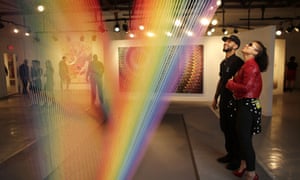
Experts expect a ‘severe correction’, particularly in contemporary and American art, after years of spiraling prices and celebrity and luxury obsession
Musician Alicia Keys, right, and her husband Swizz Beatz look at an installation by artist Gabriel Dawe, in Miami. Photograph: Lynne Sladky/AP
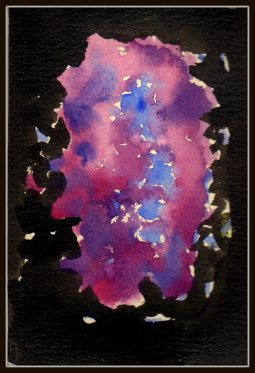
Playing with colors. Each an approximate inversion of the other in hue and tone. #222, ink and water color. Continuing my exploration of what I can do with water color… a medium I’ve not more than dipped into… but finding I love … being in love with color, how could I not be? Like being a student! Would I have been able to do this in a water color class? Maybe Debi Riley’s! Check out her blog–beautiful work, and a natural teacher.
If it’s not play… if it stops being play… get a job at something that pays.
In a better world, there would be no need for artists to sign their work. Material support would not be tied to a competitive system, and confirmation would come from performing and making and doing, without the destructive, enervating conflict that comes from confusing satisfaction with one’s work with social approval and economic status. On that level, the distinction between craft and art would vanish—as the satisfaction that comes from work well done would fall equally to all who contribute to the benefit of the community. Art would not be a specialty of a few—but a gift nurtured and shared by everyone. Those more dedicated and gifted would serve to teach and empower others.
The capitalist systems of exclusion that corrupt the arts and those who are called to them—the gatekeeping function of galleries, critics, investors, and yes—schools of art, which combine to work from earliest childhood to destroy the seed of the imaginative impulse before it can germinate—which works to marginalize, impoverish or reduce to servitude all but the smallest number of those who survive the culling—having lost its economic and political purpose, would crumble and disappear.
Aroused from the drug of the Capitalist nightmare, every artist, poet, dancer, actor, musician… would be a revolutionary
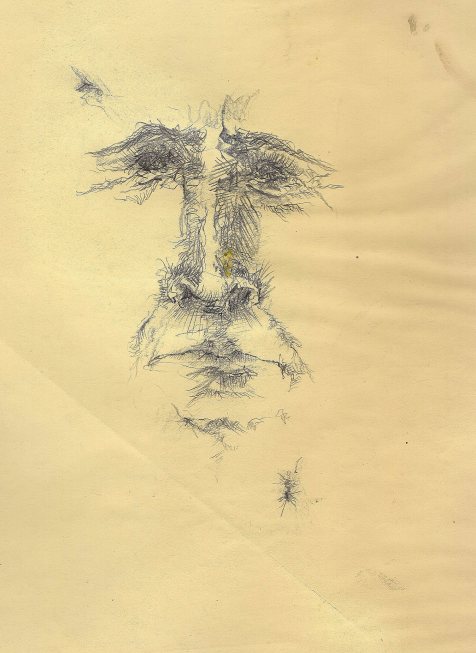
In the 60’s I bought a pad of drawing paper, cream colored, clay coated. I believe it was Morilla Cameo, a paper that was used for silver point. I’ve never found anything before or since as wonderfully responsive to pencil… or to fine ink. You could use pencil as you would use a fine pen nib with ink… with all the shading and modulating power of pencil.
Here are two drawings, the first, from 1969 (crow quill), the second, from 1970 (pencil). I’ve searched in vain trying to find paper like this. If you know where I might find it, please let me know.
Post script: my suspicions were right-that this paper was intended for SilverPoint. Here’s a wonderful site with information on technique, materials and contemporary silverpoint artists.
Doesn’t look bad matted! OMG, I love the vibrancy of water colors! Sitting over my drawing table, they just sing! I think I will be spending more time with water colors — perfect antidote to winter blahs!
Working with dominant/subordinate field reversal, where I wanted yellow orange and red for the dominant field, and blue as the accent. An attempt with acrylic was a failure. MUCH easier the other way around, where the warm colors are the accents and blue is the dominant field. I got a nice sheet of Fabriano 140 lb cp yesterday. Cut it up for 5×7 and 8×10 pieces, leaving myself 5 6×3 pieces and a 22″ strip for testing color swatches and combinations.
Here are two… still a difficult combination (though pretty close to what I have in #412) Need to think carefully about the design. And I can’t use red the way I would in acrylic or oil…tends to pink with water color. I could use it dry, almost impasto, in tiny spots, I suppose. Here are two of the 3×6 trials. I’ve posed a problem for myself… think I need to dream on this!
The Experimental Farm Network (EFN) aims to fight global climate change and ensure food security far into the future by facilitating collaboration on plant breeding and other agricultural research.
Founded in 2013 by Nate Kleinman & Dusty Hinz, the EFN is presently composed of over 200 participants: farmers and gardeners, plant breeders and researchers, amateurs and professionals alike. The network is not-for-profit, based on open-source principles, and dedicated to social justice.
All are welcome and encouraged to join. Read more, and learn how you can donate! HERE
Mouse Melons (Cucumis melo. subsp. agrestis) originally from the Maldives in the Indian Ocean, grown by EFN in 2015. Maldives is an entire country threatened by inundation due to sea-level rise caused by climate change.
EFN exists because our agricultural system is broken. As a society, we no longer grow crops primarily for human consumption, but as commodities. We don’t farm in harmony with the environment, but in ways that harm it. We’ve stopped breeding plants for resilience, taste, and nutritional value: instead we genetically engineer and patent them to maximize corporate profits.
To take back our food system, we’ll need to marshall an army of volunteers to counter the power of the multinational corporations. We’ll need to develop more agricultural cooperatives and strong regional economies like those that thrived before industrialization. And we’ll need to develop carbon-sequestering perennial staple crops (including grains and oilseeds) and more sustainable growing systems & practices in harmony with the natural world.
[…] it is usually through artistic expression that the highest values acquire permanent significance and the force which moves mankind. Art has a limitless power of converting the human soul—a power which the Greeks called pyschagogia. For art alone possesses the two essentials of educational influence—universal significance and immediate appeal. By uniting these two methods of influencing the mind, it surpasses both philosophical thought and actual life. Life has immediate appeal, but the events of life lack universal significance: they have too many accidental accompaniments to create a truly deep and lasting impression on the soul. Philosophy and abstract thought do attain to universal significance: they deal with the essence of things; yet they affect none but the man who can use his own experience to inspire them with the vividness and intensity of personal life. Thus, poetry has the advantage over both the universal teachings of abstract reason…
5×7″ watercolor, ink


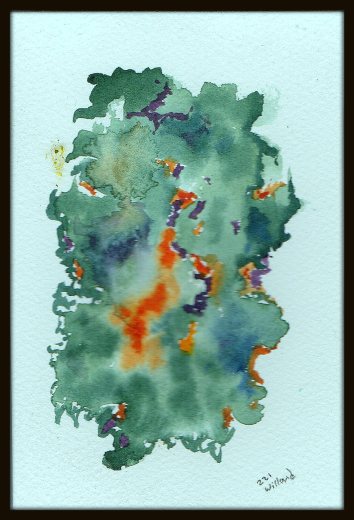 Two more, playing with colors: Dominant Blue green, with ro, yo and rv for accent.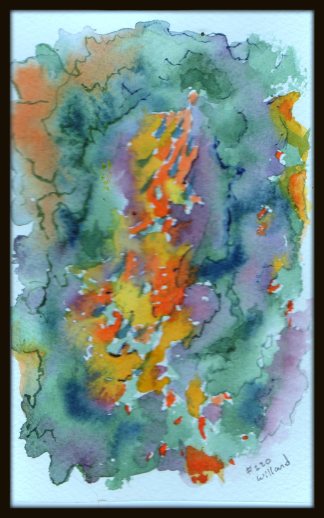

 x
x


 Jacob Russell's Magic Names