One response to the End of Posterity–making art on the brink of human extinction, is to deliberately make work that is fragile, perishable–even to incorporate its destruction into the art.
In thinking about doing silverpoint, I felt a small bubble of elation, in realizing I was doing just the opposite. Silverpoint is one of the most durable of mediums. It’s metal embedded in powdered stone, and can be done on wood or Masonite. It will hold up for centuries. Long after the last human as turned to dust. How satisfying!I will make art for the posterity of my imagination.
Guiding not steering
Sketching human frailty at the Mütter Museum Philadelphia
Silverpoint
This is such a natural, inevitable transition–from my ink and ink wash drawings to SilverPoint. I’m too old, the learning curve is too long, and I’ll never have access to press and facilities, the acid baths … no way, or I’d be into etchings. But SilverPoint opens to the kind of effects I’ve been in love with since I first saw reproductions of Piranesi’s prisons. Work I’ve done with pen and ink are suggestive in this direction. I especially like the Silverpoint will endure for centuries… when there’s not much hope human life will be around even for another 100 years. Kinda like, Fuck you, capitalist pigs! I’ll just make up the “posterity” you’re working so hard to kill off. 

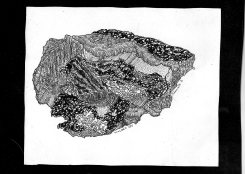 Or from my pavement series

So I spent my food money for Silverpoint ground and a stylus. I have more than enough excess weight to get me to my next SS check!
Silverpoint
In two earlier posts, HERE and HERE.
I wrote about my search for a clay coated paper I used some 40 years ago, and have searched for in vein. I realized at some point that this had probably been made for silverpoint. I still couldn’t find that paper, but have become intrigued with the thought of doing silverpoint.
I found a wonderfully informative web page, SilverPointWeb.com. It seems there is a Japanese made paper, called Karma, but only available through a NYC supplier, and they don’t ship. I’m waiting for a reply to a question I left about using Golden SilverPoint ground (another recent discovery).
Whoops… mildly embarrassing. I diligently scrolled through the FAQ looking for reference to the Golden ground, so I wouldn’t be repeating a question that had already been covered. … then going back to the site, I see this on the Page One:
Golden Artist Colors’ new Silverpoint / Drawing Ground is a recent development and is an excellent acrylic formulation, providing ease of use without the problems associated with other acrylic-based products; I not only highly recommend it but also now supply it, in the Complete Kit and separately.
If you Google, Silverpoint images contemporary artists, this is what you’ll see. Though how Dürer and Du Vinci rate as ‘contemporary,’ I don’t know. But so many rich possibilities. I’m so excited to get started with this… waiting from my silver stylus to show up in my mail box. Read everything I can get hold of while I’m waiting.
#445
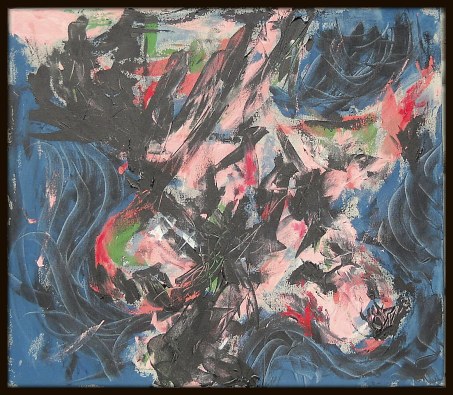

View GALLERY HERE.
32×32″ Acrylic on canvas
There were two figures when I began, heads and torsos, one behind the other facing opposite directions. The canvas was reversed from what you see here, top to bottom bottom to top. When I finished, the figures had vanished, and I decided it worked better when I flipped the canvas. I like the predominately upward sweep. I worked very quickly in 4 stages, spending no more than 10 or 15 minutes at each stage, layering, laying in colors–almost all with palate knife, scraping through flat edge to canvas, then with a nail. I thought there would be one more pass, and took it upstairs to my bedroom to look at it, see it in my dreams. This morning I thought–whatever else this needs, what I feel to be missing, I’ll have to find in the next painting. That’s something I learning in writing poetry.
#444 From Stars to Stars


an act of bravery
Source: an act of bravery
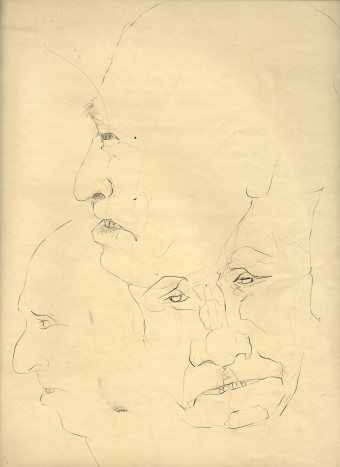
Sketch, 1974 Polish bar Margaret-Orthodox
40 years ago… I carried drawing pads everywhere I went. This was one of the regular patrons, a little bar with a Polish name, now a produce market. I had been making pottery for a couple of years, and this was about the time I gave up on painting. Convinced I would never be good enough.
#443
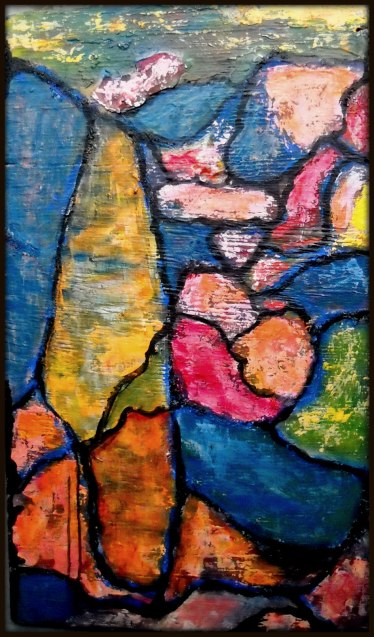
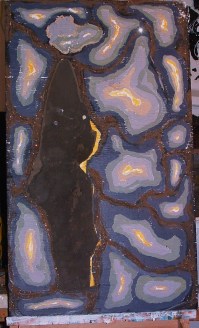
33×19 Acrylic on weathered plywood This posed some problems. It was a paint-over of a piece with built up ridges of street dirt that were going to show up no matter what (see below #181 from 6/13). I had to build on that pattern, which meant layering and impasto, without hiding the the texture of the plywood.
View GALLERY HERE.
 Jacob Russell's Magic Names