Artists, Class, Revolution

Walking thoughts… ideas come to mind, walking here and there and back: to the el, the wine store, to the Fresh Grocer. Sometimes they kick off something that comes back to me. A couple days ago, I was thinking about artists—not ART, artists. About making a living (or at least, paying for art materials), in a capitalist system, when one is a confirmed, convicted, solidarity-convinced anti-capitalist. And it occurred to me, that one could look at the problems through the lens of class—that the structures and machinery of class reproduce themselves on particular strata, and this seemed particularly helpful to me in understanding what artists deal with.

The connecting point in these thoughts, was meritocracy—how, because class is not like castes, frozen across generations for all time, but somewhat permeable, it’s easy to ignore how class, in itself, is as unchanging as an South Asian caste system. That individuals are able to climb the ladder, does nothing to overthrow the range of beliefs that justify class inequalities for those who benefit from them, or to offer serious challenge to the ideologies that use those beliefs.

What beliefs? The ‘natural’ superiority of men… (white men), is way up there at the top: patriarchy and Euro-Anglo-American racism–used to excuse, what otherwise would make what capitalism, colonialism, slavery, have done, and continue to do, to the mass humanity, intolerable. What does that have to do with, meritocracy? With art? With the capitalist class system?

Everything.

Capitalism creates, maintains, and perpetuates inequality. All the way back to the Adam Smith, this has been acknowledged, and because it so flies in the face of the most minimally developed sense of justice, is addressed in all the ideological variants that would defend and promote capitalism. For Adam Smith—it was the Invisible Hand, which, (grossly misused since) would correct the worst abuses, and prevent capitalism from becoming what it has, in face, become. But nothing has been more useful, or done greater violence, the social Darwinism and eugenics. Here was the perfect foil, the perfect answer, to justify belief in the inferiority of the masses, and if an individual here and there, rose up and proved themselves superior to their birth—the genetic mythology perfectly accounted for it, and supported those who would protect the superior races and individuals, while justifying their suppression, and attempts to control, or better, if they proved less than useful and docile–eradicate the untermenchen.

How perfectly the Art World recapitulates this! With its gallery to investor pipeline, a gatekeeper system, meant to identify the Elite, and (hopefully) erase from memory, if not from life itself all the outsiders! Women! Blacks! Colonials! A Patriarchal system (where are the women from how many generations past?) Where are non-Euro artists and their work, but as appropriated by the (even if late-acknowledged) Masters? There is such thing, as ART, let alone, an “Art WORLD!” … if it is not as varied and multiple as there are worlds and peoples! If it doesn’t crash through and DESTROY the gatekeepers and their system!

Those were my walking thoughts… how, I asked myself. .how is it possible, for anyone who calls THEMSELVES an artist—to accept this system? To define their idea of ‘success’ by it’s terms? To not throw themselves into the struggle to create—to IMAGINE… as artists do.. a new and better world?
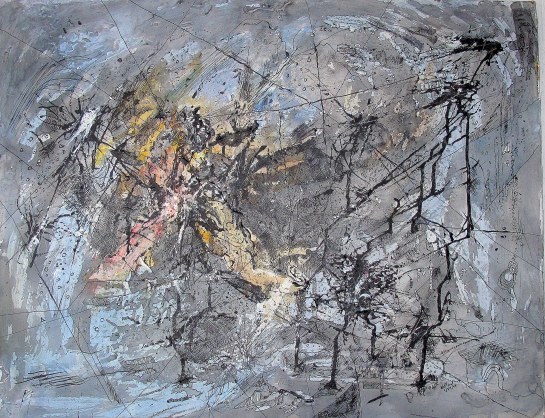
#669 (New Image)

56 x 71cm. Canvas, textured from paint-over of older painting. Gesso ground. Ink and watercolor wash: brush, pen. The texture defeated what I’d intended to do with the pen and ink–so I went with the flow. Still want to try a larger piece pen & ink. Different surface. This much improved image, from my Canon G10 (Thank you, George Kuetemeyer!)

#669.JPG


View portfolio here ART BY WILLARD
For photos on this blog:CLICK HERE, and scroll down.

Two Dreams about making art

#668

Dreams last night. I was walking with another artist in Paris (I’ve never been out of the U.S.A., let alone Paris)–but it was quite vivid, the architecture with its sculptural adornments. I was explaining to my companion, or he was explaining to me (it wasn’t clear) how when you lived in a place where you passed and saw the work of artists going back over time to the middle ages and older–that for a working artist, it would all be contemporary–all working it’s influence, all there to draw on–and it’s very diversity meant that it would be impossible to be merely derivative, or for your own work to be other than wholly new.

This seemed to fold into examining a book of illustrations, like urban street sketches of row houses. There was a small, vague figure in the lower left corner, that I realized when I saw it (as though this were being explained to me), that stood for the person who had committed suicide in each of those houses, or been murdered there… the explanations seemed to increase in the violence revealed, page by page.

These felt like they were the same dream. The same dream message.

Goby’s Journal: Harihara

images.jpg We learn from Freud, as from novelists and poets, if we learn anything at all, that we can never “know ourselves.” We fool ourselves in too many ways, and what we are, our Truth, is never fixed, but always moving, always becoming, becoming something else. How much more the difficulty, when the object of our knowledge is at a great distance.
Or is it the other way around? –the closer to the center (should I say, the heart of our being?) –the less we understand, the less we can claim to know?

Closest to one we love, our knowledge approaches a zero point–though knowledge (always imperfect though it is) circles all the while like stars in a galaxy around the black hole of love, of self–around that center–with ts power to draw toward its eventual horizon–all that we believe we know: self & beloved,  & love itself– & yet, remain untouched by mind–untouched, above all, by language, even while, in ways beyond our power to know–there from that dark, unfathomable pool, emanates the forces that shape language, all that we know, think–or think we know.

Is that how philosophy came to be captured in a word for love? And how, all the arts, all that has power to bring us to the end of knowing–are of the annihilating & generative power of love?

Love, the word we give to that manifold desire that can’t be named, or tamed–destroyer and creator of good & evil, end & beginning of all that we make & do, fusion of Vishnu and Shiva… Harihara.

Open Casket:

I keep thinking, that had Dana Shutz kept that specific association to herself–the photograph of Emmett Till in his casket–that there would have been no problem. But then, it probably wouldn’t have been accepted into the Whitney Biennial, and there is its failure, both aesthetic and ethical. That it has to draw on the title for its power is a sign of it’s weakness, of it’s failure as a purely visual work.

I think that the power of any work of art–of any medium or form, lies in the veer from direct association, even if that reference is specific and representational. She chose an abstract and ambiguous rendering of her idea: so far so good–but then, maybe because she thought that’s what would get her into the show, she had to give in to the urge to Name it.

A public image as charged, and as specific to the people involved, as that photograph, is all but beyond the possibility of direct representation. The public caste is so strong, so loud, so opaque, that it defies penetration. What we might hope for in a work that comes out of an artist’s desire to respond to such events–is that it take us deeper, that it illuminate what we did not, could not see in the public image. That it strips away the title, the naming, from the received associations, and takes us to a place we had not, could not have imagined without it.
Sensational, news-laden titles are inexcusable shortcuts, evasions of the harder work of the imagination. Whatever merit or power this painting has, is erased by misplaced ambition, by the surrender to the utterly corrupted ideas of artistic “success” in a capitalist world

What I hear the Muses tell me…

If you surrender to the machinery of capitalism, if you surrender your art-and making art, to the machinery of commodification, you will become a traitor–to your art, and to yourself.

This is what I hear…

You may deny this, but if you truly don’t know, don’t understand this, in the  core of your being, it can only be because you have already betrayed, not only your art, but your humanity.

But we need money… To have what we need, to live, to make our art. How? How then do we live?

Yes.

That’s the question you have to ask… but only if you ask it, not state it as a declaration,  an excuse,  a rationalization, as a confession of defeat–if you truly ask, cracks will open in the prison of the matrix, and that will be a beginning.

A beginning. That is the only hope we have. All we can ever do. Begin. And begin again.

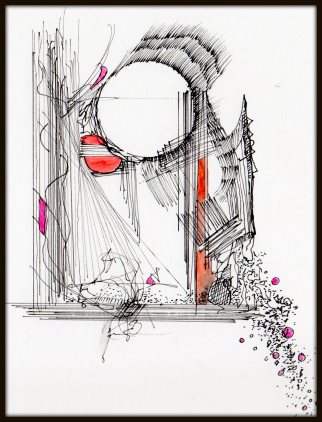
#657

#657Working on visual ‘ideas’ for a larger piece. Would you believe I’ve been working on the this for 3 days? It’s only 15x17cm, but pen & ink (with my beloved crow quill nib (Hunt No 2) is labor intensive, and I need lots of time between working sessions to observe and think about where it’s going.

I feel a contradiction, a painful tension between the increasingly abstract art I’ve been making, and my desire to make what I do register as resistance, as opposition to the fascist coup and all the horrors it’s begun to unleash.
But I can’t… I can’t work like that–come up with an idea to show what I’m thinking–something with an intelligible ‘message’.
The message, if there is one, is there. But it’s in the tensions between containment, ‘authority,’ and liberty of movement. It’s all visual. When I feel the need to SAY… I write a poem. And even there, it will be elsewhere… as the world we need to make to survive… is elsewhere. Do you understand this? Does this make sense?

View portfolio here ART BY WILLARD
For photos on this blog: