The Most Relevant Art Today Is Taking Place Outside the Art World

Read article here –>  Artsy Editorial

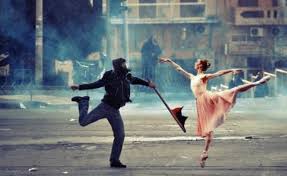
“When artists operate outside the gallery space, whether because their work functions best there, or because they are forced to, they are both creating valuable art and making the limitations of traditional art institutions visible—physically, historically, and conceptually. Perhaps such work can even change those institutions, those structures of looking. Perhaps it can change society at large. And that’s unceasingly relevant.”

#489 Basement Stairs: additional work

14″ x 17″ Charcoal, pastel, acrylic on Bristol paper. View from my easel: my dungeon studio. Thinking about Joan Eardley, whose work I wasn’t aware of till someone posted some of her paintings on Facebook… just blown away by her paintings. The write ups on web pages–the kind of dismissive praise I guess you have to expect when male critics write about a woman artist. She’s so much more than a painter of ‘Scottish identity,’ and her paintings aren’t ‘expressionistic’ –just doesn’t capture the tension she creates between her sometimes minimally suggested subjects and the powerful abstract structures that govern and contain them.  They never lapse into a mere expressionist mess. There’s no need to hold their representative subjects in mind to feel the power, the pure visual power or her re-imagining them. So much of what I aspire to do.

Photo with additional work with pastel. What do you think?#489

#489 View from my easel

Structure in Lieu of Composition

images

In an earlier post (HERE), I mentioned that I’ve been been wondering what it would mean to think in terms of structure, where one would normally use the word ‘composition,’ in lieu of composition, in the place it has occupied in art criticism.

Of Merriam-Webster’s definition:

1
: the action of building : construction
2
a : something (as a building) that is constructed
b : something arranged in a definite pattern of organization (a rigid totalitarian structure — J. L. Hess> (leaves and other plant structures)
3
: manner of construction : makeup (Gothic in structure)
4
a : the arrangement of particles or parts in a substance or body (soil structure) (molecular structure)
b : organization of parts as dominated by the general character of the whole (economic structure) (personality structure)
c : coherent form or organization (tried to give some structure to the children’s lives)
5
: the aggregate of elements of an entity in their relationships to each other (the structure of a language)

… placing particular emphasis on  1, 4 b and 5 (italics mine), and drawing a link between PROCESS and PERSONALITY STRUCTURE (thinking of this, perhaps, in psychoanalytic terms)

Carrying this a bit further, a passage by Lacan in Ecrits, Appendix II: Metaphor of the Subject, suggests to me, yet another reason for this.

“This means that the most serious reality, and even the sole serious reality for man, if one considers its role in sustaining the metonymy of his desire, can only be retained in metaphor.
What am I trying to get at, if not to convince you that what the unconscious brings back to our attention is the law by which enunciation can never be reduced to what is enunciated in any discourse?”

… how, in thinking about a painting. this allows one to give full regard to its materiality, and at the same time, opens critical analysis to metaphor… without reducing the painting to that which it might be perceived as signifying (“representing”), visual metaphor that resists subsummation to the semiotic, as is the discourse that dominates so much of art history–which, again, Hubert Damisch’s A Theory of /Cloud/ so brilliantly avoids.
What then of painting that does away with signification, is it then without metaphor Or is the denial of semiotic signification (this is that), a kind of master-metaphor, reminding us of the futility of deciphering (from written cipher to visual?) metaphors, which shape-shift away from whatever form (or formula) we try to fix them to?

End of Sovereignty: Bare Life and the Coming Civil-War?

This speaks to my anarchist heart. Yes and yes and yes–oh, and so much more! (see my comment following this post, for how this connects with my art!

Agamben at one point choses to explicate this notion in reference to the included/excluded people within and outside politics:

It is as if what we call “people” were in reality not a unitary subject but a dialectical oscillation between two opposite poles: on the one hand, the set of the People as a whole political body, and on the other, the subset of the people as a fragmentary multiplicity of needy and excluded bodies; or again, on the one hand, an inclusion that claims to be total, and on the other, an exclusion that is clearly hopeless; at one extreme, the total state of integrated and sovereign citizens, and at the other, the preserve-court of miracles or camp-of the wretched, the oppressed, and the defeated.6

Isn’t this the state of exception of migrant immigrants everywhere, a multiplicity outside the law, outside sovereignty, the inclusive excluded of the wretched, the oppressed, and the defeated?

And THIS:

“And in a different yet analogous way, today’s democratico-capitalist project of eliminating the poor classes through development not only reproduces within itself the people that is excluded but also transforms the entire population of the Third World into bare life. Only a politics that will have learned to take the fundamental biopolitical fracture of the West into account will be able to stop this oscillation and to put an end to the civil war that divides the peoples and the cities of the earth.7”
And THIS is why NONE of the candidates, of either party, will move us one footstep beyond square zero!

…is why not one of the U.S. presidential candidates, of any party, will move us one single step past ground zero!

S.C. Hickman's avatarThe Dark Forest: Literature, Philosophy, and Digital Arts

…the sovereign is the point of indistinction between violence and law, the threshold on which violence passes over into law and law passes over into violence.
– Giorgio Agamben, Homo Sacer

When one actually thinks about it, rather than just spouting rhetoric from some ideological mythology of the Left or Right the problem of immigration in our world is about Sovereignty. It’s about the emerging war against boundaries, limits, and finitude in politics, science, philosophy, the arts, and gender. In politics it’s about immigration, migration, and the sense of breakdown of nations and their paranoiac reactionism against imaginary and perceived threats to their own integrity and sovereignty. Same in the sciences we see explorations emerging in biotechnology, nanotechnology, and information and communications converging to form a global network society that will break free of political and social constraints and provide a larger framework and platform for such politically motivated notions as transhumanism that…

View original post 2,052 more words

Art and Revolution

imgres

In a better world, there would be no need for artists to sign their work. Material support would not be tied to a competitive system, and confirmation would come from performing and making and doing, without the destructive, enervating conflict that comes from confusing satisfaction with one’s work with social approval and economic status. On that level, the distinction between craft and art would vanish—as the satisfaction that comes from work well done would fall equally to all who contribute to the benefit of the community. Art would not be a specialty of a few—but a gift nurtured and shared by everyone. Those more dedicated and gifted would serve to teach and empower others.

The capitalist systems of exclusion that corrupt the arts and those who are called to them—the gatekeeping function of galleries, critics, investors, and yes—schools of art, which combine to work from earliest childhood to destroy the seed of the imaginative impulse before it can germinate—which works to marginalize, impoverish or reduce to servitude all but the smallest number of those who survive the culling—having lost its economic and political purpose, would crumble and disappear.

Aroused from the drug of the Capitalist nightmare, every artist, poet, dancer, actor, musician… would be a revolutionary

Anselm Kiefer: Negative Worship of the Capitalist State

He likes Merkel? …and calls himself ‘underground?” I guess, like Weiwei, it takes millions to be underground. I like Weiwei’s politics better. For all the brooding spectre of his work… smeared with the soot of German history. Art that only exists by the largess of power and wealth, cannot but stand as a monument to the glory of the Capitalist State–is a kind of kitsch. Like the architecture of Speers he admires.

Anselm Kiefer: ‘Art is Difficult, it is not entertainment’ An interview in the Guardian.

Abstract Art

Source Debrilly Abstract Art

When I see a work described as abstract, I ask myself–isn’t every work of visual art, ‘abstract?’ Unless it be 100% conceptual–and then it’s abstract in a cognitive or verbal sense.

I think of Cezanne, who wanted a plates of apples and pears to be as monumental and important as a portrait of a Madonna. Of course, this goes back further than Cezanne–to Manet, to Whistler, Turner, Corot… culminating in Pollack, Mondrian, Kandinsky… but isn’t that  what we see and appreciate in the cave painting of Lascaux and Altamira?

Isn’t that thing we superficially identify as ‘abstract,’ the hook that every visual work of art hangs from? That silence that surround it–at last, the verbal mind tuned out, thought without words. That blessed silence of every genuine work of visual art?


Artists as… tricksters of the real

sumeria1
I came across this cleaning my room… from 2009: two years before OWS, and 3 years before I would begin making visual art again.

…poets and artists are the ultimate subversives. Not prophets and seers, as the Romantics thought, not hermetic guides blessing humanity with visionary truth, but…
tricksters of the real,

Marxists …
of Night at the Opera, destroyers of painted sets ripping away the masks of power, tearing down the curtains of the Corporatocracy–all that makes it possible to believe in the American Hologram–the artifice of the military/industrial/prison complex. By using the stuff of our collective illusions as raw material for… play,

for delight,
for life

—they…we… poke holes in the artifice that everyone might see, that the vision be not for the few, but for all.

Art & Fear: Observations On The Perils (and Rewards) of ARTMAKING

By David Bayles & Ted Orland: Santa Cruz, CA & Eugen, Or.  1994 – 2000

Picked this up at the Faerie Pot Luck. Only 118 pages, but have never read anything better on what goes into making art, for an artist. The motivations, the distracting temptations–what constitutes the only possible reward to keep at it, to keep doing it. I’m a 74 year old artist, and have gone through all the phases of despair, stopping, starting again. This book made me weep with joy. I don’t know that I found much new here, new for me, that is, at this stage in my life and my art, but the confirmation for what I’ve struggled with over so many decades is like a blessed cool rain after a long drought. Would that I had read this book… had it existed, when I was 24.

The reviews on Goodreads either thought it was 5 star (like me)… or didn’t get it. I’d be interested in what other’s who’ve read it have to say about it. Comments welcome.