Oracular Vision

I’ve been reading John Berger’s Understanding a Photograph. He writes in the essay, Appearances: that …

In every act of looking there is an expectation of meaning. This expectation should be distinguished from a desire for an explanation. The one who looks may explain afterward: but, prior to any explanation, there is the expectation of what appearances themselves may be about to reveal.
Revelations do not come easily. Appearances are so complex that only the search which is inherent in the act of looking can draw a reading out of the underlying coherence If, for the sake of a temporary clarification, one artificially separates appearances from vision (and we have seen that in fact this is impossible), one might say that in appearances everything that can be read is already there but undifferentiated. It is the search, with its choices which differentiates. And the seen, the revealed, is the child of both appearances and the search.
Another way of making this relation clearer would be to say that appearances in themselves are oracular. Like oracles they go beyond, they insinuate further than the discrete phenomena they present, and yet their insinuations are rarely sufficient to make any more comprehensive reading indisputable. The precise meaning of an oracular statement depends upon the quest or need of the one who listens to it. Everyone listens to an oracle alone, even when in company.

“Everyone listens to an oracle alone, even when in company” When I read that, I asked myself, “isn’t this precisely how one sees… a painting?

My calling… my vocation, as a poet and artist, began at a moment like that—an oracular vision–11 or 12 years old. Forsythia blossoms after rain, when the sun came out from clouds and turned the drops of water on the petals into prisms. Everything I’ve done since, has in some way, been connected to the effort to understand that moment.

“The modality of the visible” … the expectation of meaning in what is seen – is this what I look for as I work on an abstract piece – the expectation of meaning, but one disconnected from any narrative or ideological sense–a meaning that hovers above explanation, and untouched by it?

My novel, Ari Figue’s Cat… https://www.amazon.com/Ari-Figues-Cat-Jacob-Russell/dp/1940830060 the motive for writing it; this is its central theme.

What I look for as I work—as I arrange pieces of trash, draw lines on a page, brush color on a canvas. Why I prefer abstract work. Representative art, when it seizes me, is always like this. Rousseau’s Sleeping Gypsy. The Sleeping Gypsy, 1897 by Henri Rousseau
The enigma. The expectation of meaning—that defies explanation. Iconography, represented figures… are a distraction. Though a master can so charge the most meticulously rendered images with that oracular sense, that all our efforts to explain are exhausted… and we are left with what we see, and that alone. Jan Van Eyke’s Arnolfi wedding portrait. Image result

I work on a piece until I have that sense… in looking at it, in seeing it: the feeling that it means something. I have no idea what, or how to explain it. It’s enough, if I capture that feeling, an enigma. Beyond words.

We long for a vision … a way out of this fucking capitalist hell.

We don’t know what it is… but if, in seeing this, we can believe that it exists…beyond words, beyond explanation.. but there for us to find and create… I will have done my part.

Open Casket:

I keep thinking, that had Dana Shutz kept that specific association to herself–the photograph of Emmett Till in his casket–that there would have been no problem. But then, it probably wouldn’t have been accepted into the Whitney Biennial, and there is its failure, both aesthetic and ethical. That it has to draw on the title for its power is a sign of it’s weakness, of it’s failure as a purely visual work.

I think that the power of any work of art–of any medium or form, lies in the veer from direct association, even if that reference is specific and representational. She chose an abstract and ambiguous rendering of her idea: so far so good–but then, maybe because she thought that’s what would get her into the show, she had to give in to the urge to Name it.

A public image as charged, and as specific to the people involved, as that photograph, is all but beyond the possibility of direct representation. The public caste is so strong, so loud, so opaque, that it defies penetration. What we might hope for in a work that comes out of an artist’s desire to respond to such events–is that it take us deeper, that it illuminate what we did not, could not see in the public image. That it strips away the title, the naming, from the received associations, and takes us to a place we had not, could not have imagined without it.
Sensational, news-laden titles are inexcusable shortcuts, evasions of the harder work of the imagination. Whatever merit or power this painting has, is erased by misplaced ambition, by the surrender to the utterly corrupted ideas of artistic “success” in a capitalist world

What I hear the Muses tell me…

If you surrender to the machinery of capitalism, if you surrender your art-and making art, to the machinery of commodification, you will become a traitor–to your art, and to yourself.

This is what I hear…

You may deny this, but if you truly don’t know, don’t understand this, in the  core of your being, it can only be because you have already betrayed, not only your art, but your humanity.

But we need money… To have what we need, to live, to make our art. How? How then do we live?

Yes.

That’s the question you have to ask… but only if you ask it, not state it as a declaration,  an excuse,  a rationalization, as a confession of defeat–if you truly ask, cracks will open in the prison of the matrix, and that will be a beginning.

A beginning. That is the only hope we have. All we can ever do. Begin. And begin again.

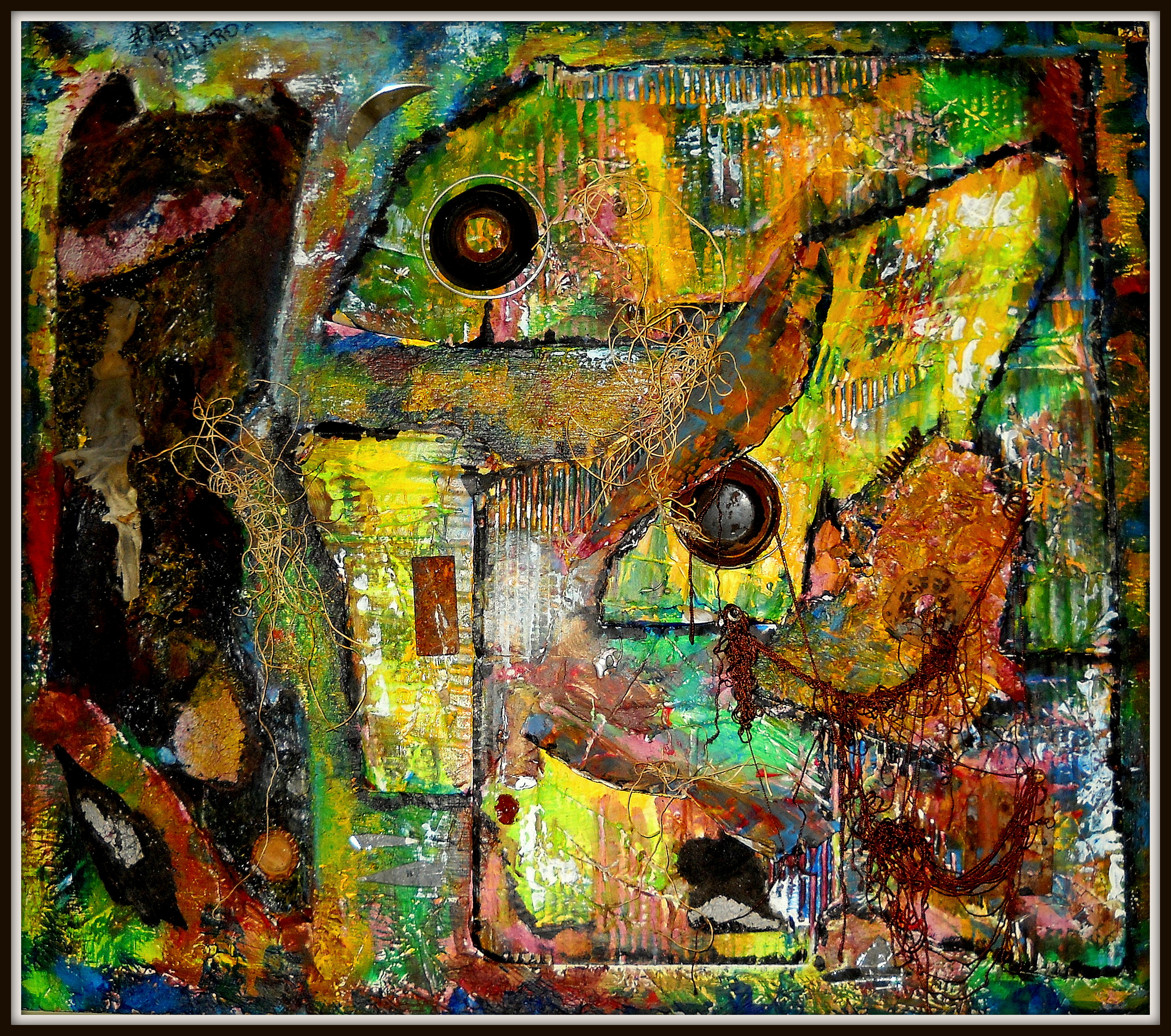
Recyclation, date unknown

Searching through photos on USB and in Picassa looking for date/ number for this. Couldn’t find it. Probably sometime in 2013, so between 81 and 295. So many misses missing: destroyed in moves, trashed, lost.
24 x 26.7cm. Not one the stronger assemblages. Came close to trashing it everytime I moved. But seeing it again, seemed interesting. Insulation or packing material, bottle caps, broken glass, street dirt. House paint, a leaf, ink, watercolor. Another face in the debris and waste of capitalism.
Reciclaytion date and number unknown.JPG

View portfolio here ART BY WILLARD
For photos on this blog:CLICK HERE, and scroll down.

#646 Gates of Unknowing

68.5 x 56 cm. Watercolor, ink, burned Buddhist paper.
Artists learn early that art won’t save us. Not that it ‘can’t,’ but that it won’t. A refusal. No different for the few who find ways to manipulate the capitalist machine to grant them false compensation in money, though that may make it easier to hide from the truth.
I’ve been thinking about this as I’ve worked on my last few pieces. No more than our children can save us, I thought. I feel, even as I work, the increasing distance, this alien thing, this work of my hand and eye–how it absorbs something of the power of the sacred, a power that is not, and never was, my own. And never will be. Like our children–we want them to live, to shine with that life that will never be ours,  even as they abandon us to death.

#646 Gates of Unknowing.JPG

View portfolio here ART BY WILLARD
For photos on this blog:CLICK HERE, and scroll down.

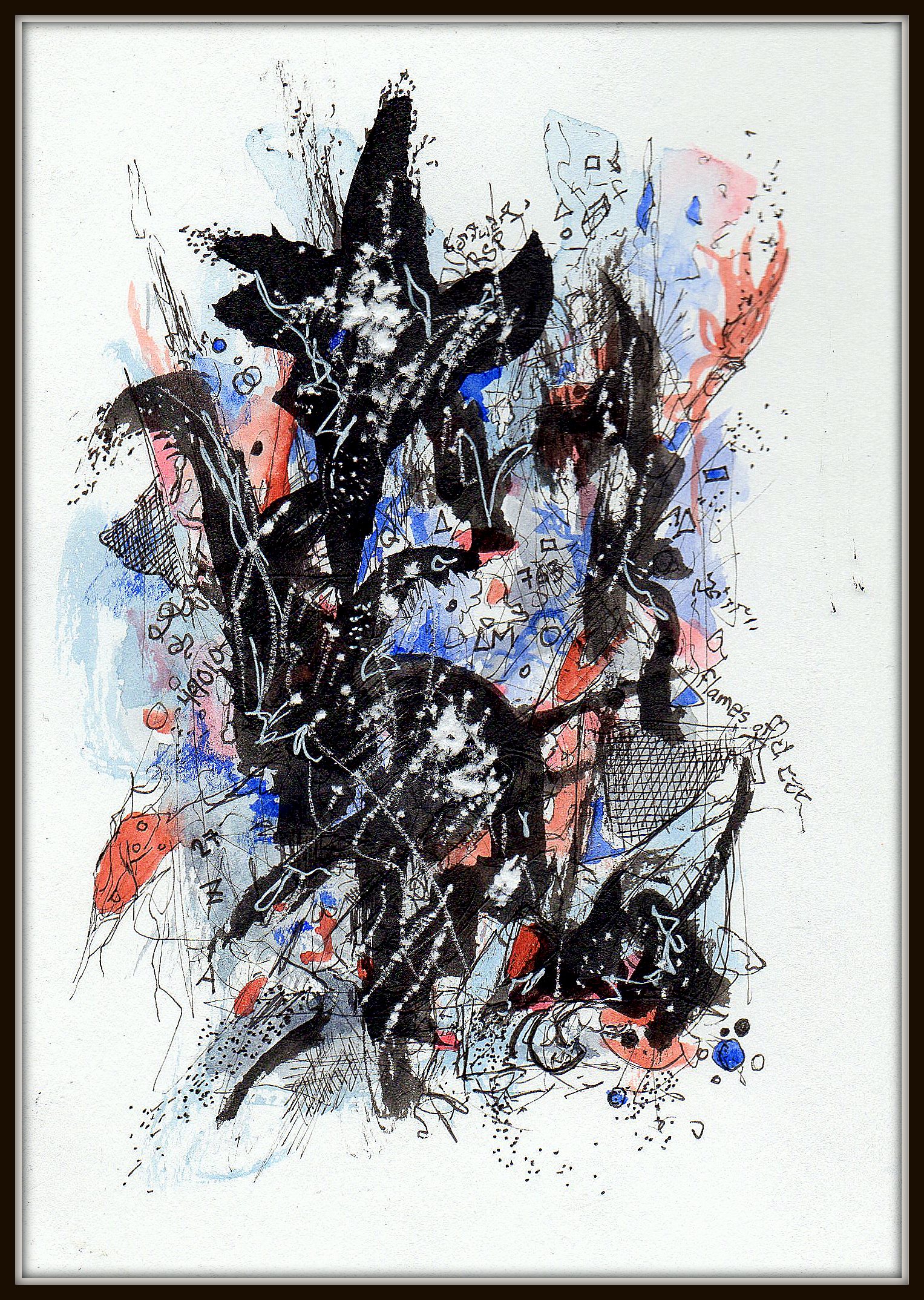
#636 Smash the State!

22″ x 20″ Black acrylic, white gouache, watercolor, pen and ink on 140 lb cold press Fabriano paper .
I’m turning to the idea of titles that simple reflect my mood, or extraneous thoughts at the time; these may or may not be descriptive of the work. In this case, the title appears in the painting, but so does ‘Train Wreck,’ ‘Sing,’ and several letters and numbers. As long as Trump is in the White House, and until we have a real revolution — I might name all my pieces, “Smash the State.”
636-smash-the-state