

View GALLERY HERE.
7×5″ watercolor, ink
Words again… is it poetry trying to pull me back into its frightful fold?
View GALLERY HERE.
7×5″ watercolor, ink
Words again… is it poetry trying to pull me back into its frightful fold?
This was one of those paintings where each attempt to solve a problem makes it worse. After working at for 5 days, I gave up and covered it with gesso. You can see hints of color showing through from the painting underneath. Dissatisfied with paintings that are stuffed to the edge and into the corners, I took a pallet knife and laid on black paint around all four sides– … then this happened.
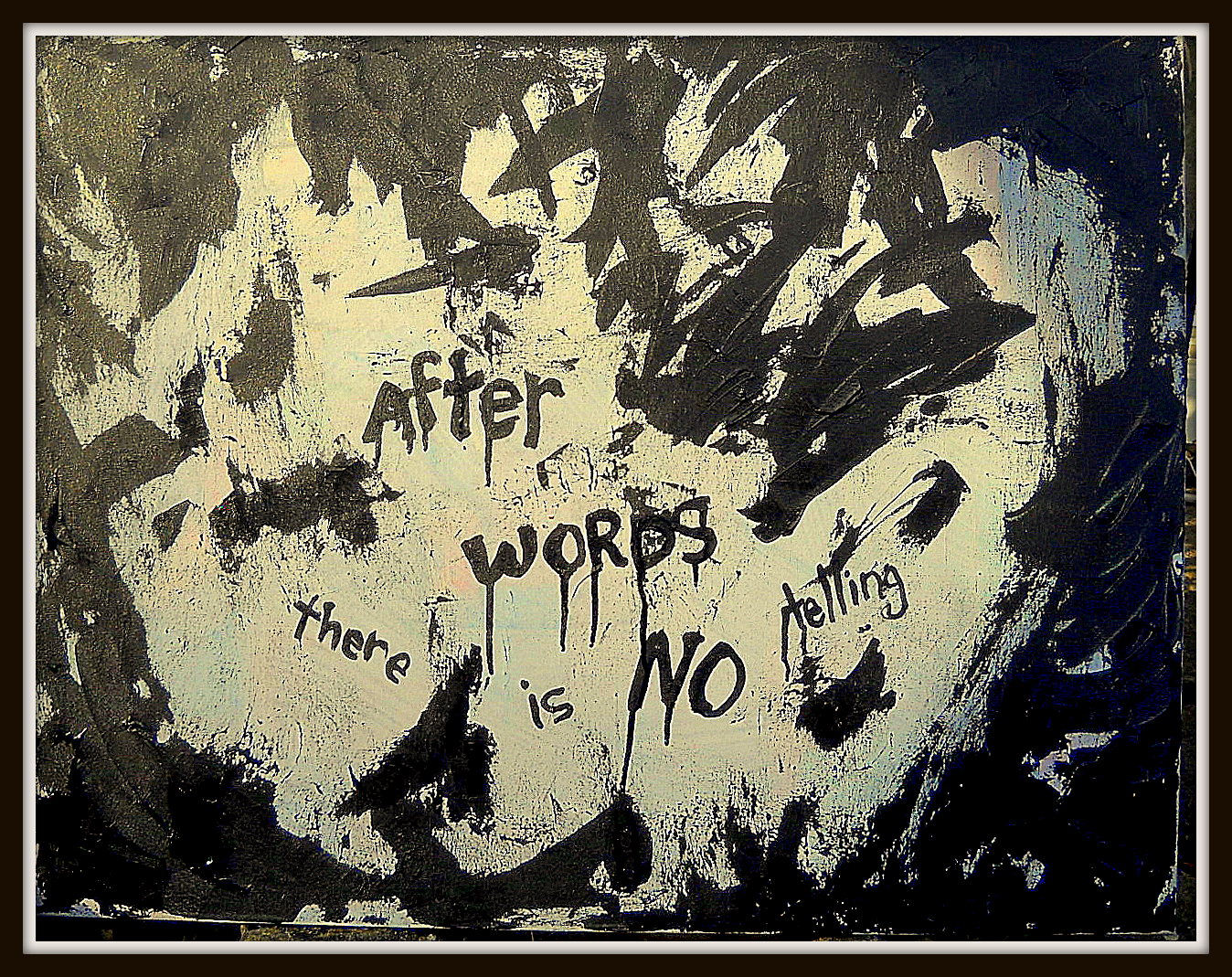
One of those pieces that seem to push me forward. I cut my losses and moved on. I’ve been adding numbers, letters, and sometimes words in my work. I’ve done this at times from the beginning, but it’s been more evident recently. Others don’t seem to take to these, but they matter to me. They draw me on… on what? I don’t know. A canvas, a wall, a scrap of paper… if I should find out, I’m not telling.
View GALLERY HERE.
… There is no Telling.
32×25″ Acrylic on canvas.
Ballet: Agony of the Feet” by Tim Burton
Taken from The Orlando Sentinel, Sunday, September 6,1998
…There is grace and nobility in those feet.
It may not be physical, like dancing en pointe…
 ”
”
…but beneath the achievement of grace–in whatever art, there is a form of torture, peculiar to the art, that lies unseen to others, and without which–that grace will never be achieved.
I remembered that article when I read a post on my beautiful machine/danseur ignoble. Asher writes about dance–not in the abstract, not as one who is watching, but from and out of the experience of their body. Muscles. Bones. Joints. Is it that dance is to the body as mind is to the brain?
Asher’s style is direct, unadorned–it’s the language of the barre, of the pianist learning scales, of listening to the body with such finely tuned perception that the body learns to hear itself without intervention, without intention.
I think of those time lapse photos where you see the body of the moving dancer following as though pure spirit, pure dance–a veil of movement. Asher doesn’t say much about that. He writes of what you see in the image of those beautiful, damaged feet in the photo above. Of the pain, the exhaustion–and the exhilaration of learning, of stretching every muscle and joint toward the impossible: toward perfection.
This is how an artist does philosophy. Read their posts, and learn.
I’m convinced that drawing is the mother of all the visual arts, and while that usually entails, figure, landscape… representational work. I’m interested in working outside of those boundaries. What we’re trained to see–is too politically constrained, that artist’s renderings of ‘realism’ recapitulate and reinforce multiple levels of the status quo, & claim by default to being the one and only and forever reality. When the ‘IS,’ when what we have, our political status quo, is hell bent on the way to ending human life on this planet.
I’m thinking… how to explore different modes of drawing–life drawing, that don’t ‘draw’ on geometric space or figurative realism… yet are as intensely involved in that visual transformation from eye to paper as traditional techniques?
This is an aesthetic dimension of my interest in the place of art in late capitalism. How… is something I’m working out my art, rather than theory.
In an earlier post (HERE), I mentioned that I’ve been been wondering what it would mean to think in terms of structure, where one would normally use the word ‘composition,’ in lieu of composition, in the place it has occupied in art criticism.
Of Merriam-Webster’s definition:
1
: the action of building : construction
2
a : something (as a building) that is constructed
b : something arranged in a definite pattern of organization (a rigid totalitarian structure — J. L. Hess> (leaves and other plant structures)
3
: manner of construction : makeup (Gothic in structure)
4
a : the arrangement of particles or parts in a substance or body (soil structure) (molecular structure)
b : organization of parts as dominated by the general character of the whole (economic structure) (personality structure)
c : coherent form or organization (tried to give some structure to the children’s lives)
5
: the aggregate of elements of an entity in their relationships to each other (the structure of a language)
… placing particular emphasis on 1, 4 b and 5 (italics mine), and drawing a link between PROCESS and PERSONALITY STRUCTURE (thinking of this, perhaps, in psychoanalytic terms)
Carrying this a bit further, a passage by Lacan in Ecrits, Appendix II: Metaphor of the Subject, suggests to me, yet another reason for this.
“This means that the most serious reality, and even the sole serious reality for man, if one considers its role in sustaining the metonymy of his desire, can only be retained in metaphor.
What am I trying to get at, if not to convince you that what the unconscious brings back to our attention is the law by which enunciation can never be reduced to what is enunciated in any discourse?”
… how, in thinking about a painting. this allows one to give full regard to its materiality, and at the same time, opens critical analysis to metaphor… without reducing the painting to that which it might be perceived as signifying (“representing”), visual metaphor that resists subsummation to the semiotic, as is the discourse that dominates so much of art history–which, again, Hubert Damisch’s A Theory of /Cloud/ so brilliantly avoids.
What then of painting that does away with signification, is it then without metaphor Or is the denial of semiotic signification (this is that), a kind of master-metaphor, reminding us of the futility of deciphering (from written cipher to visual?) metaphors, which shape-shift away from whatever form (or formula) we try to fix them to?
This speaks to my anarchist heart. Yes and yes and yes–oh, and so much more! (see my comment following this post, for how this connects with my art!
Agamben at one point choses to explicate this notion in reference to the included/excluded people within and outside politics:
It is as if what we call “people” were in reality not a unitary subject but a dialectical oscillation between two opposite poles: on the one hand, the set of the People as a whole political body, and on the other, the subset of the people as a fragmentary multiplicity of needy and excluded bodies; or again, on the one hand, an inclusion that claims to be total, and on the other, an exclusion that is clearly hopeless; at one extreme, the total state of integrated and sovereign citizens, and at the other, the preserve-court of miracles or camp-of the wretched, the oppressed, and the defeated.6Isn’t this the state of exception of migrant immigrants everywhere, a multiplicity outside the law, outside sovereignty, the inclusive excluded of the wretched, the oppressed, and the defeated?
And THIS:
“And in a different yet analogous way, today’s democratico-capitalist project of eliminating the poor classes through development not only reproduces within itself the people that is excluded but also transforms the entire population of the Third World into bare life. Only a politics that will have learned to take the fundamental biopolitical fracture of the West into account will be able to stop this oscillation and to put an end to the civil war that divides the peoples and the cities of the earth.7”
And THIS is why NONE of the candidates, of either party, will move us one footstep beyond square zero!…is why not one of the U.S. presidential candidates, of any party, will move us one single step past ground zero!

…the sovereign is the point of indistinction between violence and law, the threshold on which violence passes over into law and law passes over into violence.
– Giorgio Agamben, Homo Sacer
When one actually thinks about it, rather than just spouting rhetoric from some ideological mythology of the Left or Right the problem of immigration in our world is about Sovereignty. It’s about the emerging war against boundaries, limits, and finitude in politics, science, philosophy, the arts, and gender. In politics it’s about immigration, migration, and the sense of breakdown of nations and their paranoiac reactionism against imaginary and perceived threats to their own integrity and sovereignty. Same in the sciences we see explorations emerging in biotechnology, nanotechnology, and information and communications converging to form a global network society that will break free of political and social constraints and provide a larger framework and platform for such politically motivated notions as transhumanism that…
View original post 2,052 more words
This comes as a feeling that pressed to become a thought, or a thought that sought to become an image. I sketched a face in soluble ink. Efaced with watercolor. Still there. Subsummed

I seldom do figurative art. Not in my finished pieces. I draw the human figure… obsessively, from bones to flesh and back to bones–images of the human. But that isn’t what they are–the drawings. It isn’t there, the human, and in my finished work, what is human remains, not quite invisible, most often as little more than an unintended suggestion. Broken into fragments. Or traces and debris of our passing.
That isn’t a plan. I’m not rendering some idea I have… I don’t know what it is, other than it emerges from some primal conflict, deeply, inexorably personal. It permeates my art–how I work, how I think about it. I know that it has to do with how or why I spend so much of my private, internal conversation explaining, justifying–as though I stand before some perpetual tribunal–that has demanded, without asking (I just know)–that I’m called to account for what I make, for the very need I have to make art, in these conversations where I go endlessly back to the beginning. Do I even have a right to call it… art? To permit myself…?
How this is connected with using the human figure, I don’t know, but I know that it is. Had I all the years of a younger man ahead of me, I don’t think that a lifetime of analysis would be sufficient to uncover what lies buried, something powerful enough to have kept me away from the one thing I’ve always wanted to do–for almost 40 years.
But it’s more than personal… or should I say, more than my private demons. As though this most private struggle has reformed itself into the one subject central to everything I make. How I can feel human figures in the most abstract pieces that come from my hand. Has become their struggle. Something pressing to emerge, pressing toward freedom. Or is it the subsummation of the human back into that state from whence we came? My not distant death linking itself to the coming extinction of our species?
This is a post I left on Wet Canvas– a great resource if they confined themselves to technical questions, or were free from beholden to the status quo when posts ventured into more substantive questions about “Art” I think my welcome on this webpage is likely going to be short lived.
I know I have to tread carefully here. We have to live, to find a way to support our art. That’s a given. What’s not a given, is how we go about that, and–living in this Empire of Money and Death–what that means. And what it means to be dependent on utterly corrupted and corrupting gallery to investor pipeline.
There have to be other ways. Especially when you think of how that has come to define “success.” A form of success guarded by a system of gatekeepers, programed to exclude all but those deemed, first and foremost, most likely to produce work that will accrue in monetary value–as a commodity. Aesthetics comes in second.
How can one blame the gallery owners? They have to play the game–attract people with the money, the “investor class,” and are pressured to select artists they think will pass that test.
And for artists, the pressure begins with the first sales. What if they want to change course? To experiment? Bring something so unlike what has passed the market test that the gallery has no choice but to politely suggest they do more of … you know, what they’ve been doing.
Unless, for the very few, whose names have become the brand, the commodity.
All of which leaves art as entertainment for the oligarchy that’s won its wealth by exploiting workers, stealing the raw materials from “underdeveloped” nations, and by the profit of endless war. I mean really.. what does it mean to earn one’s living producing work to decorate corporate Human Resources waiting rooms… other than to have submitted to being nothing more than another something-less-than human resource?
Is art only to provide decor to the killer class? And ‘success’ reserved only for those who are willing slaves to their masters?
How do we defy the gatekeepers–all of them? The critics who are no more than servants to this same predatory system? Who have so successfully restricted women, blacks–anyone outside the presumed Western canon?
Capitalism destroys art. Capitalism corrupts and destroys artists. How do we find a way out of this?
Why can’t we pool or resources–draw on, encourage and help to develop the artistic aspirations of our communities? Create collectives where we can control how our art is used, and provide mutual support as we develop alternative ways to distribute our work, and alternative ways to support us?
I have a limited interest in arguing these issue, though I will be patient to explain them. What I would like, is to find artists who get it: who know that the whole “success” system is rigged (like the American USA election process), and any one artist, no matter how talented, has about as much chance of being one of the ‘winners’ as wining the lottery. And the effort to be one of those, means making oneself into a brand, and one’s art into a commodity. A total betrayal of everything that it means to make art.
The only existing alternative.. is… to go commercial.
I would prefer to give my work away to whoever wants it. I can’t. So I offer it on a sliding scale. Art that is only available to the privileged is a perversion. Thing is, can’t do this one by one. We have to create collectives, work together to create a wholly different mechanism. To become a part of the revolution. Cause if we can’t replace this late, zombie capitalist system… we are doomed to extinction. Cause they are hell bent on destroying as much life on this planet their power permits.
What are your thoughts? Again, I’m not into arguing this. If your only take is defending the status quo–pass go, go directly to EXIT. But if you have some inkling of what I’m saying here, and share my discomfort… maybe we have stuff we can talk about.
If humans didn’t have binocular vision, how would Brunelleschi have come up with the principles of linear perspective? There would be no foundation for western “representative” painting. It would have been pointless. The Quattrocento as we know it would not have happened. And all the art after would be utterly different, as there would not have been the limitations of that boxed reality and it’s spurious claims to ‘realism’ to challenge. There would be nothing remarkable or revolutionary about Manet’s fife player… or Matisse, or Picasso.
One eye or two–different ways of fooling ourselves about the look of the physical world.I highly recommend Hubert Damish’s A Theory of /Cloud/: Toward a History of Painting. First published in 1972, not translated till 2002, I so wish I had this book when I was taking courses in art history almost 50 years ago.
Dense reading… but if you keep ploughing ahead, understanding becomes cumulative as he returns again and again to the examples on which he builds his argument.
The advantage of reading it now (unless you are able to travel the world to see all the art he cites), is that reading in front of a computer, you can quickly Google images you are not familiar with, or remember only vaguely. Richly documented. THIS is what art history should aspire to.

The U.S. is a world power. Our politics is not just about those within our gated borders. Presidential elections insulated from the consequences of our global exploitation and the MILLIONS who suffer and die because of U.S. policies and actions, are exercises in a kind of mass psychosis, a manufactured, hallucinate dream. We give all the candidates a free pass on this… “maybe we can pressure Bernie to do a little better on Israel” “So what if Hillary fucks war criminal Henry, she’s a woman!”
You want your vote to matter, make it matter for everyone! Until we do–it really doesn’t matter. Better not to vote, cause for the planet and most of the humans and animals, a collapse of the U.S. political system would be the real “lesser evil.”This election reminds of those big protests in Israel a couple years ago. Israel’s occupation and brutality … like it didn’t exist. It was all bout jobs, economic inequality… la la la. Peas in pod.
Americans (U.S.A) don’t get it. The economy–all the good stuff Bernie stands for, bull shit, without including the rest of the picture, the rest of the world. It’s all one thing. A spectacle! The U.S. military occupations, the endless wars, the support of murderous regimes like the Saudis, Israel… all part of the same system that’s given so much power to so few, that’s fueled income inequality. If all of that isn’t tackled and dealt with, neither Horrible Hillary’s pitchy patchy incremental shit, or Bernies fake socialism are gonna be nothing but window dressing.
A great, tragi-comic farce.
 Jacob Russell's Magic Names