Tag: Politics
America 2016
Standing Rock: The Most Important Struggle of Our Age?

It’s not the flow of oil that’s at stake at Standing Rock, it’s the flow of money. I was thinking about why there’s not been a massive shift of investment to renewable energy: wind, solar, wave, when it’s been pretty clearly established that renewables could replace virtually everything we get from oil but lubrication and plastics, both of which also have alternatives; and watching the battle over the pipeline, it occurred to me that the answer is right there in front of our eyes: oil flows. As oil moves from source to refinery and production, to all the points of distribution, capital follows, multiplying at every stage. Renewables are far more than alternative sources of energy; they represent, forgive the cliché—a paradigm shift for economics, and existing structures of power.
The renewables truly do belong to a different world. Think of Israel, as just one example. The oil based money pipeline that flows from the Middle East to Houston to New York to Israel—without it, without that flow of American capital, in the form of money and weapons, Israel would not exist as the rogue colonial power that it does. There is little resemblance with wind and solar, to the complex, capital multiplying networks of supply and distribution that exists with fossil fuels. Why? Because… wind and sun are everywhere. Generation favors locality, and what follows, is nothing less than the dismantling of the pipeline-tanker-refinery-banker system, and with it, the vast military complex used to control and defend it. The very fact of universal delivery presages the failure of the present system ( SEE — Niklas Luhmann: So-Called System Failure)
In this light, what an amazing confluence of interests and circumstances is happening now in North Dakota! The emergence of native peoples, the blocking of the pipeline, which is the blocking of the flow… the Flow, the power driving the one civilization blocked by this beautiful eruption of spiritual power from another, one that is both a reassertion of what existed before European dominance of the continent, and promising yet another, a new world that is indeed, possible! This confrontation in North Dakota has become, materially, symbolically, spiritually—the focal center of the most important struggle of our age—on the outcome of which hangs nothing less than the survival of our species… and the many others we will take down with us if we fail.
(I would very much appreciate feedback on this, and if you think it worth while–please share)
It was the end all along
In Israel, we see how the executioners always win. If they do not succeed in exterminating their victims, they know that they will be reincarnated in the survivors.
It’s the horror of this knowledge–unacknowledged by the executioners, that drives them to ever greater carnage, to ever greater acts of cruelty. To save future generations from yet another visitation of what they have become, they are driven toward the annihilation of their victims.
Genocide as an unconscious act of mercy to future generations.
When we killed the gods, they made us their heirs.
Call for a National Day of Reparations
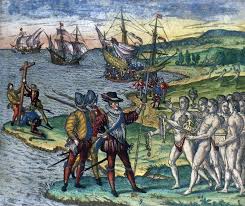
I‘m a son of parents who were children of immigrants, not a native of this continent, even so, knowing what I do about Columbus, this holiday deepens my depression and angry indignation. We can’t undo history, but neither will be free of its burden until we collectively, without reservation, acknowledge our complicity in what we have done and vow to make a new beginning. That goes both for the genocidal theft of land that was the mother of our indigenous peoples, and for the theft and enslavement of humans from the lands where their mothers bore them into the world.
Because so much of the wealth of this nation was purchased by their deaths and suffering, there is no, can be no, meaningful acknowledgement without reparations.
Let this day be known, not only as Indigenous Peoples Day, but The Day of Reparations for all those we have wronged.
Art and the Machines of Power: Connections
It’s difficult, when those in power, those with power over the lives of others, expose themselves as hateful assholes–difficult to not slip into the belief that it’s the fault of these assholes that we are, collectively, in such terrible trouble. If we could only be rid of the assholes–give power to ‘good’ people, everything would begin to improve!
But when I can manage to set aside my anger, my entirely justified anger, at these figures, I see that they do what they do, not because of character flaws, but because they follow the rules of the system, of the roles they have been assigned. Whether they have taken on those roles for selfish, or class serving motives, or because they sincerely believe that this is what works, that this is ‘reality,’ and if you are a ‘realist,’ you act accordingly. If Dick Cheney exemplifies the former, Obama might exemplify the latter–but what they do, the killing, the destruction of our supportive environment, the endless war, their support of the vindictive surveillance state, where whistle blowers are punished–when you measure them by what they do, there is little to tell them apart.
The machines of consumer capitalism, the war machine, are in a real sense, not metaphorical–self generative, independent actants. It’s those complex social/political/economic machines that determine the actions and ideas; it’s those machines that manufacture the assholes they need to keep them running.
Those of us of more progressive or radical views, have no problem recognizing how, in poor and marginalized classes, material and social conditions make criminals, create anti-social behavior, and yet we too easily fail to see how the capitalist myth of the individual, and personal responsibility, shape how we react to the assholes of the oligarchy–even when we understand ‘class,’ even when in our mouths and heads, we know it’s “The System,” and that it’s the system we have to change–that we waste our energy and thinking when we rail against individuals in power, instead of demonstrating how the system works to create the assholes, and dictates to them what they can and cannot do within it.
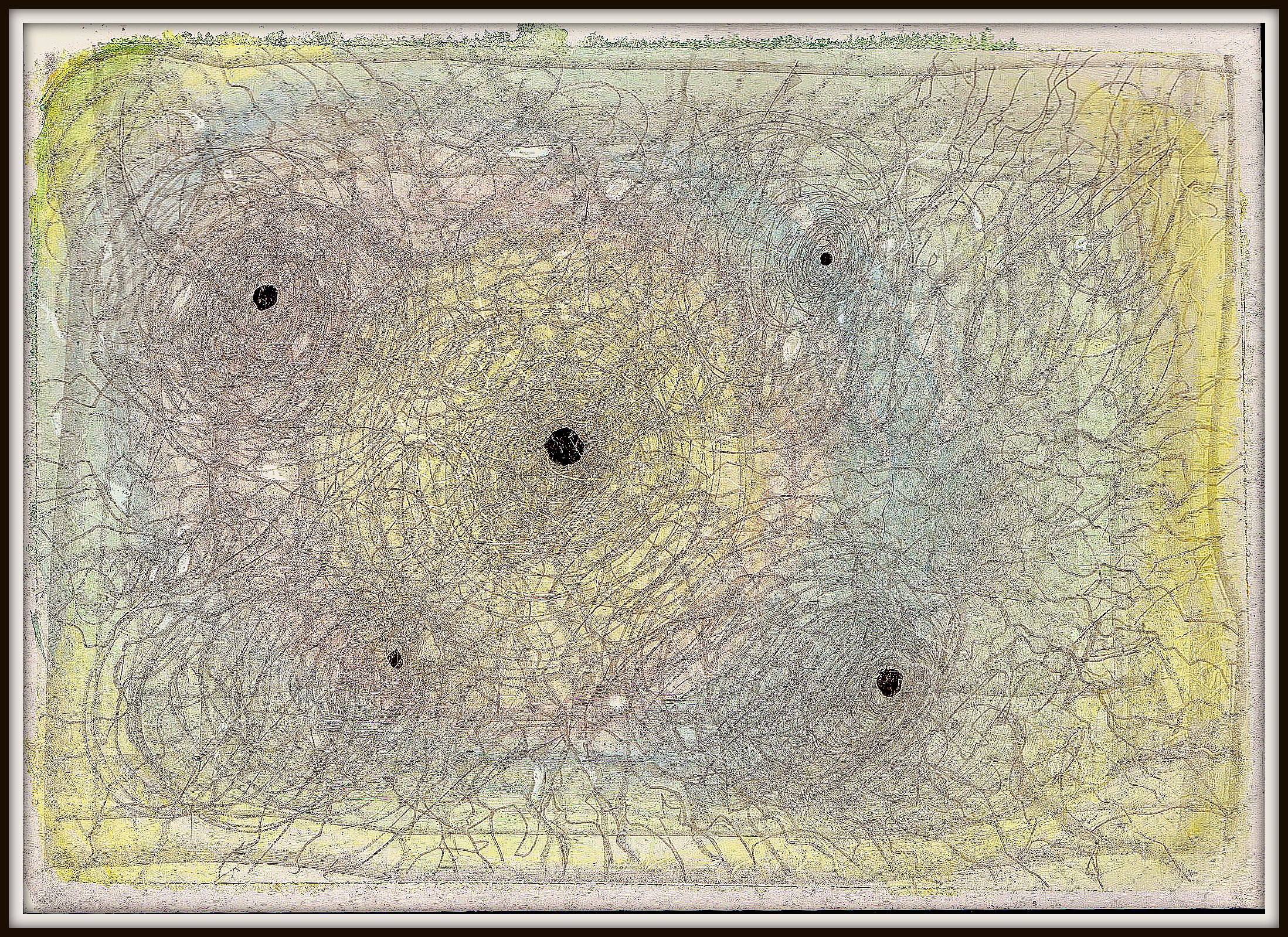
In my art, I think of this in terms of representing, not objects or ideas, but connections. Even when objects are represented–I am drawn to emphasizing the connections, and leaving the objects partially erased, covered over, and secondary to what is more real than the “thing” … the connections between that create, destroy, and create them again as something new.
My (brief) experience with Artfinder.
The Neoliberal/fascist War Machine

When we think of the war machine, the focus tends to be on the horrors of war itself, on the cost to social programs when so much of the national budget goes to military and arms makers, of our treatment of veterans… but these are only parts of the machine, and not the machine itself
When you see the figures for contributions to candidates and political representatives, the larger structure begins to emerge. Isn’t this the very heart of 21st C. neoliberal/fascism–that the war machine has become the real owner of the State, that the oligarchs we want to see as our owners and rulers, have themselves lost power over the War Machine–that to maintain their wealth and the illusion of influence, they are free only to act as operatives of and for the War Machine?
… a machine that has no goal but increasing destruction–of everything subordinate to it, until there is nothing left to destroy but itself… and all human life with it?
In the long run, all the Presidential candidates, are servants of the War Machine. There is no hope for survival, or significant change, within the orders of established power. We need to find the fissures in the walls, the cracks in the foundation, to build in spaces still invisible to The Machine–alternative lives, organizations and relationships in what, from within the orders of power, are but figments of the Unreal. Microspaces of imagination, resistance and love.
Should we be worried about Biogenetic Manipulation?
The Dark Forest: Literature, Philosophy, and Digital Arts
Should we be worried about Biogenetic Manipulation in the near future?
Not only will capabilities for genomic manipulation dissolve biological identity into techno-commercial processes of yet-incomprehensible radicality, but also … other things. For those keeping up with Biogenetics, etc. A conference about having transparency in the biogenetic and biotechnological worlds of techno-commercialism.
CFP: Performance Philosophy and Biopolitics, Biotechnology & Biogenetics: http://www.twitlonger.com/show/n_1sojcqb
This working session will explore intersections of performance and theatre with biopolitics, biotechnology, and biogenetics by looking at the ways in which life increasingly resides in a transversal realm of indistinction, which produces live (i.e. concrete and tangible) consequences within digital and embodied environments. The working session seeks to understand what theatre and performance studies can learn from a critical inquiry into biopolitics, biotechnology, and biogenetics to examine ways in which contemporary ideology gravitates towards concerns regarding transparency. By drawing on the etymology of transparency— from the Latin trans-…
View original post 315 more words
Street Sketching and Territoriality
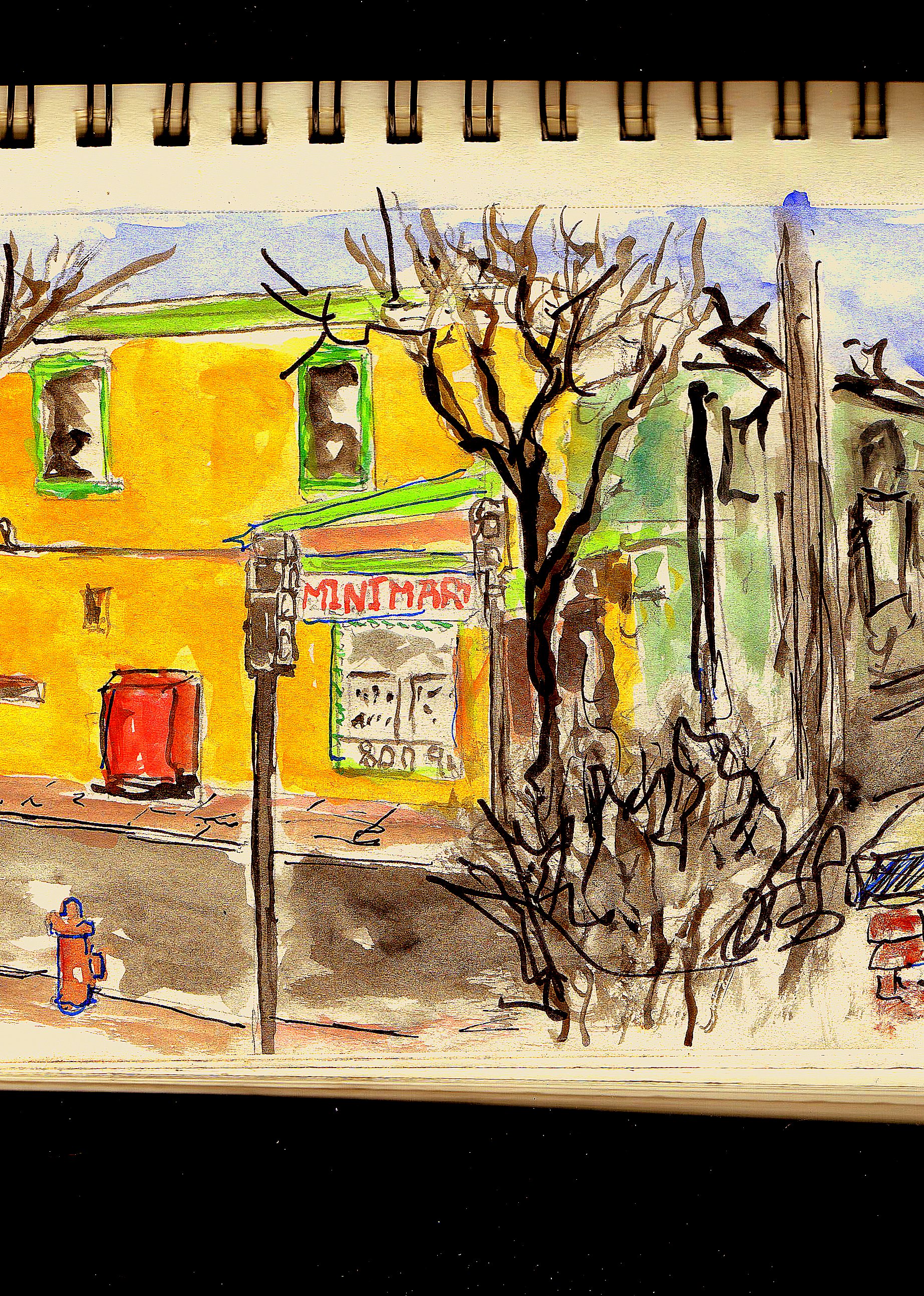
Street sketching is a new thing for me. I love how it brings my vision into focus–how I can lose myself for an hour or two in utter concentration. While I don’t think about more than what I’m doing while I work, I find that it stimulates so many questions, provokes my mind–no small part of what fascinates me, though some of those questions are troubling.
This is drawing from life. Being there. One of the things I’ve been thinking about, is how demanding this is, developing and perfecting skills, and yet, it’s not that alone. Like with figure drawing–there are comic artists who are superbly skilled at rendering human figure from imagination–think of the forshortened points of view of those superheros. Or illustrators… was looking at the cover of a book, a street of Philly row houses drawn from an acute angle, all with ariel bays in perfect perspective. You learn that well, and you can do it from imagination–maybe with the aide of photo references. I both respect and admire the skill, knowledge and facility of these artists, but that isn’t where I want to go, or what I find most interesting. There comes a point, a level of skill and knowledge, when one can draw on what has absorbed without further encounter of the kind of immediacy I want when I’m working from life. Robert Beverly Hale, the great teacher of anatomy and figure drawing summed up the learning process like this: “first you draw what you see, then you learn to know what you see, then you draw what you know.” But that leaves out the last, and most important step: returning to the subject you’ve learned, and seeing more. Beginning again that process of discovery–seeing ever more fully, more deeply. It’s possible for illustrators and cartoonists, to get to a point where they can coast on what they know–but they don’t have to. I look at the illustrations of Charles Dana Gibson, or cartoonists like Walt Kelley or Bill Watterson, who, even when using basic templates, never surrender to mere tracing of what they’ve done before. I’m not trying to distinguish between ‘high’ and ‘low’ art; I’m trying to understand something about process.
In street sketching, it’s not their technical mastery of perspective or penship–it’s that going back to the beginning that’s the life of those drawings– of those who do it well. There’s a freshness that I love, like coming across a scene for the first time–it’s a way of seeing… but this is where I begin to question what it is I’m doing. What else is going on here.
There’s a blog, Urbansketchers. org. You’ll find there work by many of the best. But you will also see another pattern… these are world travelers, who go to cities around the world, and draw… rather than taking snap shots… to see the world, one drawing at a time, I think is their phrase. While I love these drawings… I’m uncomfortable with them–with the conceptual framework that binds them. I can’t help but think of dogs… marking territories.
Vision… as a kind of ownership. A foreclosure, more than an opening. What we see–is territory, the ‘normal’ world of the capitalist tourist: this is beautiful … and ours. This is fascinating… and ours. Not the possession of the artists, but of those they unconsciously, or at least, uncritically, serve. A theme-park world for the enjoyment of the power elite, and their upper echelon servants.
Court artists of the capitalist leisure elite.
I don’t like that–that I can’t escape this thought. I really do love this body of works. I aspire to it! To render such life in my drawings, my art!
But so much else about my art –about where I want to take it–is about escape–escaping the Master’s Hand and Voice, escaping the “Art System,” the capitalist gallery to investor universe of gatekeepers and Owners–finding my way to a revolutionary, ‘anti-art,’ in as much as so much of what we–what art history–defines as ‘Art,’ is but a captive of Euro-Patriarchal art making, colonizing the traditions of other cultures–serving the Masters.
Street sketchers stand on a border… I love that there is no pretense here of “higher art,” I love the individualism, the freedom expressed by these artists.. but I despair at what I see as ideological captivity. And I don’t know what to do… or what I would like these artists I admire, to do.
I only know that it’s a problem. And that you can’t solve any problem, without first seeing it, recognizing it, defining it for what it is.
Where is my community of believing dissenters?