
View GALLERY HERE.
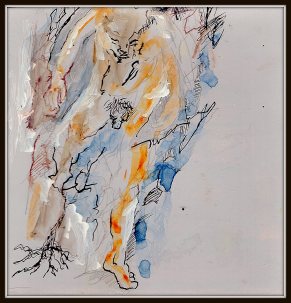
5×5 Silverpoint, ink, watercolor

24×24 Acrylic on scrap of plywood. I think maybe I’m getting someplace with this. Beginning to look like one of my assemblages. I don’t know where those letters and numbers are coming from; when I do, it will be time to stop doing them.
Ballet: Agony of the Feet” by Tim Burton
Taken from The Orlando Sentinel, Sunday, September 6,1998
…There is grace and nobility in those feet.
It may not be physical, like dancing en pointe…
 ”
”
…but beneath the achievement of grace–in whatever art, there is a form of torture, peculiar to the art, that lies unseen to others, and without which–that grace will never be achieved.
I remembered that article when I read a post on my beautiful machine/danseur ignoble. Asher writes about dance–not in the abstract, not as one who is watching, but from and out of the experience of their body. Muscles. Bones. Joints. Is it that dance is to the body as mind is to the brain?
Asher’s style is direct, unadorned–it’s the language of the barre, of the pianist learning scales, of listening to the body with such finely tuned perception that the body learns to hear itself without intervention, without intention.
I think of those time lapse photos where you see the body of the moving dancer following as though pure spirit, pure dance–a veil of movement. Asher doesn’t say much about that. He writes of what you see in the image of those beautiful, damaged feet in the photo above. Of the pain, the exhaustion–and the exhilaration of learning, of stretching every muscle and joint toward the impossible: toward perfection.
This is how an artist does philosophy. Read their posts, and learn.

View GALLERY HERE.
Love is not love which alteration finds
10×8. Water soluble ink, watercolor, pen & brush
I’m convinced that drawing is the mother of all the visual arts, and while that usually entails, figure, landscape… representational work. I’m interested in working outside of those boundaries. What we’re trained to see–is too politically constrained, that artist’s renderings of ‘realism’ recapitulate and reinforce multiple levels of the status quo, & claim by default to being the one and only and forever reality. When the ‘IS,’ when what we have, our political status quo, is hell bent on the way to ending human life on this planet.
I’m thinking… how to explore different modes of drawing–life drawing, that don’t ‘draw’ on geometric space or figurative realism… yet are as intensely involved in that visual transformation from eye to paper as traditional techniques?
This is an aesthetic dimension of my interest in the place of art in late capitalism. How… is something I’m working out my art, rather than theory.
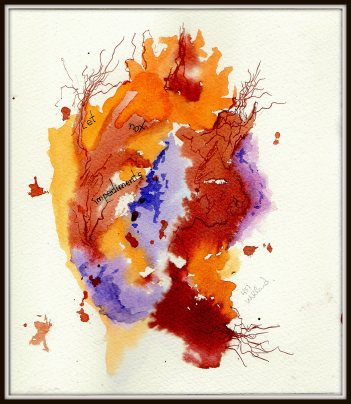
7×6″ watercolor, water soluble ink.
In an earlier post (HERE), I mentioned that I’ve been been wondering what it would mean to think in terms of structure, where one would normally use the word ‘composition,’ in lieu of composition, in the place it has occupied in art criticism.
Of Merriam-Webster’s definition:
1
: the action of building : construction
2
a : something (as a building) that is constructed
b : something arranged in a definite pattern of organization (a rigid totalitarian structure — J. L. Hess> (leaves and other plant structures)
3
: manner of construction : makeup (Gothic in structure)
4
a : the arrangement of particles or parts in a substance or body (soil structure) (molecular structure)
b : organization of parts as dominated by the general character of the whole (economic structure) (personality structure)
c : coherent form or organization (tried to give some structure to the children’s lives)
5
: the aggregate of elements of an entity in their relationships to each other (the structure of a language)
… placing particular emphasis on 1, 4 b and 5 (italics mine), and drawing a link between PROCESS and PERSONALITY STRUCTURE (thinking of this, perhaps, in psychoanalytic terms)
Carrying this a bit further, a passage by Lacan in Ecrits, Appendix II: Metaphor of the Subject, suggests to me, yet another reason for this.
“This means that the most serious reality, and even the sole serious reality for man, if one considers its role in sustaining the metonymy of his desire, can only be retained in metaphor.
What am I trying to get at, if not to convince you that what the unconscious brings back to our attention is the law by which enunciation can never be reduced to what is enunciated in any discourse?”
… how, in thinking about a painting. this allows one to give full regard to its materiality, and at the same time, opens critical analysis to metaphor… without reducing the painting to that which it might be perceived as signifying (“representing”), visual metaphor that resists subsummation to the semiotic, as is the discourse that dominates so much of art history–which, again, Hubert Damisch’s A Theory of /Cloud/ so brilliantly avoids.
What then of painting that does away with signification, is it then without metaphor Or is the denial of semiotic signification (this is that), a kind of master-metaphor, reminding us of the futility of deciphering (from written cipher to visual?) metaphors, which shape-shift away from whatever form (or formula) we try to fix them to?
 x
x
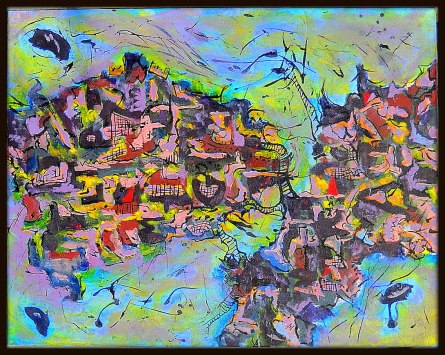
32×25″ Acrylic on canvas. This began as an image I saw in a dream–or in the hypnagogic state just before sleep. That mass on the right–like floating against a blue field. I began with blue underpainting over the whole canvas, then roughly brushed in the contours of that mass. From there, is was the usual back and forth, responding to what I saw on the canvas, not trying to reproduce the dream image. I only wish I’d left the edges and corners as bare canvas, like a torn section of a map.
View GALLERY HERE.
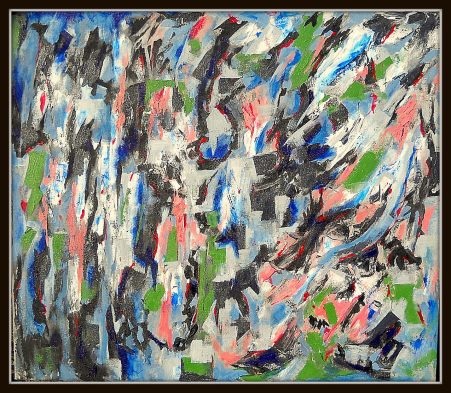
28×32″ Acrylic on canvas. Finished. The WIP I had on here last night, see below for comparison. I think it has a lot more solid structure now. The additional grays change the chromatic balance rather dramatically.


 Jacob Russell's Magic Names