
#32 32x37cm Assemblange from street trash

#38 – 50cm diameter. Assemblage on composition board, acrylic

#60 Kensington Winter, 29x60cm Mixed media, ink, water color, street dirt & trash & Ginkgo leaves.
#32 32x37cm Assemblange from street trash
#38 – 50cm diameter. Assemblage on composition board, acrylic
#60 Kensington Winter, 29x60cm Mixed media, ink, water color, street dirt & trash & Ginkgo leaves.
Given that art has human value (without– or suspending definition of what that is), it follows that the labor of the artist merits support. This entails meeting basic human needs for the artist, seeing that tools, supplies and space for making art are available. How that support is offered, where and by what means it’s obtained is not a matter of indifference for art or artist, but will have the power to affect and control both art and artist.
There is an unavoidable entanglement of the production of art and artist with the economic, social, political, and cultural, machines (thank you Levi Paul Bryant ), through which support is procured. The gallery-investment-collector-museum-gentrification-reward-machines will select that which maintains and enhances their operations, and reject what threatens them. The flow of money is the mother’s milk that fuels these machines, and those who control the flow of money will not abide anything that challenges their territorial power. If you are an artist, and court what passes for ‘success’ in this system, you will, no matter how firmly you believe in your aesthetic purity, or how hard you work to compartmentalize your creative work to shield it from the machinery you have made yourself dependent on, you will be making art that serves that system. You will be a useful servant of the Empire of Money and Death.
There was no need to define the value of art and the artists labor, because it will be defined by the machines that distribute the reward and how they make use of it. Artistic freedom will be the reward of the parasites, the rebels, thieves and refusers. When you see one of those great, expensive, powerful works of public art, those magnificent museum worthy pieces, made possible by grants and awards, by the flow of money–tell yourself, that is not what artists who value their freedom do. That is not what a free creative soul aspires to do–it’s a temptation, a seduction to join the stable of the pimps who run the machines… the machines that build the prisons and make the drones and turn everything human into a means of profit. Why am I not hearing this conversation from artists everywhere? How do we survive without supporting the machinery of slavery and death? What kind of art can we make–how does that change what we are given to do, how does that shape our creative vision? Why am I not hearing this conversation from artists everywhere?
April, 2014

#26 The Beginning is Near: View from the roof of the Ox

#27 18x32cm Assemblage, Rusted steel, paper, leaf

#30 65x40cm We Are What We Eat. Assemblage, street trash with shells

In April, 1988, standing in our kitchen in NE Philadelphia, it came to me that for the rest of my life I would follow whatever course best served my desire to write. And by that, I meant–to make art, to be an artist, though I wasn’t yet ready to accept that name for myself
I was 47, two months short of my 48th birthday. It wasn’t that I hadn’t done these things before, I had taken courses in art from childhood, at the Chicago Art Institute, Nelson-Aitkins Gallery of Art and Kansas City Art Institute. Later, majored for for time at Wichita State University. I had written stories and poetry from the time I could write, but this was new. This was something else. Like a conversion experience. A sense of accepting a calling, making a commitment. If I could live to work another 20 or 30 years, I told myself, I would have as much time as many who had begun in their youth–to leave a body of work.
Maybe it was the feeling that time was running out. Or was it that to my mind, being an artist was something too grand, that I wasn’t worthy? I thought of what Cezanne had written: ” Why so late and with such difficulty? Is art a priesthood that demands the pure in heart who must belong to it entirely?”
Yes. I thought. It does.
Though not so sure about the “pure in heart” stuff. A bit too 19th Century.
But with humor, yes. And this new sense of freedom from any judgment not my own–this was what I was going to do.
It will be 27 years come April. Some of them–pretty rough going. But I can call myself an artist now–a novelist, a poet–and not cower in shame lest I be found out as a fake. And I’m happier than I’ve ever been in my life.
I kinda like this, being a Late Bloomer–of just warming up when most people are winding down, of not having to hang it up, rest on the laurels of what I accomplished in my youth. Life is just beginning. Every day. Every day, a new beginning!
 A blog post is as ethereal as the trace of dancing particles though a cloud chamber, and yet in the universe of the web, seemingly always there, as though cyrogenically frozen beyond time, perhaps sprung to life at the mistyping of a search word, or preserved on old UBS drives at the bottom of a landfill, like mineralized imprints of the first self-replicating cells that drifted in Precambrian seas.
I don’t trust the impulse to preserve. nursing as it does, a delusional wish for immortality, and yet, like: Shakespeare’s 64th Sonnet, the wish to have that which we fear to lose, nudges aside good sense, and I go back into the old blog, searching for scraps–what, had I not written them, would have been likely nothing more than trains of thought, passing time on the el waiting for my stop, forgotten as soon as my foot touched the station platform. Here, then… from my birthday, June 22, 2008.
Ulrich went on: “Every great book breaths this spirit of love for the fate of individuals at odds with the forms the community tries to impose on them. It leads to decisions that cannot be decided; there is nothing to be done but to give a true account of their lives. Extract the meaning out of all literature, and what you will get is a denial, however incomplete, but nonetheless an endless series of individual examples all based on experience, which refute all the accepted rules, principles, and prescriptions underpinning the very society that loves these works of art! In the end, a poem, with its mystery, thousands of words in constant use, severs all these strings, and turns it into a balloon floating off into space. If this is what we call beauty, as we usually do, then beauty is an indescribably more ruthless and cruel upheaval than any political revolution ever was.”
From chapter 84 of The Man Without Qualities.
From October, 2012
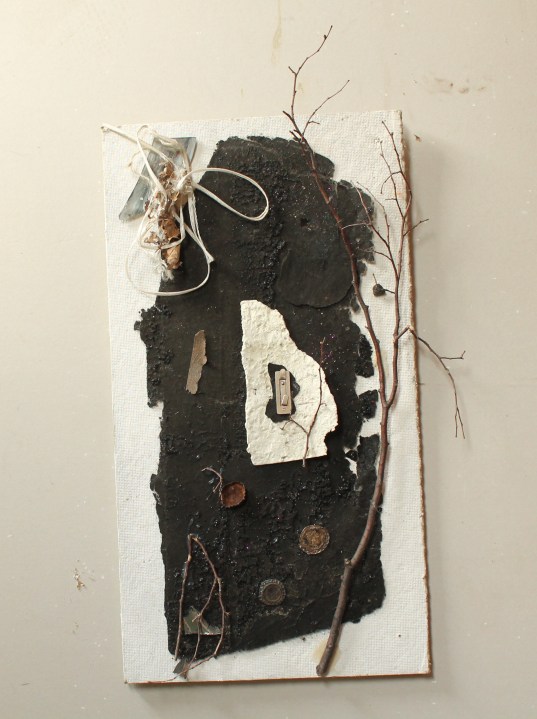
#21 Roofing, twigs, scrap

#23 63x34cm Assemblage, composition in B&W
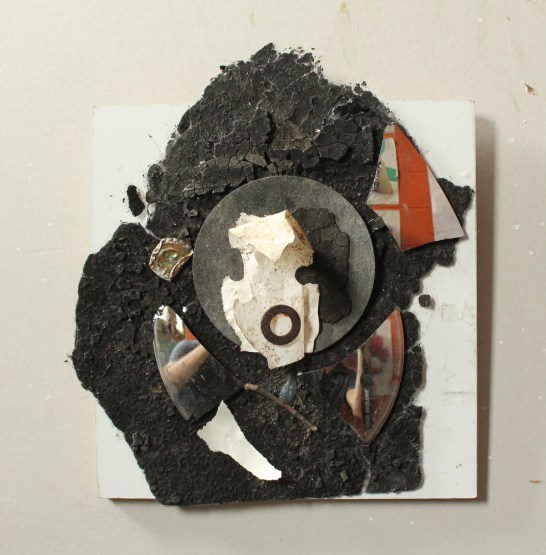
#24 27x13cm Assemblage, composition in B&W
I made 222 pieces at the Ox, from July 2012 to the end of November, 2013. I’ll begin posting those I have photos of. Here are 5 of the earliest.
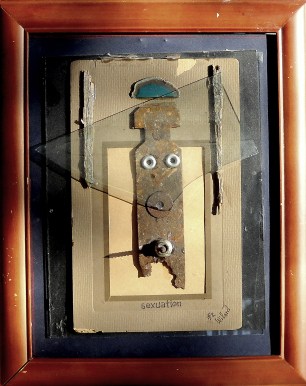
#2 Sexuation 30×25 cm Assemblage
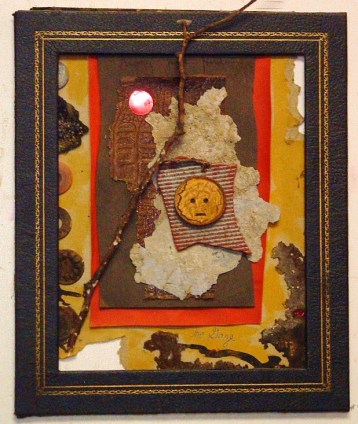
#3 The Gaze. 35x29cm, Assemblage
#10 Piece of the Puzzle 36x23cm. Assemblage

#19 37x30cm Assemblage

 From This Space, Nicholas Murray, in a comment on Steven Mitchelmore’s post, Some thoughts on the death of criticism: (From Jacob Russell’s Barking Dog, 2007)
Is it worth scrolling back to Hegel who argued that art would gradually become displaced by philosophy as we, as it were, grew up intellectually unlike those Greeks who had to take important truths in intuitively through their art. I see this as the beginning of a road that leads to conceptual art, a progress from the sensual, tactile, visual (visceral?) enjoyment towards abstract contemplation of the idea or Geist. The critic in this scheme becomes less a servant of art, an explicator and evaluator, than a fellow-creator, whose intellectual function is equal to that of the artist. Critics who argue that authority comes from being a creator are in the rearguard of this movement. The “space” identified by this blog I take it to be one in which both kinds of mind meet and explore things together, ultimately abolishing the distinction. I am warming to the idea having been a bit of an artist-knows-best fundamentalist hitherto.
I began to reply as a comment but it kept growing, and thought it would be better as a free standing post.
I asked Nicholas: What do you mean by “together?” As one thing? Or in conjunction–in dialog, in relationship? If conceptual art marks a progress toward something like abstract contemplation of the idea, would one not expect this art, not only through its appropriation of abstract ideas, but in itself, to be a kind of philosophizing? I certainly don’t find that to be the case. Conceptual art, rather than becoming more like philosophy, seems rather to be challenging philosophy and abstract thought on its own ground, appropriating ideas to its own, quite different ends.
I think you go wrong when you view this as an issue of authority, or rather, as a competition for authority, as though there were One Sort of Authority, and artist and critic were fighting for its blessing–Jacob and Essau at the feet of Isaac. Authority as Nobadday.
The authority of philosophy is not that of the artist, and the authority of the artist, not that of philosophy (the definite article with ‘artist,’ but not for philosophy) Through art, we orient ourselves in relationship with others, individually and collectively: collectively, because I don’t think of individuals (us) as discrete units apart from our relationship with others, but as beings who build a world we can have (and know) in common, a world (like the gorilla fashioning its arboreal nest) as a humanly habitable place in space and time.
What happens to us when we read stories, stand before the images we make, listening to the ordering of time and tone in music? What do we do when we experience art? We orient ourselves in reality, by selecting out of the incomprehensible totality, what we need to paint a picture of the world, to tell the story that–does not tell us, but places us–such that we “know” where and who and what sort of creatures we are.
Neither philosophy nor science do that. They can’t give us a world to live in. They examine and explain and take apart what we believe we know and experience. They can show us the artifice of our belief–in what we are, in the fabricated world we inhabit.
Art emerges from the primal effort to live as conscious beings in a reality that knows nothing of our existence as we experience it: whatever it is that drives the brain to integrate the competing and separate systems of perception, memory and interpretation into an unshakable belief in the semblance of our Selfhood.
Science can name the parts and explain their mechanisms; Philosophy can remind us that it is a semblance, that what is real lies outside our power to possess, by either experience or knowledge. Art happens. As our sense of Selfhood happens. The difference is, that art is a happening that we make. It happens in relation to a natural world filled with the many other worlds we have made. That is, it uses whatever materials it needs to give us what we need, natural and humanly fabricated: the Romantic painter using the colors of sunset and sunrise, the conceptual artist using the ideas of philosophers and critics. And here is exactly where the critic comes in. It’s not as if the critic has only one authority, one opposed to or other than that of the artist. Rather, the critic draws on multiple authorities. He examines, disassembles, names the parts–so we can better appreciate the artifice, the art that went into the making. But he also–if he is a good critic, an honest critic, enters into what happens, into the happening, and draws on that in what he writes. In this, in his drawing on what happens, he is like the artist, is an artist, and at the same time, remains other, secured to a way of knowing that frees us from the illusions we cannot help but make and need, lest we vanish into our own dreams, even as the subversive power of art frees us from the chains of knowing.
I moved into the Ox in July, 2012. A queer-safe unfinished warehouse in Kensington (Philly), occupied by an assortment of some 20 or so weird people: activists, queers, musicians, artists (and one subparticle physicist– who slept on the roof), a place I’ve never in my life felt more at home. For the first time in more than 40 years, I found myself in a place where I had room to make art. For years, I’d been fascinated by found things, junk left in the trash, things I’d come across on streets and vacant lots and nursed dreams of assembling these objects–maybe together with drawings, painting–what Rouschenberg called ‘combines.’
The Ox itself was full of stuff–I put a board on a large table in an open space by an open loading space for light, and began arranging things, moving them this way and that. I wasn’t thinking of re-making myself as an artist. It was something I could do without words–visual thinking that felt like ice breaking on a river after a very long winter.

After coming back from a week long interruption, walking from Philly to New York and Zuccotti Park with the OWS Guitarmy, in honor of Woody Guthrie’s 100’th birthday, I bought Modpodge, found some old cans of house paint, borrowed some jars of acrylic, and put this piece together.

88×64 cm. Assorted trash, branch & twigs, glitter, house paint and acrylic on wood. And poems. For my Poem Tree on East Passyunk in South Philly.
The next piece, a piece of rusted steel, glass, wood scraps, washers and a rusty nail on cardboard and a frame from an antique photo album. 30x24cm.
Called it Sexuation, and signed it ‘Willard,’ my legal birth name, which I’ve never used. Named for my maternal grandfather, who died two weeks before in I was born,I thought it would be a way to honor this man I’d never known, and my uncle, an artist and mentor, who I’d recently learned has been diagnosed with Alzheimer’s.
The next day I went to Utrect and bought brushes, pigments and more Modpodge. We made one of the rooms in the Ox into a studio. As of this day, January 25, 2015, I’ve finished another 301 pieces, assemblages, ‘combines,’ drawings and paintings.
x
I’ll be posting both old and new work on this blog. Stay tuned.
 Jacob Russell's Magic Names