Category: Uncategorized
Planning color study series. Each a Fugue in 4 voices
What I have in mind: each piece with 4 hue scheme in 4 variations
Let A be point One on color wheel, B it’s compliment, C-D split compliments
1. A = Dominant, B,C,D subordinates
2. B,C,D Dominant, A subordinates
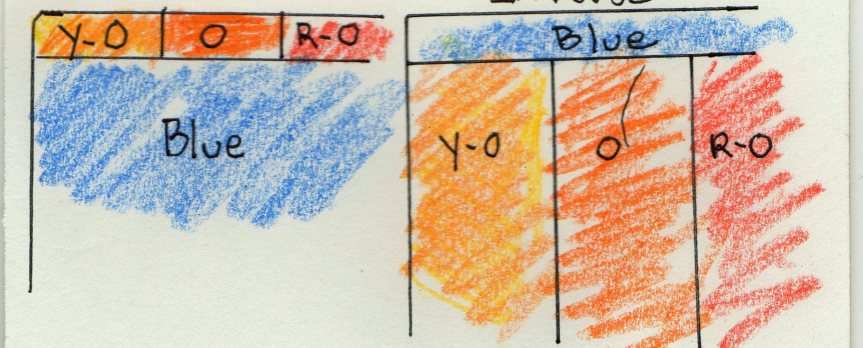
Each of these with its inverse for each chroma. Theme and variation.
For 1, if A= Blue B, C and D would be Orange, Yellow orange and Red orange respectively,
with A Dominant and B C D subordinates
Inverse would be Orange=Dominant, with Blue, Blue-violet and Blue-green as subordinates.
Tone and chroma would vary as I might see fit.
Repairs in progress
Due to some initial confusion on how Windows 10 handles photos, I accidentally deleted all the photos on Magic Names, more than 500 of them–some 300 or more photos of my art. I’ve begun to restore them, but it’s a slow, tedious process. As of January 12, I have everything I’d posted since September, 2015, and will add more each day as I have time. For now… here’s what’s up: — https://jacobrussellsmagicnames.com/category/my-art/
#416
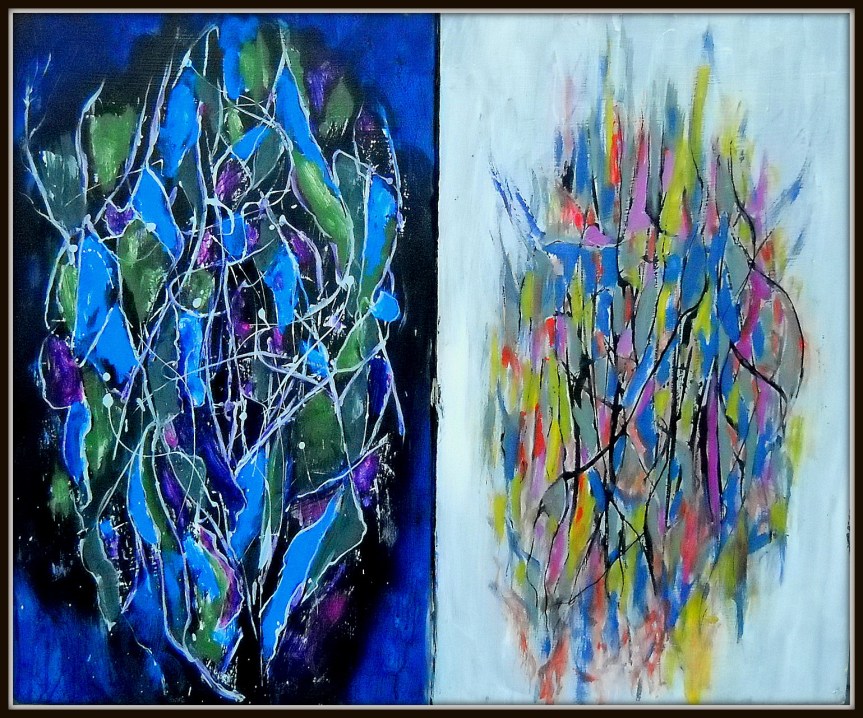
24×30″ Acrylic on press board. Color study. Left panel, inverse color and tone of right panel

View GALLERY HERE.
Harman on Latour’s Politics
This article made me think, how the material reality of the house where I live (I’m remembering the Ox, the communal warehouse where I lived) shapes our lives in ways that are beyond what we intend or choose. The material reality we make or choose, makes us. This made me think of our kitchen. My increasing dissatisfaction with how we use it. Our shared and progressively less shared and more individually fragmented kitchen–how the physical kitchen, by it’s small size, its limited storage, shapes this fragmentation into a less and less communal space. In the Ox, a dozen people could work, sit around and schmooze, clean up and cook, all in the same room. The huge work table and ample space not only made this possible, but it invited it, and the space of the Ox itself–a space with its many rooms and open areas, good for music and hanging out, needed to be filled–and that in turn, required a degree of cooperative action for cleaning and care–which when resisted, made us (FORCED us!) to be aware (to different degrees) of our mutual dependence (and how unready we were for this, having come from the dominant culture) in ways that living in an apartment, didn’t. Living in a house divided like this–like most middle and working class housing– people can comfortably settle into their habitual, individuated lives; can see in this how a shared house, arranged for isolated non-extended ‘family’ units–needs a high degree awareness–and experience with more communal living–to resist being re-formed into something closer to the cultural norm–the divided and alienated consciousness suitable for capitalist exploitation.

My way to Speculative Realism was through Harman’s was through Harman’s Prince of Networks: Bruno Latour and Metaphysics. It’s difficult, after all these years, to convey the sense of excitement I felt when reading this book. I had felt it before, my first year of graduate school when reading Zizek’s Sublime Object of Ideology (I actually dreamed about that book). There I felt as if an entire opaque world of theory opened up to me that both allowed me to understand the thought of figures such as Lacan but, more importantly, that allowed me to put that theory to work and comprehend the world around me. Harman, of course, is a consummate stylist. There is a certain charm and style to his writing that is difficult to put your finger on. Often it occurs in the margins, when the reader comes across offhand asides that he makes such as…
View original post 1,379 more words
Working on Gallery Pages for My Art
To make it easier to scroll through photos of my art… working on a Gallery Page. I want to have three sections 1: mixed media and assemblages 2: paintings, and 3: pen & ink, water color. drawings & prints. This is just a sampling of work from 2015. Click on an image, and use the arrows to scroll. A better way to see a large selection.
#408

22×10″ Acrylic on canvas
The relatively small size afforded me the opportunity to work out some ideas/techniques–thinking how I like both detail, and where, stepping back, the details merge into a broader design–become simply, elements of texture, which in turn, effects how light traverses the surface. Or reversing the order–I enjoy being able to approach an image, and find that as my eyes focus, closing in, I discover that richness of detail emerge as its own element. I like that two left clicks lets one see the detail–the close up–of these photos. Again–a dialog I’ve been carrying on between my canvases, and the intimate crowquils pen, ink and watercoler pieces.
View GALLERY HERE.
Naked & Ugly. Previously Known As “Reclining Nudes”
Refreshingly brash, intelligent commentary, You don’t have to lose your mind, or turn it off, to appreciate art.

Giorgione did a fine Venus in 1510 (believed to be the first prominent work of the reclining nudes kind), but it was painted not because he wanted the viewer to enjoy the controversial personality of the goddess. It was about her body. A nude woman has always been painted to appeal to men standing in front of the picture. Kings would boast of their lovers to their friends. Noble gentlemen would catch up by exhibiting their hunting trophies: girls they’d bedded and deer they’d killed. If you’ve visited medieval castles, did you notice that “reclining nudes” are often exhibited alongside the stuffed heads of animals?
If the 15th century saw the rise of allegory as justification for painting nude women (of which we remember Botticelli’s Venus and Spring best of all), the 16th century witnessed a tidal wave of Venuses, Dianas, and Paris Judgements. I’ll skip the rest of the…
View original post 791 more words
Abstract Art
Source Debrilly Abstract Art
When I see a work described as abstract, I ask myself–isn’t every work of visual art, ‘abstract?’ Unless it be 100% conceptual–and then it’s abstract in a cognitive or verbal sense.
I think of Cezanne, who wanted a plates of apples and pears to be as monumental and important as a portrait of a Madonna. Of course, this goes back further than Cezanne–to Manet, to Whistler, Turner, Corot… culminating in Pollack, Mondrian, Kandinsky… but isn’t that what we see and appreciate in the cave painting of Lascaux and Altamira?
Isn’t that thing we superficially identify as ‘abstract,’ the hook that every visual work of art hangs from? That silence that surround it–at last, the verbal mind tuned out, thought without words. That blessed silence of every genuine work of visual art?
Gabriel Josipovici Interview
I have great respect for Josipoici. I thought Whatever Happened to Modernism was brilliant… how commercial demand for retro-realist fiction derailed the unfinished Modernist experiment. His treatment by establishment critics in the British press tells you much of what you need to know about what’s wrong with so-called, literary fiction and it’s gatekeepers.
Thanks to Victoria Best (Litlove, of the venerable blog, Tales from the Reading Room), for this long interview–which serves as wonderful introduction to Josipovici’s writing.
Source: Gabriel Josipovici Interview

