Father’s Day

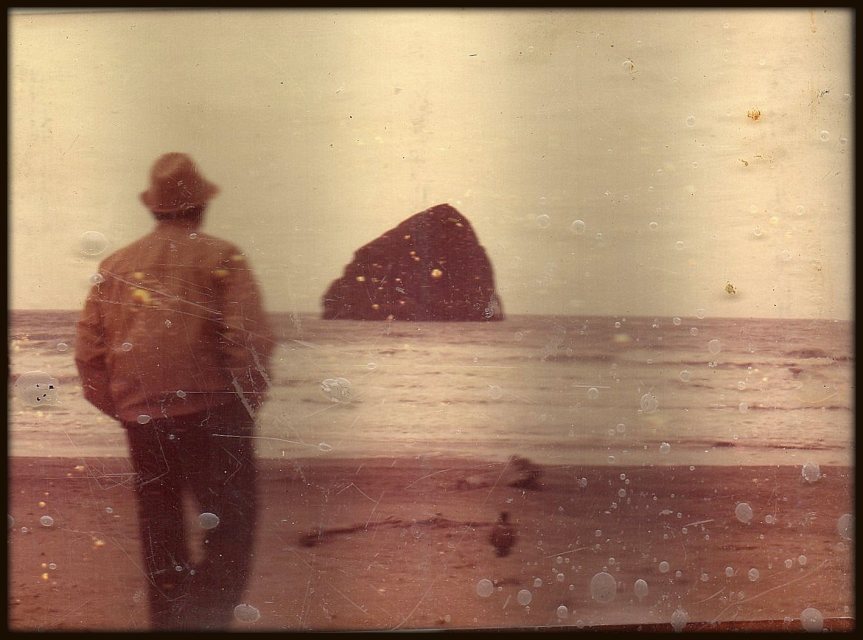
 My father in Or pacific.jpg
My father was a good man, as the world of his day would see him. He wasn’t an abuser. He learned to let me go my own way, and when he couldn’t be supportive, like when I was a draft refuser (he was Navy, WWII), he kept his silence. I think he was proud of me when became active in the civil rights struggle–but we never spoke of it. Silence–was his means for communicating both approval and anger. Which made him terrifying when I was a child.
I think, from the time I was 4 years old, I was resolved that whatever I would do or be in my life, I did not want to be like my father.
In his last years–with a failing heart and facing the approaching death of my mother–who had been for him the emotional outlet he couldn’t permit himself–I no longer feared him… but neither did I have any way to comfort him, to let him know that I saw and felt what he was going through.
He died alone, a year and a day after the burial of my mother. This photo is from a few years before her death, visiting my sister in Oregon.
I remember him with neither love nor anger… but with an infinite sadness. As though the one most lasting part of himself he gave to me… was whatever it was that was missing.
A hole at the center that can never be filled. I think he doubted if anyone in the world really loved him, but my mother–and he was never quite sure he deserved that.
When I think about my father, I’m never sure that I’m talking about him… or myself.

Gun Crazy Nation: Violence, Crime, and Sociopathy

S.C. Hickman's avatarThe Dark Forest: Literature, Philosophy, and Digital Arts

The trajectory of sociopathic society is toward destruction. It promotes destruction of other nations, of its own citizens, of the natural environment, and, ultimately, societal self-destruction.

-Charles Derber,  Sociopathic Society: A People’s Sociology of the United States

Robert W. McChesney in the preface to Noam Chomsky’s Profit Over People: Neoliberalism and Global Order admits that neoliberalism is the defining political economic paradigm of our time— it refers to the policies and processes whereby a relative handful of private interests are permitted to control as much as possible of social life in order to maximize their personal profit. Associated initially with Reagan and Thatcher, for the past two decades neoliberalism has been the dominant global political economic trend adopted by political parties of the center and much of the traditional left as well as the right. These parties and the policies they enact represent the immediate interests of extremely wealthy investors…

View original post 3,617 more words

Abstract Art: a definition

Artwork to stir the imagination: abstract paintings. What defines an abstract painting?

Source: Abstract Art: a definition

Debi Reilly’s reflections on abstractions got me thinking, about abstraction, and my current passion for street sketching.

Last year, as I was setting up for a show, someone kept pointing to places in my paintings–abstractions, emphasizing accidental effects. He would see here, a face, there a sailing ship, in a corner, a sleeping cat. He saw everything that wasn’t there, and nothing that was.

I don’t believe that anything can represent anything else. At its most extreme, the recent fad of photo-realism (which isn’t even trompe l’oueil, which was at least—remembering an 18C still life in the Nelson-Aitkins Gallery in Kansas City, with the fly that appeared both on the surface of painting, and on the petal of a flower) intentionally playful. The delight was not in fooling the eye, but letting you in on the secret. Where is the art without the lie? When I look at one of those pieces, I feel behind me a black robed judge and soldier at arms—giving me orders I’m not allowed to disobey: THIS is what you will see! All the assigned signified—and nothing of the signifier. No room left for play. This doesn’t sit well with my anti-authoritarian disposition.

I’ve been making abstractions—not exclusively, but primarily. I like that they succeed or fail as material, sensual objects: inviting the eye to traverse pattern, color, tone, texture—following “movement” from place to place and back again (what we call, ‘composition,’ and how the seemingly pure objectivity leaves us in a subjective aura that is so inexpressibly private, that the subjectivity seems to merge into the universal.

Where one perceives an identifiable image, I want to feel a tension, a conflict even—where the material object of the painting never surrenders itself to the imagined reference, but draws us back in, as into a sacred pool, where the image is erased transformed renewed, never the same a second time… changing even between blinks of an eye. There is both courage, and a necessary humility—in never attempting to hide the artifice. A work of art is always about more and other, than what it is “about.”And yet, there seems to always  be that “about” … even in the purely abstract work.

I think of the class of abstractions that decorate the walls of Corporate offices, hang over the heads of receptionists of Human Resources Departments, like guillotines (you know that heads will roll, whether theirs or ours.) They seem as programmed for effect—or lack of it– as Muzak. I wonder—is there a relationship here—something the photo-realist and Corporate Abstract have in common?

The art of an abstraction, no less than ‘representational’ work, of both — lies in a tension—a conflict (have I said this before? I feels as though I have) – a conflict generated (like that in the trompe l’oueil still life), by the artifice, as artifice… and whatever else it may be working to do. A balance, like that of the dancer in motion, that is never equilibrium—but always a falling into chaos… arrested, and renewed, and falling again.

I go out on the street and draw. I see. I draw. And the drawing awakens my vision to seeing more deeply—what is there, and what is within. I don’t know yet why I’m drawn to this… drawing (I’m not very good at it… not yet, at least), but thinking now that it’s related to what I’ve been writing here. My abstractions have—or in danger of—losing the tension. Whatever it is they need—maybe I’ll find in my return to drawing. I don’t know. I will only know that when I’ve moved past this and into a new phase. Vision… is about stepping blindly into something not yet there. Once you know… it’s too late. Beyond movement. Arrival is equilibrium. Equilibrium is Death.

Age of Abstraction 2.0?

S.C. Hickman's avatarThe Dark Forest: Literature, Philosophy, and Digital Arts

kandinsky_transverse_lines

“I always decide in favor of feeling rather than calculation.”

           – Kandinsky

As Hilton Kramer suggested in his rendition of the those modernist artists after 1913:

For both Mondrian and Kandinsky, the artistic base from which they made their fateful leap into abstraction was landscape painting, but their respective approaches to landscape were, again, very different. Whereas Mondrian’s was that of an ascetic determined to strip nature of its mutable attributes, Kandinsky’s was that of a mystical lyricist for whom nature is an enchanted realm of poetry and symbolism. Yet for both, the leap into abstraction was at once guided and sanctioned by their faith in the metaphysics of the occult, which in the end emancipated them from the mundanity of the observable world.1

This notion of the disappearance of Nature, the natural as introduced by Enlightenment philosophe’s and the rationalists before them as the mechanistic, and observable, objective…

View original post 485 more words

Should we be worried about Biogenetic Manipulation?

S.C. Hickman's avatarThe Dark Forest: Literature, Philosophy, and Digital Arts

Should we be worried about Biogenetic Manipulation in the near future?

Not only will capabilities for genomic manipulation dissolve biological identity into techno-commercial processes of yet-incomprehensible radicality, but also … other things. For those keeping up with Biogenetics, etc. A conference about having transparency in the biogenetic and biotechnological worlds of techno-commercialism.

CFP: Performance Philosophy and Biopolitics, Biotechnology & Biogenetics: http://www.twitlonger.com/show/n_1sojcqb

This working session will explore intersections of performance and theatre with biopolitics, biotechnology, and biogenetics by looking at the ways in which life increasingly resides in a transversal realm of indistinction, which produces live (i.e. concrete and tangible) consequences within digital and embodied environments. The working session seeks to understand what theatre and performance studies can learn from a critical inquiry into biopolitics, biotechnology, and biogenetics to examine ways in which contemporary ideology gravitates towards concerns regarding transparency. By drawing on the etymology of transparency— from the Latin trans-…

View original post 315 more words

Babel of Tongues: The Need for a New Language of Thought

Can poetry lead us to a new country?

S.C. Hickman's avatarThe Dark Forest: Literature, Philosophy, and Digital Arts

Reading several critical works brings me back to a notion I’ve had for some time: all the past narratives (Freud, Marx, Philosophy, Science, Economics, etc.) no longer capture the state of affairs in our time… the stories they tell, and we tell each other: the metaphors they use, the whole complex system of relations they use to capture what we are experiencing in our day to day lives, and even the global shift of relations across the world itself, are useless to most people. They no longer speak to us, give us the meaning or context within which we can relate to ourselves or others. So we wander from abstraction to abstraction, unable to relate to one another because each of us is an assemblage of competing systems of thought that no longer relate across systems. Therefore we’re in that crash space the Scott Bakker is always describing… unable to speak to each…

View original post 314 more words

Everything that’s Wrong with the “Art World”

Fuck the capitalist gallery to investor pipeline–those who own it, and those who seek to profit from it. What is both so irksome, and revealing–is how this pitch is aimed, not at those who love art, or the art… but ‘investors,’ those who, by turning art into a capitalist commodity, eviscerate it’s value as art, as set up a gatekeeping system, that functions, not as means to select the best, but to exclude all but the smallest fraction of art and artists, precisely to raise the monetary value of what the system lets in. What this has to do with aesthetic value is purely accidental.

Skip the guesswork. Here’s three things to look for in an emerging artist:

Saatchi Art