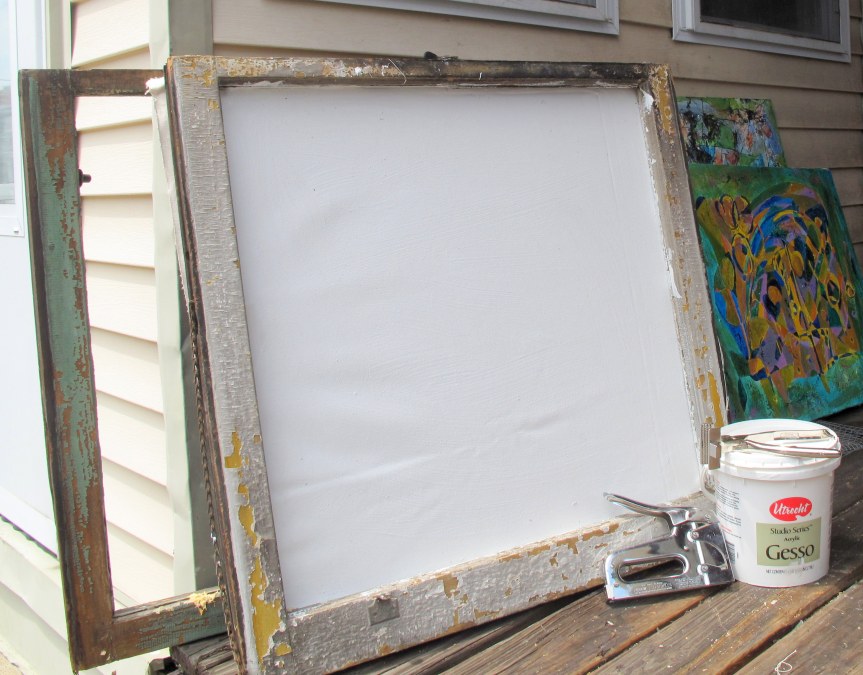
A few weeks ago, I picked up an 8×7′ piece of heavy, cotton duck canvas, painted on one side. Cut into 4 pieces. Been thinking how to use a couple old, wood window frames I found. I’ve used them as frames, before, both for paintings, and assemblages, so thought I’d try stretching a piece of canvas to the back side–using it as both stretchers and frame. The painted side, a thick coat, so couldn’t do much ‘stretching,’ but got it reasonably tight. Canvas wasn’t seized, and really soaked up the gesso. That’s a second window frame behind in the photo.

Category: Uncategorized
Art & Capitalism: the problem won’t go away.
The interface between making art, and making a living, is the most politically charged area in the life of any artist. This is where the artist engages most directly with the monster of capitalism and Empire, both as a maker of art, and as a citizen of the human community. I don’t understand why so many artists are so reluctant to seriously engage with the problems we face in this arena. This is something I’ve been thinking about — for years, and yet, the most typical response I get from working artists: on commodification of our work, on how to live by our art, of the corrupting influence of investor driven gallery gatekeepers–is a curt dismissal, as though I were an impertinent 12 year old. “I need to make a living–what am I supposed to do?” But of course, never asked as a serious question.
And of course, I have no answer. No one person does, because it’s not the kind of question that any individual can answer alone. —Artists have to figure out–together–how to control the outcome of our work–or we will be controlled and used to the ends which the Empire of Money and Death sees fit.First–acknowledge the problem. Then, pledge to work together to applying ourselves to find cracks in the walls where we can expand and live. We cannot continue to be artists under capitalism. Because, under capitalism, we will only be permitted to do what supports capitalism–that is, no longer artists, but technicians of the machine, and entertainers, distracting the masses.
“When Hate is Glorified, Institutionalized and Merges With State Power”
Two years later, Facebook acknowledged that “malicious actors” had created “fake personas” to spread misinformation on the site, updating this a week later with the admission that “any person’s Facebook account could also become the target of malicious actors… who could potentially access sensitive information that might help them advance harmful information operations.”
How did we get here? How is social media being deliberately utilized to evoke anger, hatred, bigotry, and…
View original post 803 more words
Things you wouldn’t think you could do with pastels
Skill and Expression Win the Day It’s always exciting when we hear about emerging talents in the painting and drawing fields we are passionate about. Here I’d like to introduce you to seven pastel artists whose work demonstrates a level of skill and expression that has caught the attention of critiquing artists and specialists in […]
via 7 Emerging Pastel Artists to Watch Out For — Max Mallie’s Blog
The Annihilation of the Universal
The Dark Forest: Literature, Philosophy, and Digital Arts
In the organic composition of capital, variable capital defines a regime of subjection of the worker (human surplus value), the principal framework of which is the business or factory. But with automation comes a progressive increase in the proportion of constant capital; we then see a new kind of enslavement: at the same time the work regime changes, surplus value becomes machinic, and the framework expands to all of society.
—Gilles Deleuze and Felix Guattari, A Thousand Plateaus
Isn’t it true, our fear of Artificial General Intelligence, of these radical creatures of our imaginal dreamtime futures and present unfolding’s mask our inhuman core? Our fear of losing jobs to the machines, of being obsolesced by the new conditions of society, being not only replaces but condemned to exclusion and annhilation? Haven’t we begun to realize the thing we fear most is the buried truth of our own inhumanity, that the West –…
View original post 1,878 more words
Mother Love
Some mothers are more difficult than others for the humans pulled out of their bodies. At best, if we’re honest, it’s a mutual wound that never heals.
There is an element of violence in love–that can only be deferred, or displaced, but never erased. Sentimentalizing mother love is a lie against … if not nature… truth.
That doesn’t make love less important. It makes it more so. Love is the overcoming…no, not just the overcoming, the transformation–of violence. Violence is not the opposite of love… it the mother of love.
Two months short of 30 years since my mother’s death.
The dialogs we never had, return in dreams. So often in anger–resistance. To become whole and free in the world, we need to stand up against our parents, to assert our independence. But most of that need arose when we were too young to understand it for what it was.I know that anger in my dreams, is directed at myself… for not knowing… at 3, at 12, at 18. This is what we carry through our lives. Reliving… what we can’t relive. In dreams. In fantasies. In rituals of self destruction.
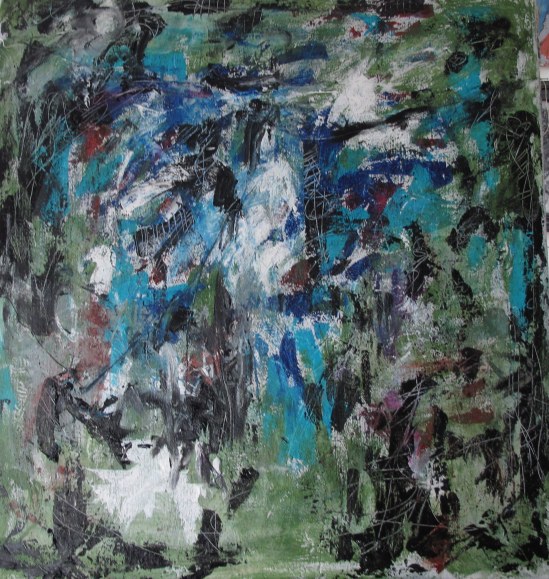
Work in progress (684)
91.4×86 cm. Acrylic.This is the FORTH try on this canvas. I think this is going to work. . The last paint-over was #680. which was making me gag. After so many small, pen & inks, I needed to loosen up.

Reading and Repetition
A central claim of Deleuze’sDifference and Repetition is that we only ever create something new through repetition. Here, then, we might encounter a fundamental difference between Badiou and Deleuze (or is it a proximity between the two?). For Badiou the new is created as a result of a truth-procedure that is evoked through fidelity to an event. Wedon’t, in fact, have toawait events as people sometimes suggest of Badiou; for there are plenty of events that have already occurred throughout history. It is not the event that produces newness in Badiou’s universe, but rather fidelity to that event and the transformation of a situation or world in terms of what is uncounted by the encyclopedia of that situation. One can continue to pay fidelity to the Paris Commune or May of 68 (if the latter was an event) today, unfolding its consequences in the present.
In…
View original post 1,561 more words
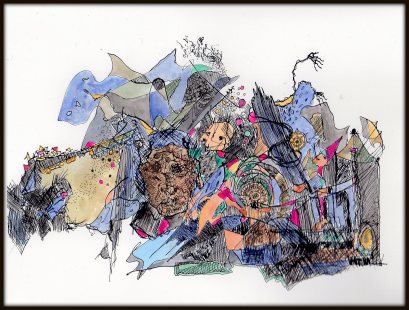
#681 4-24-17


28x19cm Pen & ink, watercolor on 140lb hot press Fabriano paper
View portfolio here ART BY WILLARD
For photos on this blog:CLICK HERE, and scroll down.
Two Dreams about making art

Dreams last night. I was walking with another artist in Paris (I’ve never been out of the U.S.A., let alone Paris)–but it was quite vivid, the architecture with its sculptural adornments. I was explaining to my companion, or he was explaining to me (it wasn’t clear) how when you lived in a place where you passed and saw the work of artists going back over time to the middle ages and older–that for a working artist, it would all be contemporary–all working it’s influence, all there to draw on–and it’s very diversity meant that it would be impossible to be merely derivative, or for your own work to be other than wholly new.
This seemed to fold into examining a book of illustrations, like urban street sketches of row houses. There was a small, vague figure in the lower left corner, that I realized when I saw it (as though this were being explained to me), that stood for the person who had committed suicide in each of those houses, or been murdered there… the explanations seemed to increase in the violence revealed, page by page.
These felt like they were the same dream. The same dream message.