Category: Goby’s Journal
How does an artist judge their own work?
This is how I would answer that question.
What most consistently matters to me is where this piece is taking me, so my liking, or judging a work to be good, is never entirely about that work–but something I see before me, something that doesn’t yet exist–or hasn’t been realized (as in, made real). That may be something I don’t see until later, after I’ve made–maybe–many many more pieces. Finding the almost hidden signs that mark the trail. I find it most satisfying when those are the pieces that others are drawn to — like, ah! they get it!
Imagine having the entire oeuvre of an artist before you, seeing each piece in the order of its making for the first time, and trying to suss out what will come next, or what will represent the apex of their life work, never knowing if that point will ever be achieved, whether the next piece will be a detour, a dead end, from which the artist never returned, but continued to turn out work that failed ever again to realize the promise of what they had done before–it’s like that, only I’m the artist. THAT describes the character of my anxiety about my own work. Nothing that anyone else will see till my work is over.
There’s a Yeat’s quote, along those lines–I believe he writing about William Blake. “In the beginning of important things—in the beginning of love, in the beginning of the day, in the beginning of any work, there is a moment when we understand more perfectly than we understand again until all is finished.”
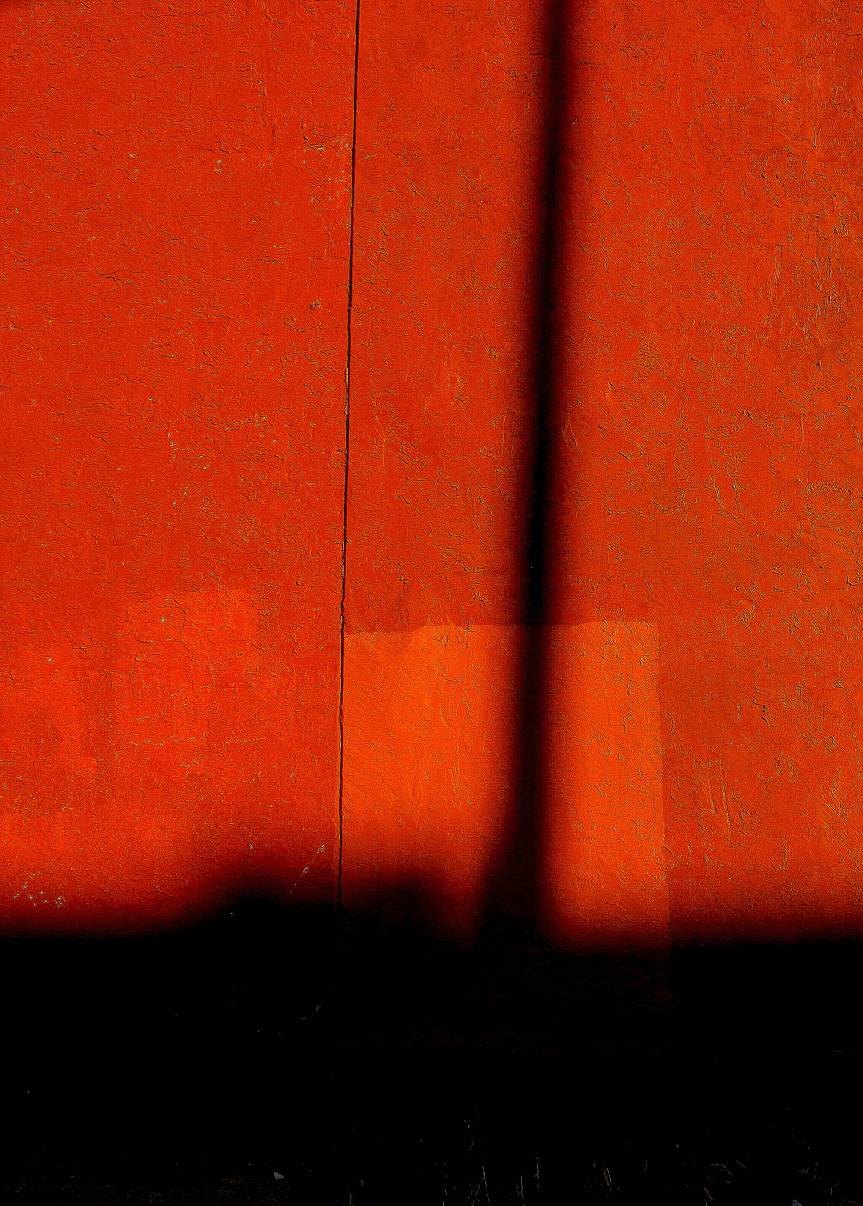
#319 Reworked: Self-Portrait in the Spirit World
31″ x 36″ Acrylic on stretched canvas. I thought I’d finished this in 2015, but was not satisfied with it. Seeing work by Tatiana Leony, an Igor Shcherbakov on Saatchieart (whose work is amazing–I encourage you to seek it out), helped me to see this with new eyes… or maybe, with my Third Eye.

View more work at SaatchieArt,
on ArtFinder, and
on my web portfolio here ART BY WILLARD
For photos on this blog, click MY ART on the right and scroll down.
On Depression, Revolution, Anarchy

It’s difficult for a person to hear themselves when they’re depressed. That’s why listening is more effective than any advice you might give, and why telling them you love them, or how much they are valued–only makes things worse.
In being heard, in being listened too, it becomes possible to hear one’s own voice–to hear, as others hear, the deprecating voices… and recognize what they are saying as distortions of the truth. It’s how we find our own way back.
The deprecating voices are external images of self that we have assimilated. No external voice will lead us out of their traps, because it’s our susceptibility to them that caught us in those webs, and to find freedom again to breath on our own, resistance has to rise from the depths of our own being. No one can do it for us, and no one else can show us how.
Keep that in mind when you offer reassurance, and are refused. The refusal is not a symptom of the malady.
Listen! Listen with such depth of attention that the person you would help, hears in their refusal, their own assertion of a will-to-health, and the means to restoration of their freedom
I think there is an analogy here to what we have to do to free ourselves from oppressive social forces.
No one ‘out there’ can save us. No Moses can come to lead us out of Pharos’s Egypt. There are no ready-made maps or instruction books or revolutionary plans. The first step, always–the beginning we need to return to, endlessly–by turning to one another, in such intensity, with such attention, such listening, that we will hear, and summon together, the creative power that has always been there: the power to create a new world–a world worthy of the struggle it will take to build it.
Gustav Landauer: Art and Revolution
“In our times, an artist is defined as someone who has a vision: someone with visions and rhythms that form a separate inner world: someone who can manifest this world on the outside; someone who can create a new, an exemplary, their own world through imagination and creative force; someone whose ideas leave their inner being like Pallas Athena left Jupiter’s head; someone who then, like an Italian trader of plaster figures, packs the result in a basket and hawks it in the “the other world,” ordinary reality, where they sell the figures of their dreams and sacred desires to the goblins and caricatures of their artistic mind, all the while advertising, calculating, haggling, arguing, cheating. This is the contemporary artist’s mixture of detachment and participation.
But mine is another: I want to use reality to create; I want art to be the process of imaginative and communal social transformation, rather than the expression of individual yearning.”
Gustav Landauer, REVOLUTION and Other Writings: A Political Reader. Edited and translated by Gabriel Kuhn. PM Press.
I changed the masculine, personal pronouns.
I was probably 22 or 23 when I read the essay on Landauer, in Martin Buber’s Paths in Utopia; it would be hard to imagine how any, indirect meeting with any thinker, could have a more powerful, influence, than the ideas in that essay had for me—over the course of whole life. Three years later, I was living in a commune—where expenses were covered, each according our means. Though it would be 45 years before, my involvement with Occupy Philly, led to the next experiment in communal living, I never gave up my search for a means to realize my ideas on communal living, and this time—I’m sure there was something of Landaur’s ideas of art and revolution, what freed me, to return to what I had been doing when I read that essay: making art.
I only last week bought a copy of this book, and in reading it, began to discover how much—from such minimal acquaintance–the seeds Landauer had planted, have meant to me over the years. The perplexity I feel, and have expressed in posts on this blog and elsewhere, on how survive as an artist in this capitalist wilderness–and as a revolutionary–without losing one’s freedom to create, or submitting to slavery of the market–I didn’t learn from Landauer, but, as in the above quote, I find, this too, I share with him—if from another side, as an artist.
Revolution is an act of imagination
Revolution is action.
Revolution takes place in the present. Now, and now, and now, or never. There can be no waiting
for the “right conditions.”
Revolution is an ever present necessity.
Revolution is every act of the imagination, made real in every present moment.
Solidarity, Love, Imagination, RESISTANCE!
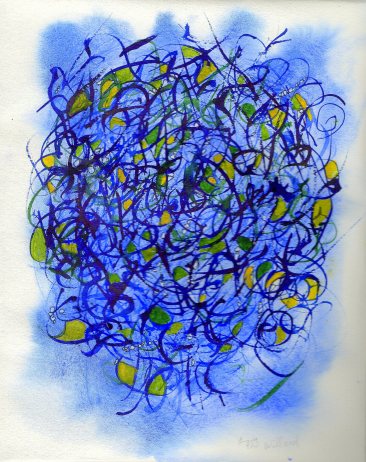
#753
10×8″ Watercolor, some pen & ink. Another experiment–feeling my way to making larger watercolors. I stapled 140lb Canson paper to a small stretched canvas, folding edges around the sides. I used a wet wash over most of the paper to see how it would respond. There was a little buckling, enough to be of concern for a larger piece. I will have to fix the paper to the canvas with gel. I’m NOT going to soak and stretch a 60 plus inch piece of watercolor paper. Maybe if I had a large floor space, and a bin, like used to mix cement–pull the paper out and lay it on towels. The Canson paper was too smooth, and too absorbent–got it for pen & ink and more discrete application of watercolor–not broad washes. For the larger work, I’ll get rolls of cold press Fabriano or Arches, rough.
 View my web portfolio here ART BY WILLARD
For photos on this blog:CLICK HERE, and scroll down.
What is to be done?
Genocide and capitalism are inseparable, and inevitable.
If you pose a serious challenge to the order of the capitalist state–you will be marked for extermination.
I suspect that any STATE, any order dependent on coercion and violence, will degenerate into authoritarian, elitist rule. For a capitalist state–that will take the form of fascism.
As capitalism founds itself on a claim to representing an order of Nature, it follows–as sure as natural law–that all opposition will be declared, whether by eugenics, or other theoretical justification for the extreme inequality created by capitalism, as pathological–necessitating the extermination of those carrying the disease.
Genocide and capitalism are inseparable, and inevitable.
If you pose a serious challenge to the order of the capitalist state–you will be marked for extermination.
In a pseudo-democracy, it will come about in stages… but it will come about.
Understand, that if you are serious about challenging the capitalist state–they want you dead. And will find the means to satisfy their desire. There is nothing you can do to change that.
The question, as always… what is to be done?
#745
13×12″ Watercolor on 140lb Fabriano cold press paper, fixed to stretched canvas. Experimenting, thinking this is what I will do for extra large watercolors. I used acrylic gel to fix the paper to the canvas. No problems. The next painting I sell (so I can afford it) I’ll buy a roll of watercolor paper. Arches 44.5″ x 10 yds, cotton, watermarked 140lb cold press, rough. $153.60 … $119 at Blick. Work up to 60×44″
Commissions welcome! Have to work this out, but given material costs, I expect I would have to ask for $800 to $1200 for the largest work.
 View my web portfolio here ART BY WILLARD
$150.00
For photos on this blog:CLICK HERE, and scroll down.
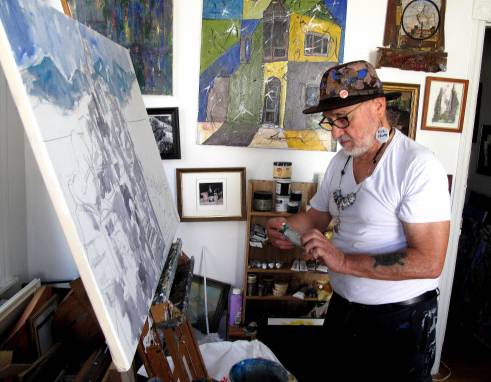
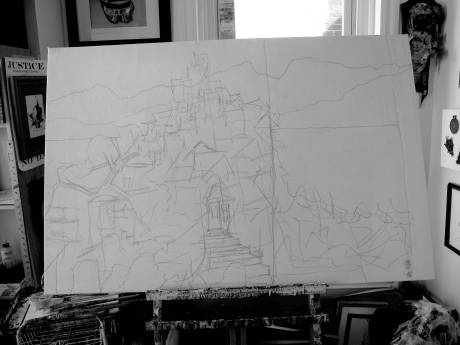
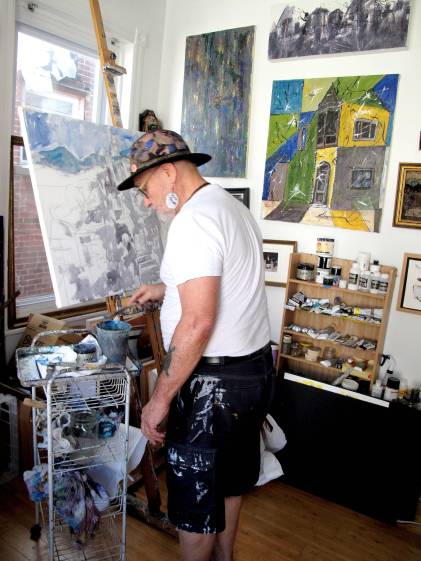
My studio–working on #743

Thoughts on what we call “disabilities”
I’m at a loss how to communicate what this hearing aid means to me–how profoundly it has effected…changed, my life. It’s not the inability to hear–but the effect of losing a capacity one has come to depend on, and lacks the resources to replace. Hard of hearing is not a less severe form of deafness–it is different, as any truly deaf person would almost certainly agree.
I belong to the hearing world. At my age, I will never belong to the deaf world–which is a culture onto itself, for which, “Hearing” is not something that’s been lost, not a deficiency… it is simply, Other. If I were to learn ASL (something I would very much like to do–though learning a new language at my age is probably more of a challenge than I’m able to take on) –and even become proficient in it–I would still be a visitor in the culture. I would still belong to the Hearing world, the hearing culture.
When I say, I’m at a loss to communicate what this means to me–it’s in part, because of how profoundly this has impressed on me the degree to which our various capacities, define us–and what this means. How all of these, are less about our physical differences, or neurodiversity, than the social conditions imposed on us.
I do not have a ‘disability’ because I do not hear well, but because I do not hear well– I am, to the degree of that loss, excluded from full participation in the hearing world to which I belong–in ways more profound than I would have imagined… and more profoundly than I can adequately express. Let me state this in different words: my disability does not consist of a hearing loss, but in how it excludes me from the social culture to which I belong–and there lies the more important meaning–for in different ways, this can be said of all the various ways humans diverge from the norm, from the privileged, power enforced mythologies of the Normal.
And in this, I can be thankful for this loss, in that it has given me insight into a range of human diversity, and the cruel tyranny of the Normal over all of us.. without which, I would not have understood with such clarity.
The neo-Nazi, eugenicists, who have risen to power–with representatives in the White House–are our ultimate enemies. Enemies of all of us. All of us. Because there is no such thing, as “Normal”… and there is no way to be rid of us… but extermination of the entire human species. Which is clearly, their unconscious goal.
 Jacob Russell's Magic Names