13″x11″ watercolor, ink Number 3 in a series

Author: wjacobr
Visual artist, poet, novelist, activist & Street Medic, living in North. Penn Name: Jacob Russell
My blog is a confluence of art, writing, politics.
my Art portfolio: Art-by-Willard.com
#897 Assata 2 in the series
Some variation in wording. I’ve gone with what I’ve heard on the street–Assata Shakur’s words come alive in the throats of comrades, rather than searching for the “authentic” dead letter original.

Assata Shakur

#896
22″x15″ Mixed media: acrylic, watercolor, ink on Fabriano 140lb coldpress
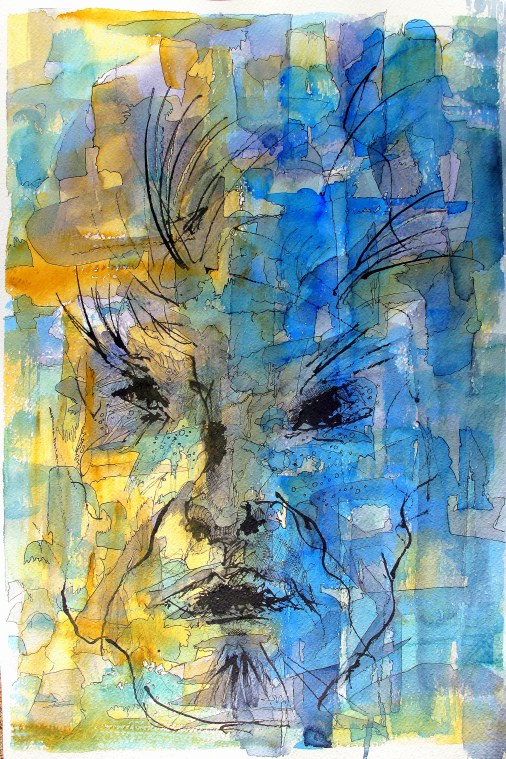
View more work at Saatchi Art, and on my web portfolio: ART BY WILLARD For photos on this blog, click MY ART on the right panel and scroll down.
Entanglements and Why Change is So Difficult

 Why is social change so difficult? In Entangled, Ian Hodder outlines four forms of entanglement where people, as it were, become enmeshed in the world in ways that render alternatives or change difficult. These entanglements are forms of dependency forming series or chains. There are, first, human – human entanglements (HH). These are what the social sciences, political philosophy, and political critique largely focus on. HH entanglements are the realm of representation, norms, laws, signs, and power. In my last post, I spoke of an HH entanglement with respect to citizenship status. Although citizenship or being categorized as undocumented is not a material determination but the result of a signifier or what Deleuze and Guattari call an “incorporeal transformation”, it nonetheless has profound material consequences for the person that falls within the web of these signifiers, determining what movements and forms of life are possible for that person.
 The…
The…
View original post 1,685 more words
#895
10.5″ x 14″ Watercolor, ink

View more work at Saatchi Art, and on my web portfolio: ART BY WILLARD For photos on this blog, click MY ART on the right panel and scroll down.
#894
15″ x 11.5″ Acrylic, watercolor and ink on Fabriano 140lb cold press paper.
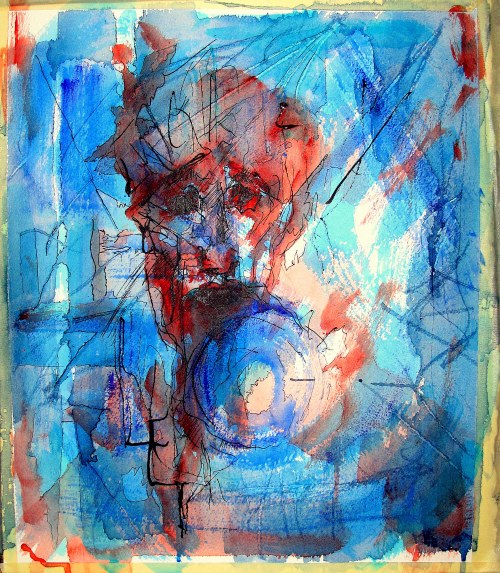 View more work at Saatchi Art, and on my web portfolio: ART BY WILLARD For photos on this blog, click MY ART on the right panel and scroll down.
Meditation and Trauma
We are told that meditation is the answer to trauma; this is not always so. It can be–counter intuitively–a conduit for repressed trauma.
I came to this realization at the sound therapy session I went to a couple months ago, and I’ve been putting some things together from related experiences with this over the years.
My first intuitive awareness of this, goes back some 50 years ago, when I found that the calmed state at the end of a meditating session, not only didn’t last or translate into routine activities, it left me way MORE susceptible to snapping out in anger when ambushed by unanticipated disappointments or frustrations. This made me wonder– but I assumed there was something wrong with how I was meditating.
At that sound therapy session–it was something different–I left feeling more anxious, my thoughts wanting to skim the edges of various disappointments, things I’d done that brought me shame, and petty traumatic memories of childhood. I say petty, cause this wasn’t about remembering abuse or physical trauma–it was the cumulative experience of my first years of elementary school–stuff I’d thought I’d worked through years ago,.
I think it was the passivity of meditating, that recalled feelings of helplessness as a child, a powerlessness at the hands of adult “caretakers” … the passivity of waiting to be punished, waiting for some unspecified, but terrible, consequences of experiences I was incapable of understanding. .
I can meditate to an almost trance like state…but what it leaves me with, is not peace, not an alleviation of anxiety–but a vulnerability to lashing out at the first thing to interrupt that state.
I wonder if others have had this experience?
Imagination, not “Will”
It’s not ‘will’ but the stories we tell ourselves, that give us power–or have power over us.
Do I take the day off, or go to City Hall “just to see how things are going?” Do I go the Wine and Spirit Store, or save the money and do without? Such choices are made, not by “will,” but by imagination.
Will power is helpless against habit. It isn’t even real.
If I give in and go to City Hall, even though I need a full day off; if I go to the store and buy a bottle of wine, it’s because I more powerfully imagined having done these things, internally imagined them, and that imagination overrules attempts to “will” myself to make other choices. Every time.
I think that’s how I quit smoking almost 40 years ago. Quitting was hard, not because I lacked sufficient will power, but because Not Smoking, was impossible to imagine, Not Smoking brought to mind flickering pictures of the many situations where I really wanted a cigarette: after morning coffee, after a nice meal, when I felt stressed out and needed something to distract me–but I could imagine, stripped of any particular context, giving up just one cigarette–the next one.
Is it possible then, when I feel that internal “choice” to have already determined, to tell myself a different story (and this is the deeper meaning of how stories effect us, isn’t it?) I spin out a picture narrative, of what I will do…no! Not, what I WILL do, will to do–framed as a choice–but DOING it. I am catching up on my journal. I’m making rice and beans, step by step. I’m tapping down a piece of watercolor paper, preparing it for a painting. One thing at a time (that one-day-at-a-time) thing is useless, if you can’t fill the day ahead with a story powerful enough to carry you through).
If I find myself trapped by habit, by neurotic compulsion… –what are the stories I’ve been telling myself?
But then, imagination is all entangled with desire, so the question is, what do I want? But what I want is shaped by the stories that have shaped me. So who and what is it that tells us our stories?
Why psychoanalysis has more to tell about about ourselves than any of the behavior modification theories.
#893
22″ x 16″ Watercolor, ink
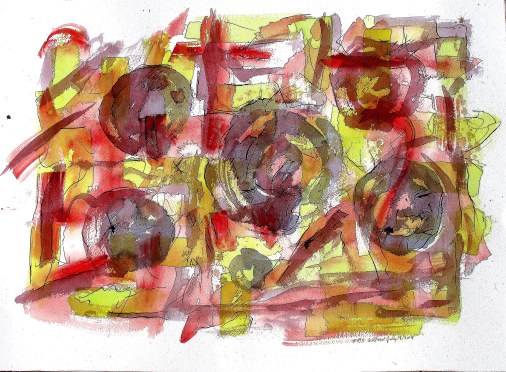
View more work at Saatchi Art, and on my web portfolio: ART BY WILLARD For photos on this blog, click MY ART on the right panel and scroll down.
 Jacob Russell's Magic Names