
#32 32x37cm Assemblange from street trash

#38 – 50cm diameter. Assemblage on composition board, acrylic

#60 Kensington Winter, 29x60cm Mixed media, ink, water color, street dirt & trash & Ginkgo leaves.
#32 32x37cm Assemblange from street trash
#38 – 50cm diameter. Assemblage on composition board, acrylic
#60 Kensington Winter, 29x60cm Mixed media, ink, water color, street dirt & trash & Ginkgo leaves.
Given that art has human value (without– or suspending definition of what that is), it follows that the labor of the artist merits support. This entails meeting basic human needs for the artist, seeing that tools, supplies and space for making art are available. How that support is offered, where and by what means it’s obtained is not a matter of indifference for art or artist, but will have the power to affect and control both art and artist.
There is an unavoidable entanglement of the production of art and artist with the economic, social, political, and cultural, machines (thank you Levi Paul Bryant ), through which support is procured. The gallery-investment-collector-museum-gentrification-reward-machines will select that which maintains and enhances their operations, and reject what threatens them. The flow of money is the mother’s milk that fuels these machines, and those who control the flow of money will not abide anything that challenges their territorial power. If you are an artist, and court what passes for ‘success’ in this system, you will, no matter how firmly you believe in your aesthetic purity, or how hard you work to compartmentalize your creative work to shield it from the machinery you have made yourself dependent on, you will be making art that serves that system. You will be a useful servant of the Empire of Money and Death.
There was no need to define the value of art and the artists labor, because it will be defined by the machines that distribute the reward and how they make use of it. Artistic freedom will be the reward of the parasites, the rebels, thieves and refusers. When you see one of those great, expensive, powerful works of public art, those magnificent museum worthy pieces, made possible by grants and awards, by the flow of money–tell yourself, that is not what artists who value their freedom do. That is not what a free creative soul aspires to do–it’s a temptation, a seduction to join the stable of the pimps who run the machines… the machines that build the prisons and make the drones and turn everything human into a means of profit. Why am I not hearing this conversation from artists everywhere? How do we survive without supporting the machinery of slavery and death? What kind of art can we make–how does that change what we are given to do, how does that shape our creative vision? Why am I not hearing this conversation from artists everywhere?
April, 2014

#26 The Beginning is Near: View from the roof of the Ox

#27 18x32cm Assemblage, Rusted steel, paper, leaf

#30 65x40cm We Are What We Eat. Assemblage, street trash with shells

Reposting this pre-review of my novel from Goodreads.
We cannot know both the reality of the Snow Angel and the trajectory of our desire. The one will erase the other, opposite poles of attraction we cannot hold together. But somewhere, (who cannot believe it will be so!) we may hear a Voice that will lead us to some greater freedom, from the prisons of memory, to visions of the Peaceable Kingdom, lead us on a Winter’s Night, t, even to the Left Side of the World, and grant us the gift of a new name.
So it was for Jacob, who first saw the angel on the Frankford El, and where she fell in the snow–a photograph, a note, an address to the house of Nacht. What could he do, but follow the signs? Ah, but there will be fire to pass through if you are to meet the messenger, with riddles, like koans that have no end. Follow the cat. Run your finger over the alphabet–feel where his teeth have left their marks, close your eyes, draw pictures in the dark, let your fingers tell the story, like reading brail, that it may unfold, not in words, but out of the unfathomable silence of the body.Paperback, 233 pages
Expected publication: May 25th 2015 by Deep Sett PressJacob Russell’s Ari Figue’s Cat does what few novels do: grabs you and won’t let go, without resorting to the cheap gimmicks New York agents rave about (explosions, long lost siblings, incest, and other soap opera tactics).
The Cat is the multiplicity of consciousness, a la Schrödinger, but Russell never lets the scale of his art’s inquiry overshadow the simple humanity of his characters; each is painted delicately and humanely– appropriate, as the author is also a painter.
This book provides no easy answers; if it had, I would not have read it. It is the kind of art we have always needed: questioning, beautiful, full of soul.
Robin Dunn

In April, 1988, standing in our kitchen in NE Philadelphia, it came to me that for the rest of my life I would follow whatever course best served my desire to write. And by that, I meant–to make art, to be an artist, though I wasn’t yet ready to accept that name for myself
I was 47, two months short of my 48th birthday. It wasn’t that I hadn’t done these things before, I had taken courses in art from childhood, at the Chicago Art Institute, Nelson-Aitkins Gallery of Art and Kansas City Art Institute. Later, majored for for time at Wichita State University. I had written stories and poetry from the time I could write, but this was new. This was something else. Like a conversion experience. A sense of accepting a calling, making a commitment. If I could live to work another 20 or 30 years, I told myself, I would have as much time as many who had begun in their youth–to leave a body of work.
Maybe it was the feeling that time was running out. Or was it that to my mind, being an artist was something too grand, that I wasn’t worthy? I thought of what Cezanne had written: ” Why so late and with such difficulty? Is art a priesthood that demands the pure in heart who must belong to it entirely?”
Yes. I thought. It does.
Though not so sure about the “pure in heart” stuff. A bit too 19th Century.
But with humor, yes. And this new sense of freedom from any judgment not my own–this was what I was going to do.
It will be 27 years come April. Some of them–pretty rough going. But I can call myself an artist now–a novelist, a poet–and not cower in shame lest I be found out as a fake. And I’m happier than I’ve ever been in my life.
I kinda like this, being a Late Bloomer–of just warming up when most people are winding down, of not having to hang it up, rest on the laurels of what I accomplished in my youth. Life is just beginning. Every day. Every day, a new beginning!
 A blog post is as ethereal as the trace of dancing particles though a cloud chamber, and yet in the universe of the web, seemingly always there, as though cyrogenically frozen beyond time, perhaps sprung to life at the mistyping of a search word, or preserved on old UBS drives at the bottom of a landfill, like mineralized imprints of the first self-replicating cells that drifted in Precambrian seas.
I don’t trust the impulse to preserve. nursing as it does, a delusional wish for immortality, and yet, like: Shakespeare’s 64th Sonnet, the wish to have that which we fear to lose, nudges aside good sense, and I go back into the old blog, searching for scraps–what, had I not written them, would have been likely nothing more than trains of thought, passing time on the el waiting for my stop, forgotten as soon as my foot touched the station platform. Here, then… from my birthday, June 22, 2008.
Ulrich went on: “Every great book breaths this spirit of love for the fate of individuals at odds with the forms the community tries to impose on them. It leads to decisions that cannot be decided; there is nothing to be done but to give a true account of their lives. Extract the meaning out of all literature, and what you will get is a denial, however incomplete, but nonetheless an endless series of individual examples all based on experience, which refute all the accepted rules, principles, and prescriptions underpinning the very society that loves these works of art! In the end, a poem, with its mystery, thousands of words in constant use, severs all these strings, and turns it into a balloon floating off into space. If this is what we call beauty, as we usually do, then beauty is an indescribably more ruthless and cruel upheaval than any political revolution ever was.”
From chapter 84 of The Man Without Qualities.
From October, 2012
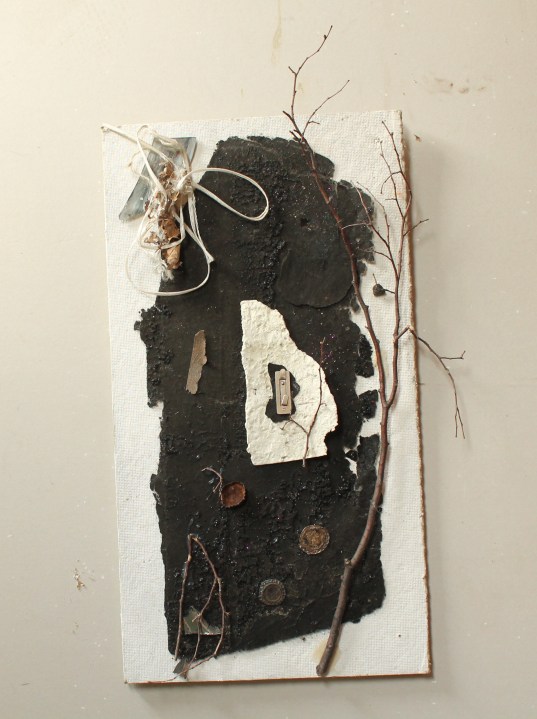
#21 Roofing, twigs, scrap

#23 63x34cm Assemblage, composition in B&W
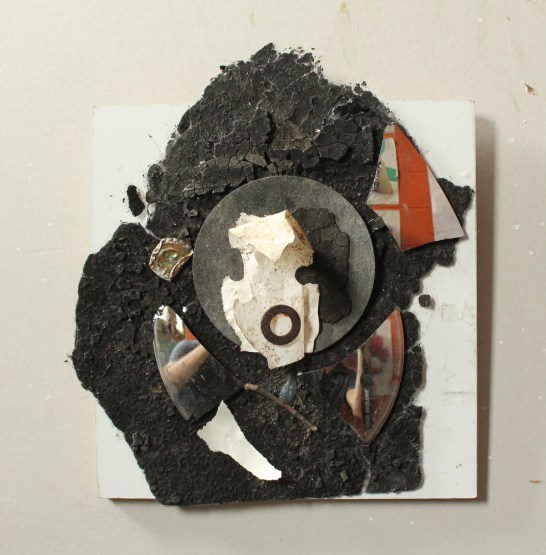
#24 27x13cm Assemblage, composition in B&W

We are not immortal. “We” absolute.
No universal multiplication of “I”
All of us, here now and to come. Not one by one our extinction, but in the end, all, all. Even–should we evolve to something that survives past the death of the sun, our solar system, past the the universe recalled to its origin or dissipated to the logical version of entropic “forever;” we will have become something else–as radically other as we are from the replicating chains of RNA before they made room for the generations of the double helix, of which we, in our expanded consciousness, are the descendants and heirs.
No longer: “I am going to die,” but we… Ivan’s question demythologized.
This comes to mind when I hear fantasies of lifeboats to other galaxies… the need to populate the stars lest “we” (a version of “we” that has not overcome the most primitive version of imagined survival at the expense of everyone “other”… nevermind all those left behind… that is, there is no “we” there…
If there is to be any survival worth imagining, this would be its antithesis.
To conjure values suited for a new age, the starting point is imagining… as it always has… our mortality… our common mortality, and our solidarity in the face of it–human solidarity against the idea of the sacrifice of the many for the sake of the few.
How little has changed.
from December, 2008, Barking Dog
I made 222 pieces at the Ox, from July 2012 to the end of November, 2013. I’ll begin posting those I have photos of. Here are 5 of the earliest.

#2 Sexuation 30×25 cm Assemblage
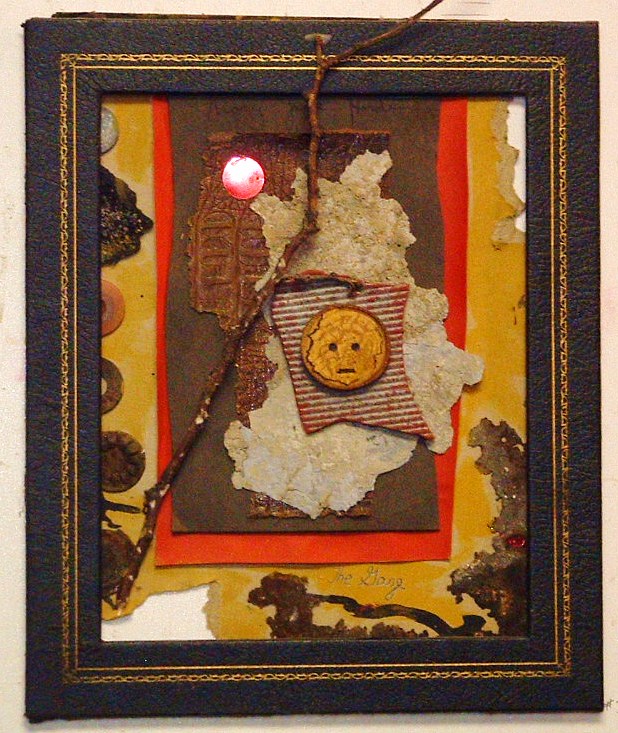
#3 The Gaze. 35x29cm, Assemblage
#10 Piece of the Puzzle 36x23cm. Assemblage

#19 37x30cm Assemblage
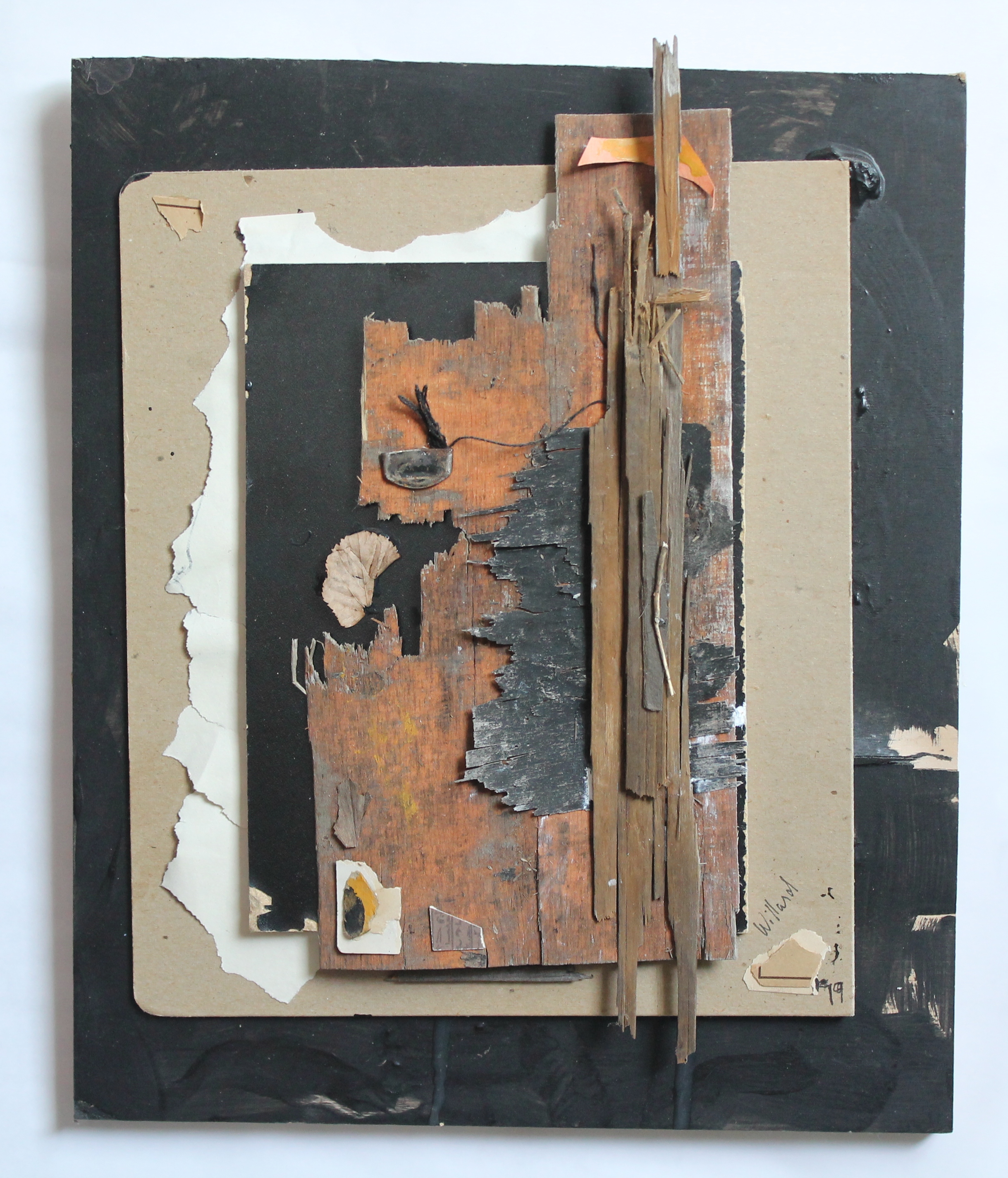
R.I.P Barking Dog
Do I bury her
her faithful head always
at my finger tips
so many 1’s and 0’s–
or keep her stuffed &
mounted–
tie poems to her tail
her eyes reflecting the titles
of the books she loved
her last bark
echoing in the libraries of forgotten blogs
I think what I’ll do for the time being, is use the old blog for an archive: recycle what seems worth another look, delete the dated and ephemeral posts, transfer photos of my art here, a few at a time.

