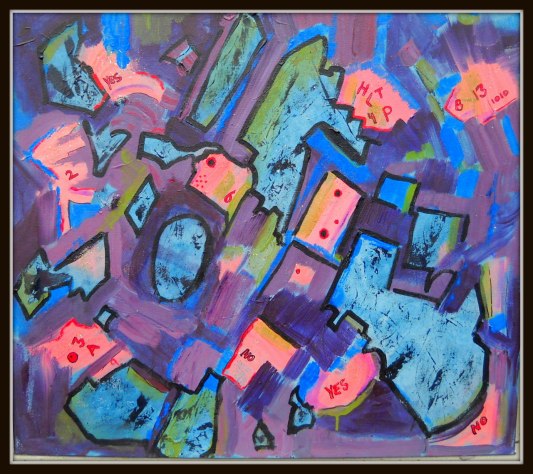
#464

Pretty stuff I post (art), gets some likes–some of it, a lot. The work I’m most happy with… not so much. Fuck that. It’s not a popularity poll. Maybe the eyes I see the world through are better than yours!
#46424.5×24.5″

View GALLERY HERE.

Acrylic on broken plywood

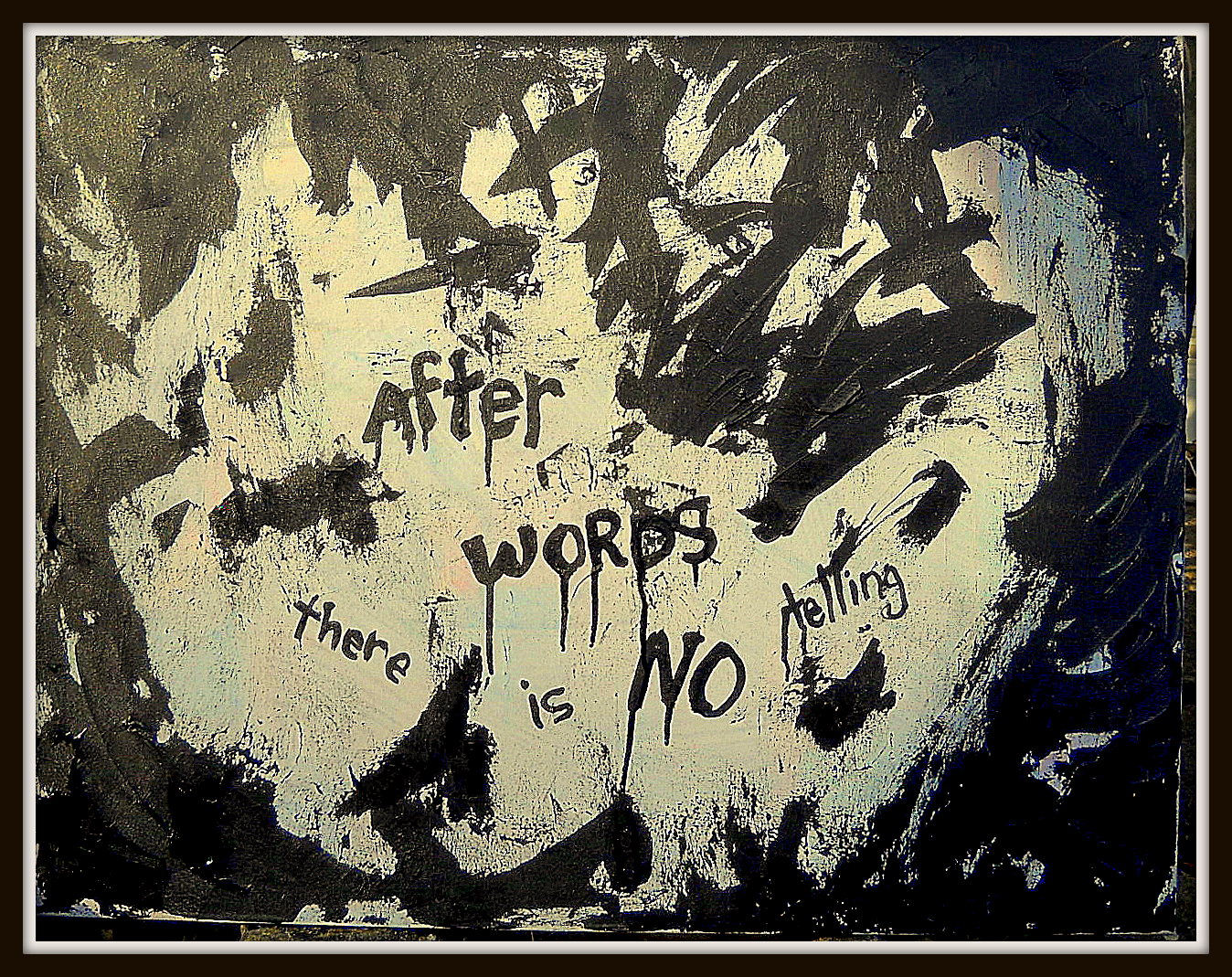
After Words… #461

This was one of those paintings where each attempt to solve a problem makes it worse. After working at for 5 days, I gave up and covered it with gesso. You can see hints of color showing through from the painting underneath. Dissatisfied with paintings that are stuffed to the edge and into the corners, I took a pallet knife and laid on black paint around all four sides– … then this happened.
#461 After Words
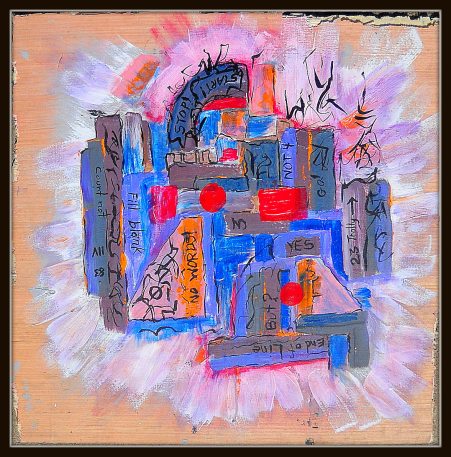
One of those pieces that seem to push me forward. I cut my losses and moved on. I’ve been adding numbers, letters, and sometimes words in my work. I’ve done this at times from the beginning, but it’s been more evident recently. Others don’t seem to take to these, but they matter to me. They draw me on… on what? I don’t know. A canvas, a wall, a scrap of paper… if I should find out, I’m not telling.
View GALLERY HERE.

… There is no Telling.
32×25″ Acrylic on canvas.

Felix Guattari: The Schizo, the New Earth, and Subjectivation

” True madness is staying with the sanity of our world, holding onto the insane violence of capitalism which is destroying the very foundations of life on our planet. True sanity is in rejection of this world, of exiting its mad ways, of marshalling the energetic creativity to enter a new earth, a new realm of freedom beyond the madness. Yet, to do this is to push past the boundary lines of our current thinking, to enter into a new relation with ourselves and the environment around us.”

S.C. Hickman's avatarThe Dark Forest: Literature, Philosophy, and Digital Arts

From now on, no domain of opinion, thought, image, affect or narrativity can pretend to escape from the invasive grip of ‘computer-assisted’ data banks…
………– Felix Guattari, Schizoanalytic Cartographies

“How should we talk today about the production of subjectivity?” asked Felix Guattari. Then he’d recognize the obvious: “A first observation leads us to recognize that the contents of subjectivity depend more and more on a multitude of machinic systems”.1 Ahead of his time, or just looking around and seeing what was already obvious, and yet bringing to the fore the hidden kernel of that ubiquitous world we now term the network society we’ve become.

I remember reading and rereading a particularly poignant section of Anti-Oedipus: Capitalism and Schizophrenia – that collaborative project of Deleuze and Guattari, two friends whose lives would be entwined. As  Francois Dosse relates it in his biography of the two friends Intersecting Lives, Deleuze and Guattari have described…

View original post 1,560 more words

Monstrous Existence: Icon of Creativity and Destruction

S.C. Hickman's avatarThe Dark Forest: Literature, Philosophy, and Digital Arts

.‘Oh Mother’  – Kali-Ma, Queen of Life and Death: dance upon my ashen bones, dine upon my entrails, feed upon my darkest soul!
…..– Hymn to Night & Time

Smash the mirror: it’s a lie what you tell yourself, the world is invisible and waiting. Let the darkness seep in and envelop you. The world of light you see around you is but the flotsam and jetsam, a drift of rainbow plumage on a sea of energy that seeks its daemonic day in the Sun.

Enter your melancholia as if it were your lover’s body; and like a lover savor its dark passions, then like a Mantis slay it, be done with it, and eat it alive till there is nothing of melancholy left but only the power of your dread life.

Think on Black Kali-ma, an image of the fierce life of creative destruction that is this universe…
View original post 243 more words

Subtraction Theory: The Future of Capitalism

S.C. Hickman's avatarThe Dark Forest: Literature, Philosophy, and Digital Arts

Over on The Real Movementblog Jehu has a timely post that carefully evaluates the so-called post-capitalist notion as erroneous. He begins with the worn and obvious quote by Zizek ironizing the notion that “it’s much easier to imagine the end of all life on earth than a much more modest radical change in capitalism.” As Jehu says, “I have been reading a lot of writers who are trying to prove Zizek wrong by imagining a society that might be loosely categorized as post-capitalism — a term I personally detest.” Read his post: here.

Marx in the Grundrisse sees the future of capitalism as the End of History, or as he termed it the monopoly capitalist was ultimately seeking the elimination of space and time in a global system of absolute control:

“In as much as the circuits which capital travels in order to go from one of [its] forms into the other…

View original post 4,382 more words