22x30cm Selfie, pen & ink, white gel pen, watercolor over photo, printed on Borden & Riley #234 108lb paper for pens. Trying something new.


View portfolio here ART BY WILLARD
For photos on this blog:CLICK HERE, and scroll down.
Author: wjacobr
Visual artist, poet, novelist, activist & Street Medic, living in North. Penn Name: Jacob Russell
My blog is a confluence of art, writing, politics.
my Art portfolio: Art-by-Willard.com
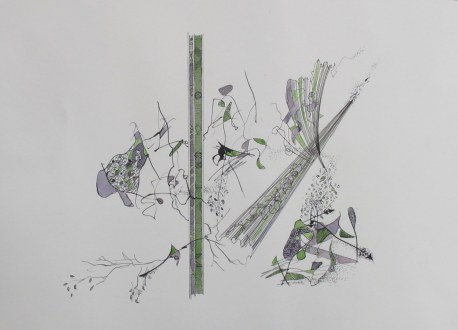
#682
28x38cm Pen & ink, watercolor 140lb Fabriano hot press paper
View portfolio here ART BY WILLARD
For photos on this blog:CLICK HERE, and scroll down.
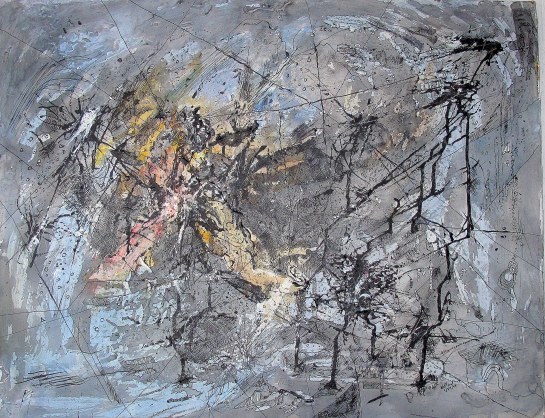
#669 (New Image)
56 x 71cm. Canvas, textured from paint-over of older painting. Gesso ground. Ink and watercolor wash: brush, pen. The texture defeated what I’d intended to do with the pen and ink–so I went with the flow. Still want to try a larger piece pen & ink. Different surface. This much improved image, from my Canon G10 (Thank you, George Kuetemeyer!)
View portfolio here ART BY WILLARD
For photos on this blog:CLICK HERE, and scroll down.
Reading and Repetition

 A central claim of Deleuze’sDifference and Repetition is that we only ever create something new through repetition. Here, then, we might encounter a fundamental difference between Badiou and Deleuze (or is it a proximity between the two?). For Badiou the new is created as a result of a truth-procedure that is evoked through fidelity to an event. Wedon’t, in fact, have toawait events as people sometimes suggest of Badiou; for there are plenty of events that have already occurred throughout history. It is not the event that produces newness in Badiou’s universe, but rather fidelity to that event and the transformation of a situation or world in terms of what is uncounted by the encyclopedia of that situation. One can continue to pay fidelity to the Paris Commune or May of 68 (if the latter was an event) today, unfolding its consequences in the present.
In…
View original post 1,561 more words
#681 4-24-17
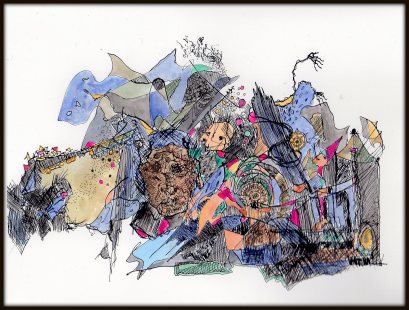
28x19cm Pen & ink, watercolor on 140lb hot press Fabriano paper
View portfolio here ART BY WILLARD
For photos on this blog:CLICK HERE, and scroll down.
Two Dreams about making art

Dreams last night. I was walking with another artist in Paris (I’ve never been out of the U.S.A., let alone Paris)–but it was quite vivid, the architecture with its sculptural adornments. I was explaining to my companion, or he was explaining to me (it wasn’t clear) how when you lived in a place where you passed and saw the work of artists going back over time to the middle ages and older–that for a working artist, it would all be contemporary–all working it’s influence, all there to draw on–and it’s very diversity meant that it would be impossible to be merely derivative, or for your own work to be other than wholly new.
This seemed to fold into examining a book of illustrations, like urban street sketches of row houses. There was a small, vague figure in the lower left corner, that I realized when I saw it (as though this were being explained to me), that stood for the person who had committed suicide in each of those houses, or been murdered there… the explanations seemed to increase in the violence revealed, page by page.
These felt like they were the same dream. The same dream message.
#680
30.5 x 22.9 cm. Pen & ink, watercolor on Bristol paper. I chose the Bristol because I wanted the smooth surface for pen work. Had intended only a minimal touch of color, but Merlin Magic Cat knocked my elbow while I was holding the brush… most of the color was added after to compensate from the unintended blurb. I think I need to use Arches or Fabriano hot press water color paper for this kind of work.

View portfolio here ART BY WILLARD
For photos on this blog:CLICK HERE, and scroll down.
#679
86.3 x 91.4cm Acrylic on canvas, with pen & ink and sparkles

View portfolio here ART BY WILLARD
For photos on this blog:CLICK HERE, and scroll down.
Goby’s Journal: Harihara
We learn from Freud, as from novelists and poets, if we learn anything at all, that we can never “know ourselves.” We fool ourselves in too many ways, and what we are, our Truth, is never fixed, but always moving, always becoming, becoming something else. How much more the difficulty, when the object of our knowledge is at a great distance.
Or is it the other way around? –the closer to the center (should I say, the heart of our being?) –the less we understand, the less we can claim to know?
Closest to one we love, our knowledge approaches a zero point–though knowledge (always imperfect though it is) circles all the while like stars in a galaxy around the black hole of love, of self–around that center–with ts power to draw toward its eventual horizon–all that we believe we know: self & beloved, & love itself– & yet, remain untouched by mind–untouched, above all, by language, even while, in ways beyond our power to know–there from that dark, unfathomable pool, emanates the forces that shape language, all that we know, think–or think we know.
Is that how philosophy came to be captured in a word for love? And how, all the arts, all that has power to bring us to the end of knowing–are of the annihilating & generative power of love?
Love, the word we give to that manifold desire that can’t be named, or tamed–destroyer and creator of good & evil, end & beginning of all that we make & do, fusion of Vishnu and Shiva… Harihara.
Abstract Harmony
It takes time to see a painting. I like that an abstract, or non-representational work (they’re ALL ‘abstract,’ when you get down to it)… gives little or nothing back at a glance. You can’t walk by and say to yourself, ‘nice waterfall.’ It refuses to be reduced to one of the ready made identity tags people hold in store to stick on the art–an act of dismissal, really.
It takes time to actually SEE any work of art. And more than one viewing.
Painting for me, is a retreat from words. I can appreciate works that are are rich with literary allusions, or symbolic puzzles (Van Eyck;s Arnolfini Wedding — an endless maze of riddles!) — but they are for another time, another age.
Living, as I do, in this Empire of Money and Death–language is too deeply corrupted. Even much of the language of abstractions… but there, at least, I can offer my refusal to words. What that refusal means.. is for the viewer to figure out.
 Jacob Russell's Magic Names