Signs of the times…(police will be called)


View portfolio here ART BY WILLARD
For photos on this blog:CLICK HERE, and scroll down.
Author: wjacobr
Visual artist, poet, novelist, activist & Street Medic, living in North. Penn Name: Jacob Russell
My blog is a confluence of art, writing, politics.
my Art portfolio: Art-by-Willard.com
Teach the Youth
Signs of the times...

View portfolio here ART BY WILLARD
For photos on this blog:CLICK HERE, and scroll down.
My calling card… what’s in a name?
A sort of a prose poem.
Names… I had never gone by my birth name, but then I decided to sign my art with it. At first, it was to honor the grandfather I was named after–who I never knew (He died two weeks before I was born) And my uncle, also an artist, and a kind of mentor for me. But I’ve gotten acclimated to it. Accepted it for what I do. Which has become what names mean for me, and how I use them.

Jacob Russell (Russell, being my middle name), was how I sign my poetry and fiction, and has been my go-to name for most of the last four decades. More recently–there’s, Goby. A fish that can change it’s sex. I don’t change my sex, but accepted in my late years, that I am in no way limited in my desires to the opposite gender/sex–though this is something that works out mostly on the level of imagination. A Radical Faerie name–a fantasy name for fantasy sex. And, planting beans. Planting beans, today…climbing beans… wondering if I might, when they reach the clouds, climb to the top and visit the kindly giant who lives there (his bad reputation? what you would expect from English colonizers and would be capitalists!)… so… a gardener’s name. A Magic name… when “Jacob” sounds way too serious.
A name should never be a prison. But a seed. Germinating new names, new identities. Always becoming, always under repair… and never, ever… fixed.
Fuck Trump

Oracular Vision
I’ve been reading John Berger’s Understanding a Photograph. He writes in the essay, Appearances: that …
In every act of looking there is an expectation of meaning. This expectation should be distinguished from a desire for an explanation. The one who looks may explain afterward: but, prior to any explanation, there is the expectation of what appearances themselves may be about to reveal.
Revelations do not come easily. Appearances are so complex that only the search which is inherent in the act of looking can draw a reading out of the underlying coherence If, for the sake of a temporary clarification, one artificially separates appearances from vision (and we have seen that in fact this is impossible), one might say that in appearances everything that can be read is already there but undifferentiated. It is the search, with its choices which differentiates. And the seen, the revealed, is the child of both appearances and the search.
Another way of making this relation clearer would be to say that appearances in themselves are oracular. Like oracles they go beyond, they insinuate further than the discrete phenomena they present, and yet their insinuations are rarely sufficient to make any more comprehensive reading indisputable. The precise meaning of an oracular statement depends upon the quest or need of the one who listens to it. Everyone listens to an oracle alone, even when in company.
“Everyone listens to an oracle alone, even when in company” When I read that, I asked myself, “isn’t this precisely how one sees… a painting?
My calling… my vocation, as a poet and artist, began at a moment like that—an oracular vision–11 or 12 years old. Forsythia blossoms after rain, when the sun came out from clouds and turned the drops of water on the petals into prisms. Everything I’ve done since, has in some way, been connected to the effort to understand that moment.
“The modality of the visible” … the expectation of meaning in what is seen – is this what I look for as I work on an abstract piece – the expectation of meaning, but one disconnected from any narrative or ideological sense–a meaning that hovers above explanation, and untouched by it?
My novel, Ari Figue’s Cat… https://www.amazon.com/Ari-Figues-Cat-Jacob-Russell/dp/1940830060 the motive for writing it; this is its central theme.
What I look for as I work—as I arrange pieces of trash, draw lines on a page, brush color on a canvas. Why I prefer abstract work. Representative art, when it seizes me, is always like this. Rousseau’s Sleeping Gypsy. 
The enigma. The expectation of meaning—that defies explanation. Iconography, represented figures… are a distraction. Though a master can so charge the most meticulously rendered images with that oracular sense, that all our efforts to explain are exhausted… and we are left with what we see, and that alone. Jan Van Eyke’s Arnolfi wedding portrait.
I work on a piece until I have that sense… in looking at it, in seeing it: the feeling that it means something. I have no idea what, or how to explain it. It’s enough, if I capture that feeling, an enigma. Beyond words.
We long for a vision … a way out of this fucking capitalist hell.
We don’t know what it is… but if, in seeing this, we can believe that it exists…beyond words, beyond explanation.. but there for us to find and create… I will have done my part.
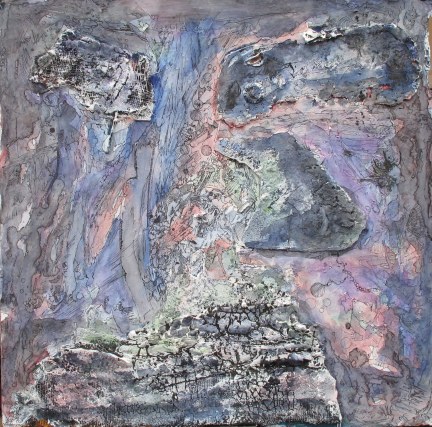
#685
63.5 x 61cm Mixed media: Pen & ink, watercolor, roofing paper on Masonite
View portfolio here ART BY WILLARD
For photos on this blog:CLICK HERE, and scroll down.
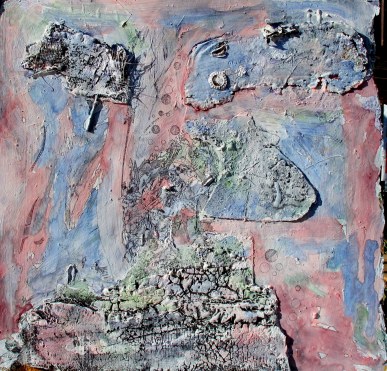
#685 work in progress
Pen & ink, watercolor, on Masonite with roofing paper and trash
63.5x61cm detail. Full image below

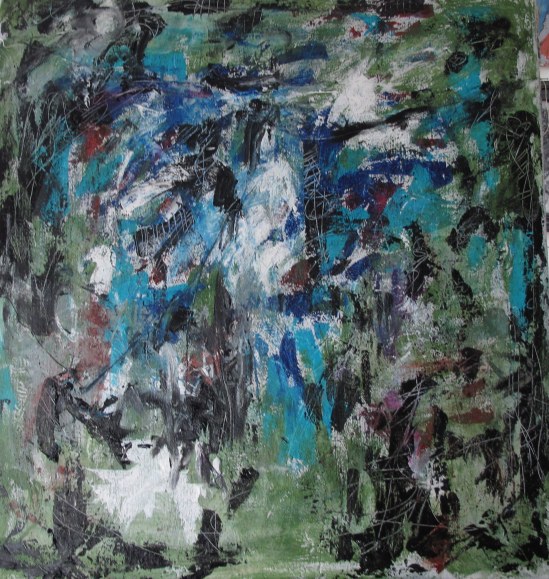
#684
91.4 x 86.3cm Acrylic and strings on canvas. I see an ‘M” center bottom. Thinking, I should paint a BIG M. at an angle, left center. A big black letter M. Yes! I think I’ll do that! See below!


View portfolio here ART BY WILLARD
For photos on this blog:CLICK HERE, and scroll down.
Work in progress (684)
91.4×86 cm. Acrylic.This is the FORTH try on this canvas. I think this is going to work. . The last paint-over was #680. which was making me gag. After so many small, pen & inks, I needed to loosen up.
Artists, Class, Revolution
Walking thoughts… ideas come to mind, walking here and there and back: to the el, the wine store, to the Fresh Grocer. Sometimes they kick off something that comes back to me. A couple days ago, I was thinking about artists—not ART, artists. About making a living (or at least, paying for art materials), in a capitalist system, when one is a confirmed, convicted, solidarity-convinced anti-capitalist. And it occurred to me, that one could look at the problems through the lens of class—that the structures and machinery of class reproduce themselves on particular strata, and this seemed particularly helpful to me in understanding what artists deal with.
The connecting point in these thoughts, was meritocracy—how, because class is not like castes, frozen across generations for all time, but somewhat permeable, it’s easy to ignore how class, in itself, is as unchanging as an South Asian caste system. That individuals are able to climb the ladder, does nothing to overthrow the range of beliefs that justify class inequalities for those who benefit from them, or to offer serious challenge to the ideologies that use those beliefs.
What beliefs? The ‘natural’ superiority of men… (white men), is way up there at the top: patriarchy and Euro-Anglo-American racism–used to excuse, what otherwise would make what capitalism, colonialism, slavery, have done, and continue to do, to the mass humanity, intolerable. What does that have to do with, meritocracy? With art? With the capitalist class system?
Everything.
Capitalism creates, maintains, and perpetuates inequality. All the way back to the Adam Smith, this has been acknowledged, and because it so flies in the face of the most minimally developed sense of justice, is addressed in all the ideological variants that would defend and promote capitalism. For Adam Smith—it was the Invisible Hand, which, (grossly misused since) would correct the worst abuses, and prevent capitalism from becoming what it has, in face, become. But nothing has been more useful, or done greater violence, the social Darwinism and eugenics. Here was the perfect foil, the perfect answer, to justify belief in the inferiority of the masses, and if an individual here and there, rose up and proved themselves superior to their birth—the genetic mythology perfectly accounted for it, and supported those who would protect the superior races and individuals, while justifying their suppression, and attempts to control, or better, if they proved less than useful and docile–eradicate the untermenchen.
How perfectly the Art World recapitulates this! With its gallery to investor pipeline, a gatekeeper system, meant to identify the Elite, and (hopefully) erase from memory, if not from life itself all the outsiders! Women! Blacks! Colonials! A Patriarchal system (where are the women from how many generations past?) Where are non-Euro artists and their work, but as appropriated by the (even if late-acknowledged) Masters? There is such thing, as ART, let alone, an “Art WORLD!” … if it is not as varied and multiple as there are worlds and peoples! If it doesn’t crash through and DESTROY the gatekeepers and their system!
Those were my walking thoughts… how, I asked myself. .how is it possible, for anyone who calls THEMSELVES an artist—to accept this system? To define their idea of ‘success’ by it’s terms? To not throw themselves into the struggle to create—to IMAGINE… as artists do.. a new and better world?
 Jacob Russell's Magic Names