86.3 x 91.4cm Acrylic on canvas, with pen & ink and sparkles


View portfolio here ART BY WILLARD
For photos on this blog:CLICK HERE, and scroll down.
Month: April 2017
Goby’s Journal: Harihara
We learn from Freud, as from novelists and poets, if we learn anything at all, that we can never “know ourselves.” We fool ourselves in too many ways, and what we are, our Truth, is never fixed, but always moving, always becoming, becoming something else. How much more the difficulty, when the object of our knowledge is at a great distance.
Or is it the other way around? –the closer to the center (should I say, the heart of our being?) –the less we understand, the less we can claim to know?
Closest to one we love, our knowledge approaches a zero point–though knowledge (always imperfect though it is) circles all the while like stars in a galaxy around the black hole of love, of self–around that center–with ts power to draw toward its eventual horizon–all that we believe we know: self & beloved, & love itself– & yet, remain untouched by mind–untouched, above all, by language, even while, in ways beyond our power to know–there from that dark, unfathomable pool, emanates the forces that shape language, all that we know, think–or think we know.
Is that how philosophy came to be captured in a word for love? And how, all the arts, all that has power to bring us to the end of knowing–are of the annihilating & generative power of love?
Love, the word we give to that manifold desire that can’t be named, or tamed–destroyer and creator of good & evil, end & beginning of all that we make & do, fusion of Vishnu and Shiva… Harihara.
Abstract Harmony
It takes time to see a painting. I like that an abstract, or non-representational work (they’re ALL ‘abstract,’ when you get down to it)… gives little or nothing back at a glance. You can’t walk by and say to yourself, ‘nice waterfall.’ It refuses to be reduced to one of the ready made identity tags people hold in store to stick on the art–an act of dismissal, really.
It takes time to actually SEE any work of art. And more than one viewing.
Painting for me, is a retreat from words. I can appreciate works that are are rich with literary allusions, or symbolic puzzles (Van Eyck;s Arnolfini Wedding — an endless maze of riddles!) — but they are for another time, another age.
Living, as I do, in this Empire of Money and Death–language is too deeply corrupted. Even much of the language of abstractions… but there, at least, I can offer my refusal to words. What that refusal means.. is for the viewer to figure out.
#678
19.5 x 25cm Pen & Ink, Watercolor

View portfolio here ART BY WILLARD
For photos on this blog:CLICK HERE, and scroll down.
Juried submissions…
I submitted to Vox Populi’s annual juried show. The last juried show I submitted to–was some 50 years ago. I had a piece accepted. And it sold.
I had hoped I could link my web portfolio for my submission, but no luck there.
These are the 5 pieces I submitted (5 was the limit).
Submissions | Willard Johnson
art-by-willard.com
The Matrix, Schizophrenia and the Fascist War Machine

Letter from Carl Gustav Jung to Echidna Stillwell, dated 27th February 1929 [Extract] …your attachment to a Lemurian cultural-strain disturbs me intensely. From my own point of view – based on the three most difficult cases I have encountered and their attendant abysmally archaic symbolism – it is no exaggeration to state that Lemuria condenses […]
via Hyperstition: Metafiction and the Landian Cosmos — southern nights
#677
13 x 40.6cm Pen & ink, watercolor, on wood with gesso ground.

View portfolio here ART BY WILLARD
For photos on this blog:CLICK HERE, and scroll down.
#676
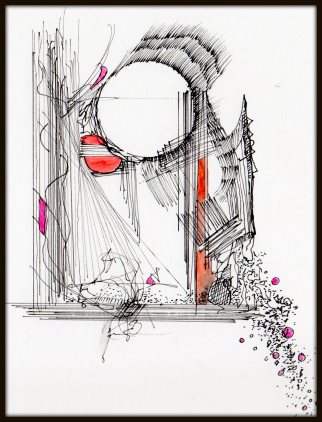
23 x 20xm Ink & watercolor. I want to call these recent pieces, ‘Prophesies,’ but of what, I have no idea.
View portfolio here ART BY WILLARD
For photos on this blog:CLICK HERE, and scroll down.
Abstract Horror: The Domestication of the Human Species

Real abstraction is the transcendental conception of Spinozistic substance.
—Nick Land, Fanged Noumena: Collected Writings 1987 – 2007
Certain figures, nodal points of obstruction, resistance, power arise repeatedly within Nick Land’s essays: Spinoza, Kant, Schopenhauer, Nietzsche, Rimbaud, Bataille, Trakl, Deleuze, etc. Each a defining aspect of a genealogical history of the immanence and collapse, annihilation and suicidal tendencies within Western Civilization. Each of these men are not so much full blown personalities to be represented, but rather bombs to be exploded within our domesticated sociality. From Plato to Derrida philosophy contributed to the domestication of humanity through the slow embellishment and formulation of an abstraction: Reason.
One could point to the early agricultural civilizations of the Middle East as the pre-formative realms within which this process of domestication took root. In these early civilizations the mapping of the stars and the earth became the ultimate foregrounding of the human mind, and thereby the…
View original post 2,118 more words
Zapatistas Reimagine Science as Tool of Resistance

by Sophie Duncan
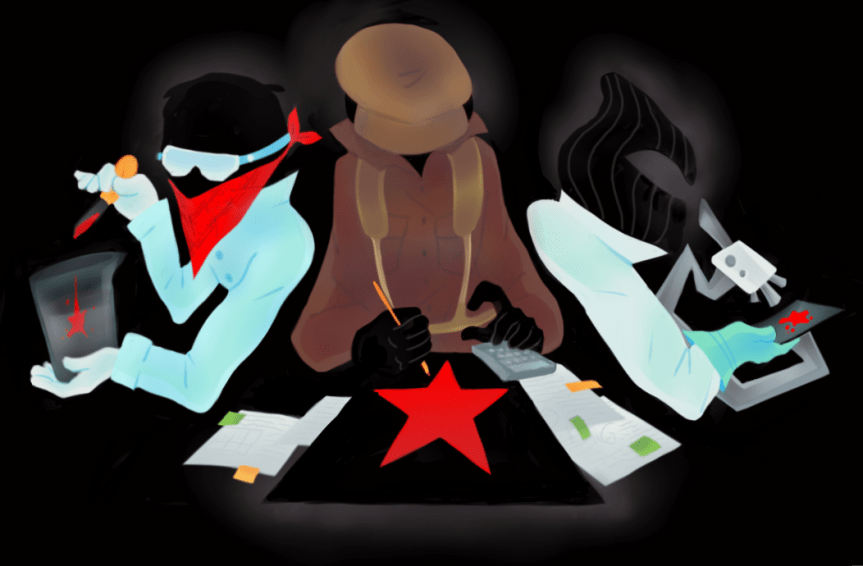
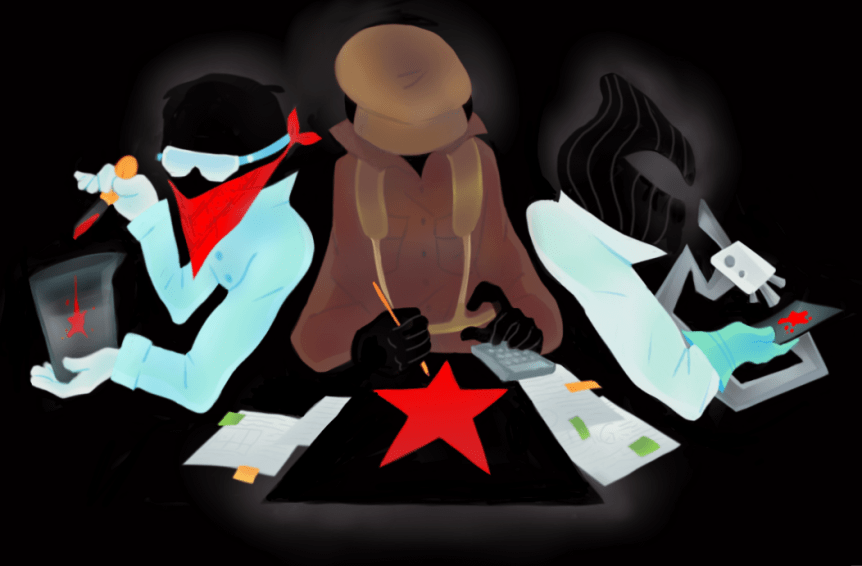 A digital illustration imagining Zapatista scientists: the first one holds a dropper and beaker, the second on a calculator, and the third is looking under the microscope. All three evoke the imagery of the Zapatista flag with a red star and a black background. Artwork by Keshy Jeong.
“Is it possible to create a science that is truly human?”
April 5, 2017
As scientists grapple with what it means to march for science and defend an apolitical and ahistorical vision of science “safe” from identity, the Zapatistas have put forth the possibilities of a symbiotic relationship between science and social justice. Between December 26 and January 4th, the Ejército Zapatista de Liberación Nacional (EZLN or the Zapatistas) facilitated an interdisciplinary conference in San Cristóbal de Las Casas, México: “L@s Zapatistas y las ConCiencias por la Humanidad”. [1] As part of an armed indigenous resistance…
View original post 827 more words
 Jacob Russell's Magic Names