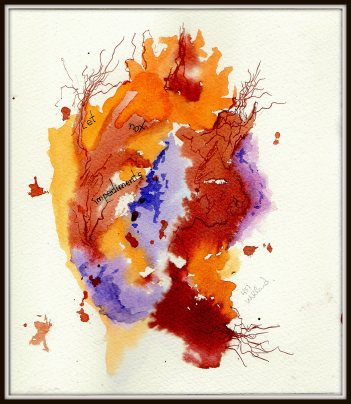
7×6″ watercolor, water soluble ink.
7×6″ watercolor, water soluble ink.
In an earlier post (HERE), I mentioned that I’ve been been wondering what it would mean to think in terms of structure, where one would normally use the word ‘composition,’ in lieu of composition, in the place it has occupied in art criticism.
Of Merriam-Webster’s definition:
1
: the action of building : construction
2
a : something (as a building) that is constructed
b : something arranged in a definite pattern of organization (a rigid totalitarian structure — J. L. Hess> (leaves and other plant structures)
3
: manner of construction : makeup (Gothic in structure)
4
a : the arrangement of particles or parts in a substance or body (soil structure) (molecular structure)
b : organization of parts as dominated by the general character of the whole (economic structure) (personality structure)
c : coherent form or organization (tried to give some structure to the children’s lives)
5
: the aggregate of elements of an entity in their relationships to each other (the structure of a language)
… placing particular emphasis on 1, 4 b and 5 (italics mine), and drawing a link between PROCESS and PERSONALITY STRUCTURE (thinking of this, perhaps, in psychoanalytic terms)
Carrying this a bit further, a passage by Lacan in Ecrits, Appendix II: Metaphor of the Subject, suggests to me, yet another reason for this.
“This means that the most serious reality, and even the sole serious reality for man, if one considers its role in sustaining the metonymy of his desire, can only be retained in metaphor.
What am I trying to get at, if not to convince you that what the unconscious brings back to our attention is the law by which enunciation can never be reduced to what is enunciated in any discourse?”
… how, in thinking about a painting. this allows one to give full regard to its materiality, and at the same time, opens critical analysis to metaphor… without reducing the painting to that which it might be perceived as signifying (“representing”), visual metaphor that resists subsummation to the semiotic, as is the discourse that dominates so much of art history–which, again, Hubert Damisch’s A Theory of /Cloud/ so brilliantly avoids.
What then of painting that does away with signification, is it then without metaphor Or is the denial of semiotic signification (this is that), a kind of master-metaphor, reminding us of the futility of deciphering (from written cipher to visual?) metaphors, which shape-shift away from whatever form (or formula) we try to fix them to?
 x
x

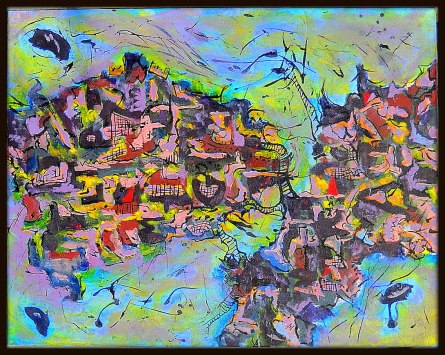
32×25″ Acrylic on canvas. This began as an image I saw in a dream–or in the hypnagogic state just before sleep. That mass on the right–like floating against a blue field. I began with blue underpainting over the whole canvas, then roughly brushed in the contours of that mass. From there, is was the usual back and forth, responding to what I saw on the canvas, not trying to reproduce the dream image. I only wish I’d left the edges and corners as bare canvas, like a torn section of a map.
View GALLERY HERE.
This speaks to my anarchist heart. Yes and yes and yes–oh, and so much more! (see my comment following this post, for how this connects with my art!
Agamben at one point choses to explicate this notion in reference to the included/excluded people within and outside politics:
It is as if what we call “people” were in reality not a unitary subject but a dialectical oscillation between two opposite poles: on the one hand, the set of the People as a whole political body, and on the other, the subset of the people as a fragmentary multiplicity of needy and excluded bodies; or again, on the one hand, an inclusion that claims to be total, and on the other, an exclusion that is clearly hopeless; at one extreme, the total state of integrated and sovereign citizens, and at the other, the preserve-court of miracles or camp-of the wretched, the oppressed, and the defeated.6Isn’t this the state of exception of migrant immigrants everywhere, a multiplicity outside the law, outside sovereignty, the inclusive excluded of the wretched, the oppressed, and the defeated?
And THIS:
“And in a different yet analogous way, today’s democratico-capitalist project of eliminating the poor classes through development not only reproduces within itself the people that is excluded but also transforms the entire population of the Third World into bare life. Only a politics that will have learned to take the fundamental biopolitical fracture of the West into account will be able to stop this oscillation and to put an end to the civil war that divides the peoples and the cities of the earth.7”
And THIS is why NONE of the candidates, of either party, will move us one footstep beyond square zero!…is why not one of the U.S. presidential candidates, of any party, will move us one single step past ground zero!

…the sovereign is the point of indistinction between violence and law, the threshold on which violence passes over into law and law passes over into violence.
– Giorgio Agamben, Homo Sacer
When one actually thinks about it, rather than just spouting rhetoric from some ideological mythology of the Left or Right the problem of immigration in our world is about Sovereignty. It’s about the emerging war against boundaries, limits, and finitude in politics, science, philosophy, the arts, and gender. In politics it’s about immigration, migration, and the sense of breakdown of nations and their paranoiac reactionism against imaginary and perceived threats to their own integrity and sovereignty. Same in the sciences we see explorations emerging in biotechnology, nanotechnology, and information and communications converging to form a global network society that will break free of political and social constraints and provide a larger framework and platform for such politically motivated notions as transhumanism that…
View original post 2,052 more words
 Jacob Russell has written a very nice response to my post on Margaret’s Pepper Principle, translating this principle into the domain of aesthetics. The money quote comes at the end:
From my earlier POST (a chapter in my novel-in-progress, Ari Figue’s Cat, I wrote (with some alterations)
Until the first word is written everything is possible. … We may, of course, erase as we write, circling back to a new starting point–speaking to ourselves, as it were, but that all comes to an end the moment the page is read, and in truth, even the freedom of erasure and revision is an illusion. Every word added to the next forecloses an infinite array of possibilities.
If you set out to tell a story you quickly find that you cannot go just anywhere. The more you write the more the words take charge, reducing the writer to a mere instrument…
View original post 1,425 more words
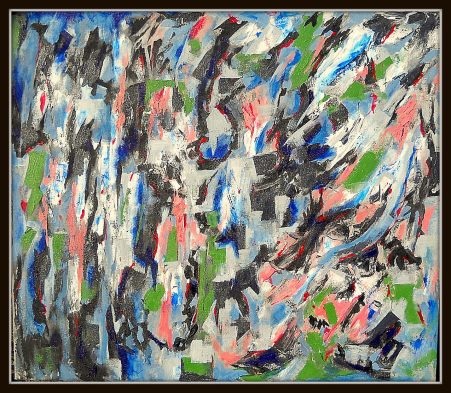
28×32″ Acrylic on canvas. Finished. The WIP I had on here last night, see below for comparison. I think it has a lot more solid structure now. The additional grays change the chromatic balance rather dramatically.

This comes as a feeling that pressed to become a thought, or a thought that sought to become an image. I sketched a face in soluble ink. Efaced with watercolor. Still there. Subsummed

I seldom do figurative art. Not in my finished pieces. I draw the human figure… obsessively, from bones to flesh and back to bones–images of the human. But that isn’t what they are–the drawings. It isn’t there, the human, and in my finished work, what is human remains, not quite invisible, most often as little more than an unintended suggestion. Broken into fragments. Or traces and debris of our passing.
That isn’t a plan. I’m not rendering some idea I have… I don’t know what it is, other than it emerges from some primal conflict, deeply, inexorably personal. It permeates my art–how I work, how I think about it. I know that it has to do with how or why I spend so much of my private, internal conversation explaining, justifying–as though I stand before some perpetual tribunal–that has demanded, without asking (I just know)–that I’m called to account for what I make, for the very need I have to make art, in these conversations where I go endlessly back to the beginning. Do I even have a right to call it… art? To permit myself…?
How this is connected with using the human figure, I don’t know, but I know that it is. Had I all the years of a younger man ahead of me, I don’t think that a lifetime of analysis would be sufficient to uncover what lies buried, something powerful enough to have kept me away from the one thing I’ve always wanted to do–for almost 40 years.
But it’s more than personal… or should I say, more than my private demons. As though this most private struggle has reformed itself into the one subject central to everything I make. How I can feel human figures in the most abstract pieces that come from my hand. Has become their struggle. Something pressing to emerge, pressing toward freedom. Or is it the subsummation of the human back into that state from whence we came? My not distant death linking itself to the coming extinction of our species?
10×6″ Water soluble brown ink, watercolor: thalo blue and alizaran crimson


 Jacob Russell's Magic Names