Month: January 2016
#417 Blue dominant: A language more primal than words.

View GALLERY HERE.
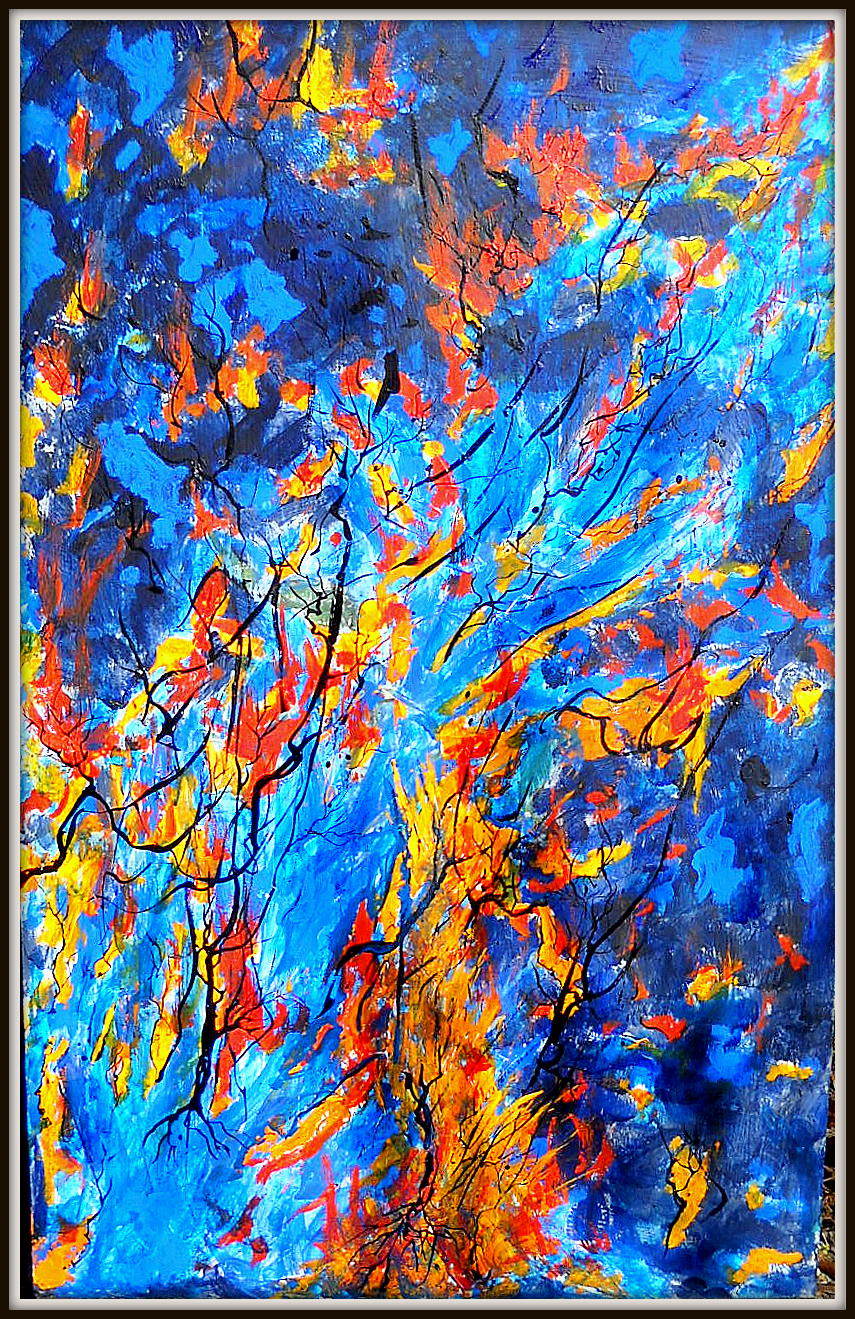
24×18″ Acrylic on scrap pressboard. Why… with blue dominant, didn’t I choose a horizontal and pacific design? I don’t know…. and yet….
… I look at this again, as something in a dream, or an image–not even an image, but movement. Remember when you were a child, watching runoff along the curb after a rain? Imaging yourself watching a great river from space, a deluge slicing through continents. Is it that these patterns are there in our unconscious, so when we think we are working with abstract, non-figurative visual ideas, we are mapping those patterns, and the degree of satisfaction we feel as we work derives from how close we have come to those unconscious patterns? Before we had words for what we saw, images–moving, always moving–crossed our fields of vision, without names, without the burden of language–or rather, with a language more primal than words?
How can it ever be irrelevant–to map what is hidden–to what actually drives our actions? We give so much credit to consciousness–to conscious will, when it’s no more that a pipping bird on the back of a Rhinoceros.
Planning color study series. Each a Fugue in 4 voices
What I have in mind: each piece with 4 hue scheme in 4 variations
Let A be point One on color wheel, B it’s compliment, C-D split compliments
1. A = Dominant, B,C,D subordinates
2. B,C,D Dominant, A subordinates
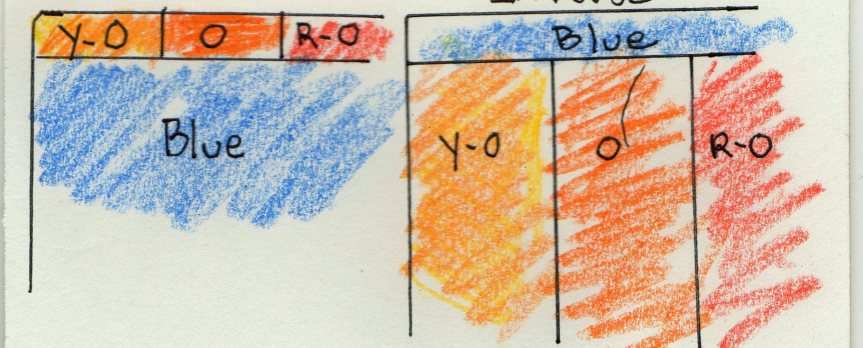
Each of these with its inverse for each chroma. Theme and variation.
For 1, if A= Blue B, C and D would be Orange, Yellow orange and Red orange respectively,
with A Dominant and B C D subordinates
Inverse would be Orange=Dominant, with Blue, Blue-violet and Blue-green as subordinates.
Tone and chroma would vary as I might see fit.
Repairs in progress
Due to some initial confusion on how Windows 10 handles photos, I accidentally deleted all the photos on Magic Names, more than 500 of them–some 300 or more photos of my art. I’ve begun to restore them, but it’s a slow, tedious process. As of January 12, I have everything I’d posted since September, 2015, and will add more each day as I have time. For now… here’s what’s up: — https://jacobrussellsmagicnames.com/category/my-art/
David Bowie… reflections on our human failings
Have been following the emotional outpouring on the death of David Bowie–from those who mourn his loss, and of those who call out, with equal passion–call attention to his sexual abuse–and not always different people.
I was 28 when he came out with his first album. The year my oldest son was born, Thirty-one when he emerged into the iconic image he was to occupy for the rest of his life. The only song I could name of his… I guess would be Changes.
There would be no one I could name–certainly no figure in the popular spotlight, who had the life changing impact for me that I’ve been reading on FB. More a solitary journey, that coming into my own life. Books. Camus’ Resistance Rebellion & Death. Leaves of Grass. Blake. There were artists that had that kind of force–Kathe Kollwitz, Daumier. There were no friends, no one my age, I shared this with.
Music? Nothing will ever change me more than that half hour sitting on the front steps of my parents’ house, 12 or 13… listening to… and hearing, really hearing… a recording of Bach. I think it was the Musical Offering. Nothing could be more different than the collective release and joy people have been describing–their first Bowie concert. I envy that… to have had an experience that connects–that brought people out of their felt estrangement, when all such analogous moments for me, have been to fortify my own spiritual isolation.
Also has me thinking of how difficult it is to emerge from the culturally accepted miasma of confused notions about what’s ok… and what’s not… into something like a clear understanding that there is no way to ‘get it’… to get what is right or wrong, good or bad–but through observing and listening to the effects of what you do, what others do, what the conditions of culture does– to others–on other lives. Real lives. Lives, not your own. It doesn’t come by ideology, isn’t learned by rules… “rules” are the biggest problem.
It’s a kind of learning that comes by fits and starts. There’s no sudden perfect enlightenment. Where all at once you see… that no matter how your friends, the supporting cast of your young life, sees sexual conquest as a good thing, as something to be admired–that you come to see what that has done to a life that is not your own, for whom that cacophonous drum of collective expectation, is a kind of death–if not a real, physical death. That what we do, without thought, has other names, deserves other names: abuse, rape, murder… spiritual, if not physical.
By fits and starts we learn to free ourselves. As abusers, would-be abusers or actual, and by fits and starts–as the victims of power and privilege. By fits and starts.
I hope, for the sake of those who loved this man, who found in his art a gateway wide open to wider awareness and freedom–for their sake, if not for his memory–a memory I don’t share… that through fits and starts, he learned. He learned to know what he had done–felt the shame and remorse of having hurt, having damaged another life… and moved past it. If he did… I hope… for all of us… who learn by fits and starts, out of lives where none have been free–of what we have done, of what has been done to us… learn to forgive. Not to erase the reality–but to embrace that freedom–that we can live a life of healing, beyond hurt, and hurting. What else is freedom for? What other meaning can freedom possibly have?
#416
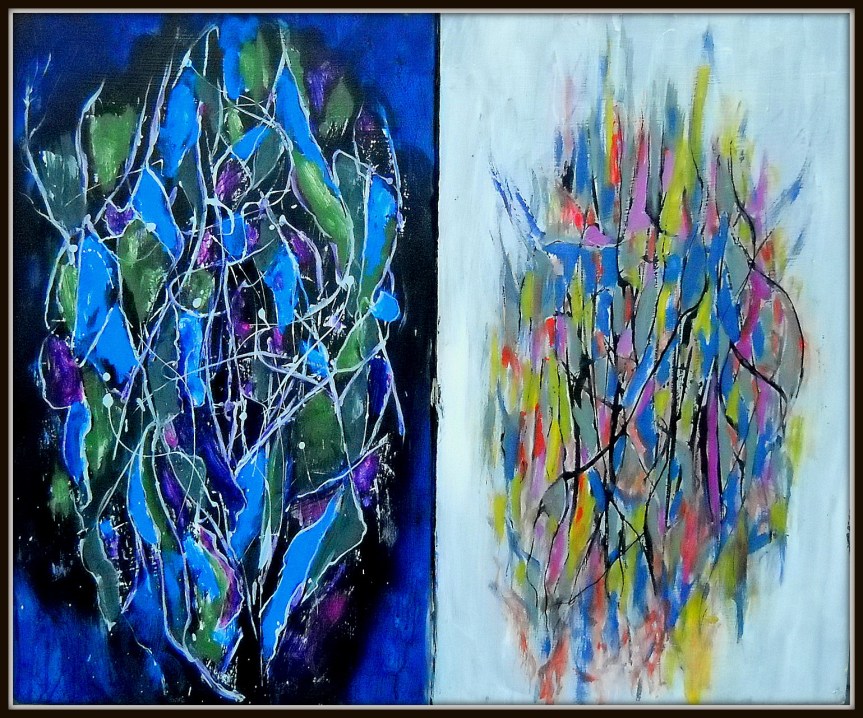
24×30″ Acrylic on press board. Color study. Left panel, inverse color and tone of right panel
View GALLERY HERE.
Harman on Latour’s Politics
This article made me think, how the material reality of the house where I live (I’m remembering the Ox, the communal warehouse where I lived) shapes our lives in ways that are beyond what we intend or choose. The material reality we make or choose, makes us. This made me think of our kitchen. My increasing dissatisfaction with how we use it. Our shared and progressively less shared and more individually fragmented kitchen–how the physical kitchen, by it’s small size, its limited storage, shapes this fragmentation into a less and less communal space. In the Ox, a dozen people could work, sit around and schmooze, clean up and cook, all in the same room. The huge work table and ample space not only made this possible, but it invited it, and the space of the Ox itself–a space with its many rooms and open areas, good for music and hanging out, needed to be filled–and that in turn, required a degree of cooperative action for cleaning and care–which when resisted, made us (FORCED us!) to be aware (to different degrees) of our mutual dependence (and how unready we were for this, having come from the dominant culture) in ways that living in an apartment, didn’t. Living in a house divided like this–like most middle and working class housing– people can comfortably settle into their habitual, individuated lives; can see in this how a shared house, arranged for isolated non-extended ‘family’ units–needs a high degree awareness–and experience with more communal living–to resist being re-formed into something closer to the cultural norm–the divided and alienated consciousness suitable for capitalist exploitation.

My way to Speculative Realism was through Harman’s was through Harman’s Prince of Networks: Bruno Latour and Metaphysics. It’s difficult, after all these years, to convey the sense of excitement I felt when reading this book. I had felt it before, my first year of graduate school when reading Zizek’s Sublime Object of Ideology (I actually dreamed about that book). There I felt as if an entire opaque world of theory opened up to me that both allowed me to understand the thought of figures such as Lacan but, more importantly, that allowed me to put that theory to work and comprehend the world around me. Harman, of course, is a consummate stylist. There is a certain charm and style to his writing that is difficult to put your finger on. Often it occurs in the margins, when the reader comes across offhand asides that he makes such as…
View original post 1,379 more words
#277
View GALLERY HERE.
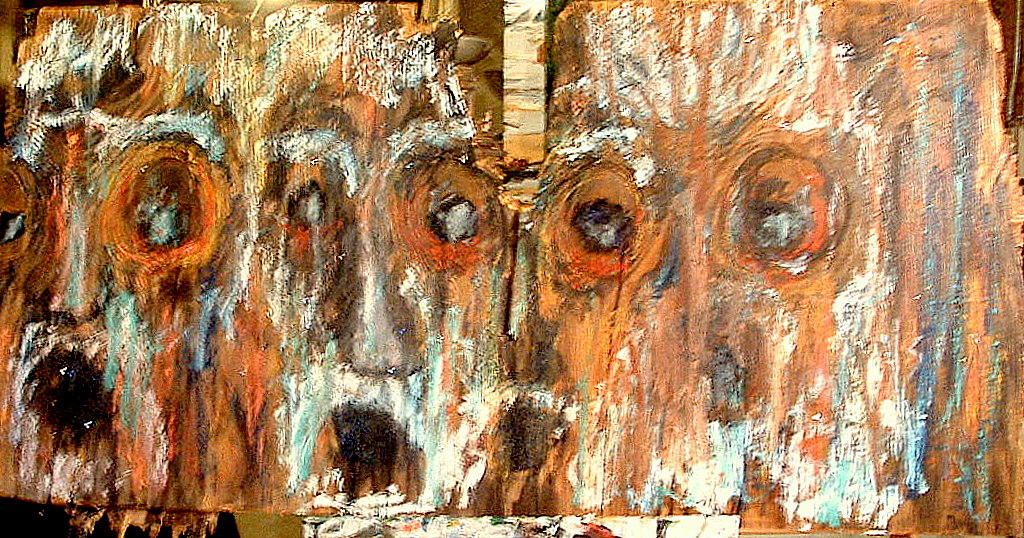
Three Who Saw Truth. Oil stick, acrylic, dirt & sparkles on weathered plywood.
This was my first post on this blog, January 23, 2015. Windows 10 changed how it handled pictures–which led to some confusion, and my deleting almost 400 images added since that first post. With much cursing and hair pulling, I’ve begun to restore the images.
I found this piece of plywood put out for trash. I liked the textures, the large knot-rings suggested eyes. I worked it over with oil sticks and these three–or are there four? — faces emerged. Two of them seenm to share one of the eyes. Not the kind of ‘beautiful’ piece most people want to have in their home, but I think this would look awesome on a well lit wall.
#414 color study
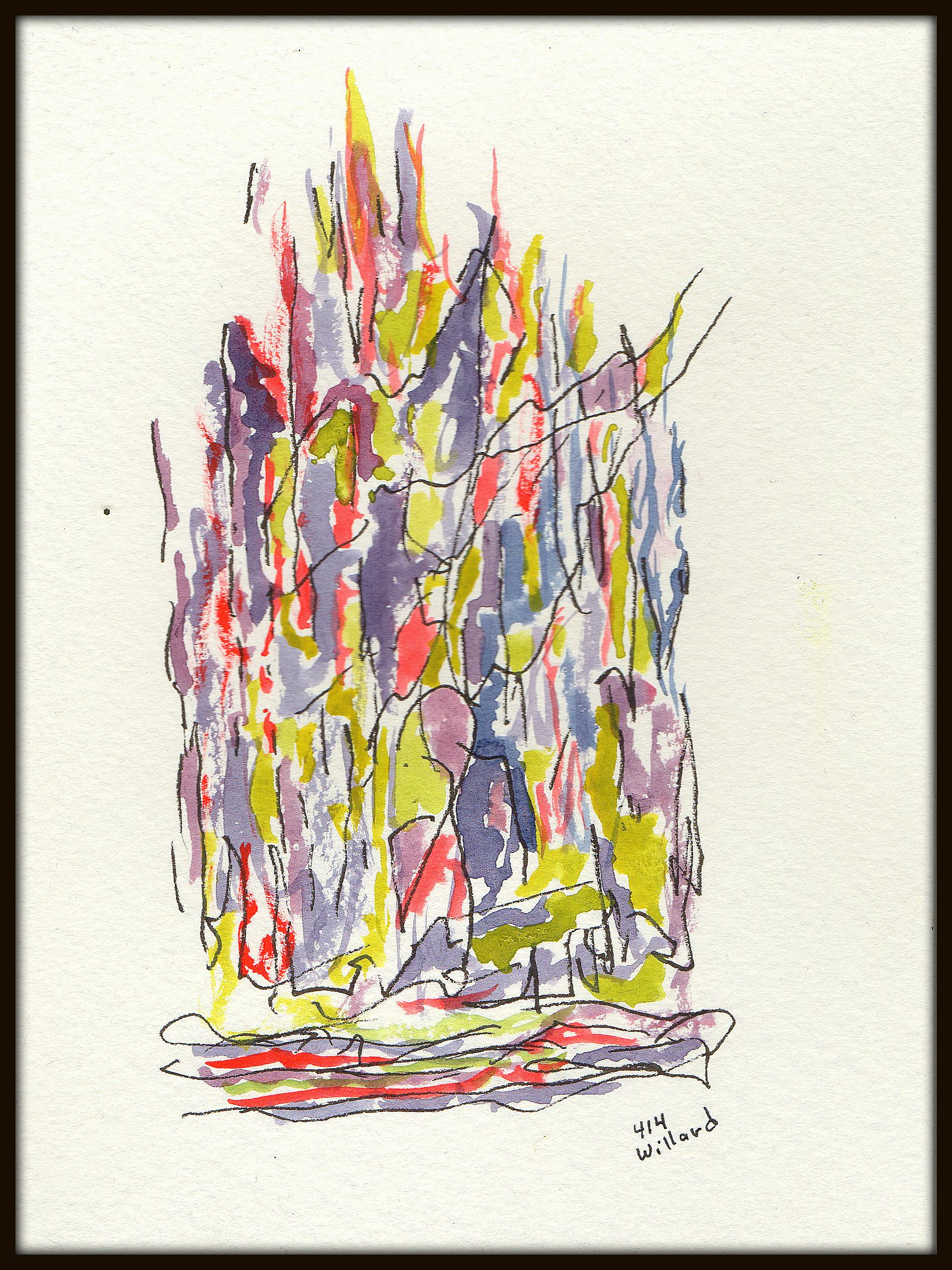
#414 watercolor, ink
View GALLERY HERE.
#413

33×41″ (including frame) Acrylic on press board–painted over a flea market reproduction. What I do when I don’t have the $100-150 for 2 or 3 yards of canvas and stretchers–find paintings and reproductions in flea markets or thrift stores to paint over. Anything that the paint will stick to and not peel off. And if wood, and I can glue and nail things on, all the better.
Here, using compliments and split compliments (violet, red-violet and blue-violet) to intensify the yellow. Color as light and color as pigments play with our perception: compliments in balance are dissonant, giving your eyes no rest–like flashing Xmas lights (red & green); mixed as pigments, they make grays or browns–but they can also bring out maximum intensity, jarring, disturbing when equal surface areas are covered, but with one color dominant, and the addition of split compliments, all the colors leap out as though back lit and glowing. Fun to use crayons to explore these combinations–even if you don’t paint. Try it!
View GALLERY HERE.
 Jacob Russell's Magic Names