The Authoritarian State’s Duel Legal system

This is as important as anything you are likely to read on our slide into Fascism.

Pia Crawford-Silva

oorpednSts376113f08gu16m4i1l2u4lh36fhiiua5fui331clf4h5au623c  ·

5/3/25 The New York Times subscriber newsletter, “The Interpreter.” I found it a super valuable read.

The frightening precedents for Trump’s ‘legal abyss’

“Oopsie … Too late,” President Nayib Bukele of El Salvador wrote on X with a cry-laughing emoji on March 16. Below it was a screenshot of a headline: “Fed judge orders deportation flights carrying alleged gangbangers to return to US, blocks Trump from invoking Alien Enemies Act.”

Despite the court order, federal officials had neither prevented the takeoff of the deportation flight that was still on the ground at the time of the court’s order, nor turned around the two other planes that were already in the air. After news broke that the men were now in El Salvador, imprisoned in the notorious complex known by its Spanish acronym CECOT, Bukele’s mocking tweet made clear that he considered the deportees beyond the reach of U.S. courts.

The Trump administration has taken a similar position, albeit with fewer emojis. “Federal courts generally have no jurisdiction over the president’s conduct of foreign affairs, his authorities under the Alien Enemies Act, and his core Article II powers to remove foreign alien terrorists from U.S. soil and repel a declared invasion,” Karoline Leavitt, the White House press secretary, said in a statement on March 17.

Since then, the administration has grown even more defiant. This week, when asked about the case of Kilmar Abrego Garcia, a Salvadoran immigrant and Maryland father of three who was deported from Maryland to CECOT as a result of “administrative error,” Trump told a reporter that he has the power to free Abrego Garcia but won’t do so — despite a Supreme Court order to “facilitate” his release.

Those claims, along with the Trump administration’s broadly resistant attitude to court orders, its arrests of foreign students for their political activism and its wide-ranging campaign of retribution and intimidation against law firms and universities, have raised alarms that the country is hurtling into a new era of lawlessness.

But there’s a more precise way to understand the Trump administration’s approach to the law, and its potential dangers: the concept of the “dual state.”

First developed by a German lawyer named Ernst Fraenkel in the 1930s, the dual-state theory posits that authoritarianism can take hold in small pockets, even while the broader legal system appears to function more or less normally. In his 1941 book “The Dual State,” Fraenkel, who was Jewish, argued that within Nazi Germany there were in effect two interlinked systems: one in which most laws and many rights still applied; and alongside it a zone of authoritarianism, in which government power was unbounded.

“You can have a world in which there’s the ordinary law that most people benefit from,” said Aziz Huq, a law professor at the University of Chicago who recently wrote about the dual-state theory for The Atlantic. “But running alongside that is this kind of legal abyss in which people fall, and never get out of.”

Ad

Ad

Fraenkel called the first system the “normative state” and the latter the “prerogative state.” But it is perhaps clearer to think of them as the “zone of legality” and the “legal abyss.”

Fraenkel’s crucial observation was that in a dual state, authoritarianism arrives much sooner for some people than others. Those unlucky enough to fall into the legal abyss would find themselves subjected to uncontrolled state violence, while life continued largely as normal for others.

Today, scholars say, the Trump administration appears to be claiming the right to create its own legal abyss. Courts have not yet acceded, and it remains unclear whether the administration will succeed in acquiring such powers. But some of the most vulnerable targets have already been swallowed up. And if left unchecked, the legal abyss can grow ever wider.

A parallel system

In 1930s Germany, the Nazis had been granted near-unlimited power by the Reichstag Fire Decree of 1933, which suspended civil liberties and allowed Hitler to overrule state and local government decrees. The government wasted little time in setting up a system in which the state could do anything from seizing a person’s assets to trying them before a special court and then sending them to a concentration camp to be tortured or killed.

And yet the Nazis still maintained the ordinary legal system to handle cases that were not seen as political — many contract cases, employment disputes, and criminal prosecutions, for example — and did not involve individuals seen as enemies of the regime, such as Jews or dissidents.

Fraenkel, one of the few Jewish lawyers allowed to practice law under Nazi rule until he fled the country in 1938, concluded that his paramount task as an attorney was to act as a kind of railway “switchman,” doing whatever he could to prevent his clients from getting shunted off the tracks of the normative system and into the legal abyss.

But dual states were hardly unique to Nazism. Scholars have used Fraenkel’s theory to explain the dynamics of fully and partly authoritarian governments around the world. In the early years of apartheid rule in South Africa, for example, rule-guided courts existed alongside a violent parallel system in which Black activists could be detained for years without trial. In Chile during the dictatorship of Gen. Augusto Pinochet, the junta detained, tortured and disappeared its perceived enemies, even as the country’s courts still enjoyed formal independence.

In Singapore, the rule of law applies within the economic and commercial sphere, while political dissent is suppressed. And in China, the legal system has supported the country’s economic boom by generally enforcing rules around contracts and investment, even as the country’s leaders have expanded a legal abyss that has swallowed up political dissidents, ethnic minorities like Uighurs, and others.

Dual states can also arise in countries that are eroding from democracy into authoritarianism. In those cases, leaders often selectively preserve some aspects of the preexisting legal system, but take steps to ensure that it cannot interfere with their oppression of political enemies, Zhiyu Li, a law professor at Durham University in England, writes in a forthcoming law review article. Frequently, this is done by packing high courts with loyalist judges and creating special tribunals with little or no due process for certain cases or people.

One of the most prominent recent examples of that phenomenon occurred in the place to which the Trump administration is deporting migrants: El Salvador.

In 2020, Bukele’s party removed all of the members of the Constitutional Chamber of the country’s Supreme Court, replacing them with handpicked loyalists. Then in 2022, following an outburst of gang violence of the kind he’d campaigned to curtail, he declared a state of emergency, suspended civil liberties, and ordered mass arrests of those believed to be gang members.

Ordinary courts still exist and have jurisdiction over disputes and criminal cases that fall outside Bukele’s criminal crackdown. That has helped to bolster the president’s message, at home and abroad, that his exceptional powers are a means of allowing ordinary life — and the economy — to flourish within a safer El Salvador.

But his anti-gang efforts created a complete legal abyss. In remote hearings, often conducted anonymously by so-called “faceless judges,” as many as 500 people at a time are charged with crimes as vague as “illicit gathering,” with no opportunity to offer a defense or even know the evidence against them. Accused gang members or those accused of collaborating with gangs in any way can also be held indefinitely under “pretrial detention” measures. Those imprisoned are often so thoroughly cut off from the outside world that their families and attorneys have no way of knowing whether they are still alive.

‘I’m all for it’

Of course, the United States today looks very different from El Salvador. The federal judiciary has not been purged of independent judges. There is no sweeping state-of-emergency decree. But the Trump administration still appears to be claiming a zone of power in which civil liberties do not apply, and over which courts have no authority.

Experts say the recent Supreme Court case Trump v. J.G.G. et al, with its decision that challenged the administration’s use of the Alien Enemies Act to deport Venezuelan migrants to El Salvador, captures both the Trump administration’s attempt to create a legal abyss and the federal courts’ refusal, thus far, to allow it that unchecked power.

The unanimous Supreme Court decision in that case, as well as its most recent emergency order barring deportations to El Salvador in a related matter, have made clear that judicial review still applies to deportation cases, even if they are conducted under the Alien Enemies Act. “For me, that is an example of the ‘normative state’ in action,” said Jens Meierhenrich, a law professor at the London School of Economics who is one of today’s leading scholars of the dual-state theory.

However, relying on the Alien Enemies Act is a way for the Trump administration to claim the “prerogative state” power to rule wantonly on certain matters, Meierhenrich said. The administration has claimed that the act, together with the president’s constitutional power to conduct foreign affairs, creates a zone in which individuals have no access to due process and courts have essentially no jurisdiction.

And while dual states create the impression that the ordinary legal system is reliably separate from the zone of authoritarianism, in practice, the lines between them are often porous.

Trump has said that he is eager to find ways to send U.S. citizens to CECOT. “You think there’s a special category of person? They’re as bad as anybody that comes in,” he said in response to a reporter who asked if he was open to deporting U.S. citizens to El Salvador. “I’m all for it.” His administration was “studying the law” for a way to do so, he said. And Ms. Leavitt, the White House press secretary, has said that Trump wanted to deport U.S. citizens who were “heinous, violent criminals” to El Salvador “if there’s a legal pathway to doing that.”

While there is no evidence of U.S. citizens being sent to CECOT so far, the administration’s uses of aggressive immigration powers have already affected U.S. citizens and legal residents.

Consider, for example, the case of Rumeysa Ozturk, a Tufts University Ph.D. student whose arrest last month made headlines after security-camera footage of masked plainclothes agents surrounding her on the street and handcuffing her was released online.

Ms. Ozturk was in the United States legally, on a valid student visa. But the Trump administration stated that it had detained her under a rarely used provision of the Immigration and Nationality Act that allows the secretary of state to initiate deportation proceedings against any noncitizen if he deems that person a threat to U.S. foreign policy. Ms. Ozturk appears to have been deemed a threat based on a student newspaper opinion piece that she coauthored. It called on university leaders to fulfill resolutions passed by the student government concerning the Gaza war — political expression ordinarily protected by the First Amendment.

The consequences of that policy are most severe, of course, for the immigrants who are detained or deported as a result of their political expression. But the First Amendment also protects the right to receive information and ideas. A policy designed specifically to chill speech about the Gaza war also threatens the rights of the broader American public to hear and engage with those ideas.

The case of Abrego Garcia, the Maryland man whom the Trump administration mistakenly deported to CECOT and now refuses to bring back, offers a glimpse of how Americans might also be caught up in a legal abyss ostensibly limited to noncitizens. (Abrego Garcia is said to have been moved to a different prison after a U.S. senator traveled to El Salvador to demand his release.)

Abrego Garcia, who came to the United States from El Salvador, is not a U.S. citizen. But there are numerous cases of U.S. citizens being mistakenly swept up in immigration raids, detained, and sometimes even removed from the country. As long as they have access to the normal legal system, they have a chance to present evidence of their legal status and win their freedom. But Abrego Garcia had no such opportunity. Nor, it appears, did the three U.S. citizen children whom the administration sent to Honduras last week along with their mothers. One of the children, a 4-year-old boy, is currently in treatment for stage 4 cancer.

Immigration cases are the most obvious example of the Trump administration’s claim to “prerogative” powers, but Huq said he sees worrying echoes of it in other actions as well, including in the campaigns of retribution against law firms and universities seen as hostile to the president’s agenda.

Warning and hope from history

Past episodes in American history suggest that the United States — despite its democratic traditions — is vulnerable to the creation of zones of authoritarianism. But history also shows that the zone of legality can fight back.

When the country was founded, the liberal legal order applied to European settlers, while Native Americans and enslaved people were subjected to a more authoritarian, violent system. During the Jim Crow era, Southern states operated as single-party authoritarian regimes, permitting or even encouraging extralegal violence like lynching, while participating in democracy at the federal level.

During the so-called war on terror, the Bush administration claimed sweeping powers to detain suspected terrorists. While those powers were mostly applied to foreign citizens captured on the battlefield and imprisoned abroad, the government did claim the power to detain some individuals within the United States as “enemy combatants,” including Jose Padilla, a U.S. citizen, and Ali Saleh Kahlah al-Marri, a legal U.S. resident.

Huq, who was one of al-Marri’s attorneys, said that those cases can be seen as a precursor to the Trump administration’s nascent dual state. “You have a moment when somebody decides you are not in the normal legal system, you are in this system in which you are essentially at our whim,” he said. And while the government, after years of pressure, largely abandoned those policies, many were never definitively ruled illegal. “If not a gaping hole, I still see a fragile seam in the law,” Huq said.

But, Meierhenrich noted, in those periods the zone of legality eventually won out over the legal abyss, even though elements of duality remained. “The U.S. has come back from — I don’t want to be dramatic, but — from the brink previously,” he said.

“This is why the dual state also provides a certain amount of hope,” he said. “If we believe there is this duality, it’s interesting to also ponder to what extent the normative state still permits acts of resistance within the law. The small victories are not insignificant
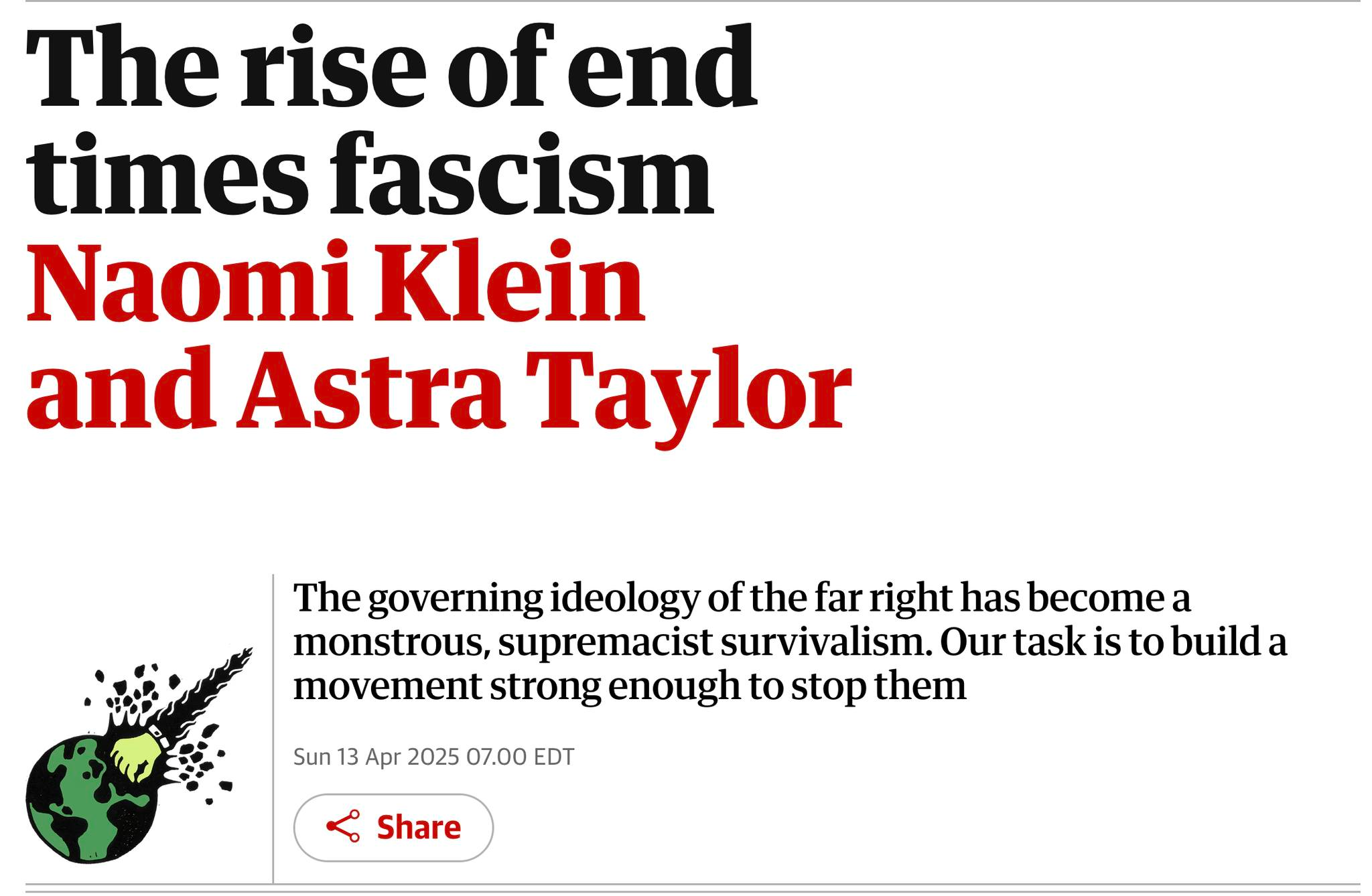
Resisting End time Fascism.

If we are to meet our critical moment in history, we need to reckon with the reality that we are not up against adversaries we have seen before. We are up against end times fascism.

Reflecting on his childhood under Mussolini, the novelist and philosopher Umberto Eco observed in a celebrated essay that fascism typically has an “Armageddon complex” – a fixation on vanquishing enemies in a grand final battle. But European fascism of the 1930s and 1940s also had a horizon: a vision for a future golden age after the bloodbath that, for its in-group, would be peaceful, pastoral and purified. Not today.

Alive to our era of genuine existential danger – from climate breakdown to nuclear war to sky-rocketing inequality and unregulated AI – but financially and ideologically committed to deepening those threats, contemporary far-right movements lack any credible vision for a hopeful future. The average voter is offered only remixes of a bygone past, alongside the sadistic pleasures of dominance over an ever-expanding assemblage of dehumanized others.

And so we have the Trump administration’s dedication to releasing its steady stream of real and AI-generated propaganda designed solely for these pornographic purposes. Footage of shackled immigrants being loaded on to deportation flights, set to the sounds of clanking chains and locking cuffs, which the official White House X account labeled “ASMR”, a reference to audio designed to calm the nervous system. Or the same account sharing news of the detention of Mahmoud Khalil, a US permanent resident who was active in Columbia University’s pro-Palestinian encampment, with the gloating words: “SHALOM, MAHMOUD.” Or any number of homeland security secretary Kristi Noem’s sadism-chic photo ops (atop a horse at the US-Mexican border, in front of a crowded prison cell in El Salvador, slinging a machine gun while arresting immigrants in Arizona …).

The governing ideology of the far right in our age of escalating disasters has become a monstrous, supremacist survivalism.

It is terrifying in its wickedness, yes. But it also opens up powerful possibilities for resistance. To bet against the future on this scale – to bank on your bunker – is to betray, on the most basic level, our duties to one another, to the children we love, and to every other life form with whom we share a planetary home. This is a belief system that is genocidal at its core and treasonous to the wonder and beauty of this world. We are convinced that the more people understand the extent to which the right has succumbed to the Armageddon complex, the more they will be willing to fight back, realizing that absolutely everything is now on the line.

Our opponents know full well that we are entering an age of emergency, but have responded by embracing lethal yet self-serving delusions. Having bought into various apartheid fantasies of bunkered safety, they are choosing to let the Earth burn. Our task is to build a wide and deep movement, as spiritual as it is political, strong enough to stop these unhinged traitors. A movement rooted in a steadfast commitment to one another, across our many differences and divides, and to this miraculous, singular planet.

CECOT share awareness

From Suzy Subways on Facebook
No sunlight, no outdoor time, no beds or cots, no letters or phone calls, no books, no outside medical care, no charges or trial, no hope for release. Beatings and torture as the rule. Sleeping on concrete next to the dead. Does it really matter which of these people are innocent? Does anyone belong here?

Zann Zsuzsannika is with Antonia Eden Dana.

posteodSrn100595l9771hm53mag1uh902ctlgiic5g082h0838u9ih93c2m  ·

Okay, let’s get into Centro de Confinamiento del Terrorismo (CECOT), the prison in El Salvador where the Trump admin is sending men that they believe are “in gangs”, with no due process.

I’d like to start by saying, we found out yesterday that of the 238 men that Trump has sent to CECOT, 179 of the men have NO criminal record, here or abroad. Please let that register before you continue reading. No. Criminal. Record. Whatsoever. 75% have clearer backgrounds than a lot of the people you know. The names of possibly innocent men are towards the bottom of this post.

I’m going to try to break this down in easy to understand sections. Please forgive me if I’m repetitive.

About CECOT

+ Designed and completed in 2023 in response to overcrowding in other El Salvador prisons.

+ Built to house up to 40,000 inmates.

+ For the “worst of the worst” gang members.

+ Its aim is to be a PERMANENT solution, no rehabilitation, no return to society. The justice minister bluntly stated that prisoners at CECOT will “never return to their communities.”

+ 8 pavilions with 256 cells.

+ Cells house 80 – 100 men, sometimes more. 100 square meters in size.

+ 19 guard towers, multiple layers of fencing, 24/7 surveillance.

+ CECOT officials refuse to disclose actual population.

DAILY REGIMEN

+ Total lockdown. Prisoners are confined shoulder to shoulder in their cells 23.5 hours a day.

+ No outdoor time whatsoever.

+ Fluorescent lights remain on 24 hours a day. They have no sense of time and no sleep cycle.

+ They receive 30 minutes a day of tightly controlled corridor exercise.

+ No jobs, no classes, no books, no programs of any kind. Nothing.

+ CCTV watches prisoners 24 hours a day like “silent Gods.”

COMMUNICATION AND ISOLATION

+ No visits from family or lawyers.

+ No letters or phone calls.

+ All cell signal is blocked for a 1.5 mile radius.

+ Mass virtual trials via video link with up to 900 prisoners at a time.

+ Most inmates have never been formally charged or sentenced.

DISCIPLINE AND PSYCHOLOGICAL CONTROL

+ Prisoners arrive barefoot and shackled with their heads bowed.

+ Forced to kneel in tight rows with their heads shaved upon arrival.

+ If they are to be punished, they are put into an even smaller cell that is completely dark.

+ Swift violence for perceived “disobedience” or breaking of any rule.

+ No sunlight, ever. No clocks. No time markers.

+ Inmates experience “profound psychological deterioration.”

+ Juveniles, around the age of 16, are in cells with hardened gang members.

+ Inmates are required to be “alert and obedient” at all times during the day.

+ Most sit idly. They are often required to remain silent. The rest of the time they remain mostly silent out of fear.

+ Some inmates have reportedly lost their voices from prolonged silence and stress.

+ Journalists who have been allowed in reported an atmosphere of “unnatural, tense silence.”

+ The guards are armed and wearing balaclavas to increase fear.

LIVING CONDITIONS

Sleep

+ Each cell is designed for 80 people, but often it far surpasses 100.

+ Inmates sleep on concrete floors without mattresses or on iron bunk tiers where they must lay across the metal slats.

+ Cells are so crammed full they sleep standing up or take turns laying down.

+ No pillows or blankets.

Food

+ Meals are minimal, rice and beans. Sometimes a tortilla. Sometimes an egg.

+ No utensils, prisoners eat with their hands.

+ Water is extremely limited. They share a jug within their cells.

+ Malnutrition is common and has been contributed to multiple deaths.

Hygiene

+ Each cell has 2 toilets and 2 sinks for 80+ men.

+ No privacy, ever. Constant filth and foul smells.

+ Bathing and “laundry” is done by buckets inside the cell.

+ Diseases are rampant. TB, scabies, fungal infections, stomach illnesses.

+ NO outside medical care is allowed, ever.

+ Over 350 inmates have died and most were due to medical conditions or abuse from guards.

+ If someone falls gravely ill, they are treated (if at all) in an on-site infirmary. “No prisoner ever leaves the premises alive” for medical care outside, a CECOT official told journalists, a chilling acknowledgment that even medical transfers are off the table.

ABUSE AND VIOLENCE

+ Much of the abuse is only recorded from President Bukeles former facility, the secrecy and lack of oversight at CECOT makes all reporting difficult. Nobody comes out, and dead bodies are viewed through photos. Human rights inspectors are denied access.

+ Beating by guards are common, especially upon first arrival. One man temporarily detained said he watched guards beat all new arrivals for an hour straight. When he tried to tell the guards he was wrongfully detained, they broke his ribs and threw him in a “dark hole” with 320 other men who also beat him.

+ Reported use of water torture and extended kneeling.

+ “Simulated drowning” has been repeatedly reported.

+ Guards often choose to humiliate. At the former CECOT facility, guards would strip inmates naked, push their faces into ice water until they nearly drowned while calling them “dogs” and “scum.”

+ Solitary confinement is used as punishment.

+ In the 350+ deaths since 2022, there were signs of asphyxiation, fractures and blunt trauma seen in photos.

+ Bodies are buried in mass graves, with no family notification.

+ Rival gangs are mixed together as punishment.

+ Government claims gang hierarchy is broken, reports suggest otherwise.

+ One of the few people ever released from CECOT said they often had to sleep and live next to the corpses of their cell mates until the guards got around to removing them.

+ Another man said they had to kneel for hours and if someone collapsed from exhaustion, they would “drag them out like an animal.” He said many of the men there were “not even gang members.”

LEGAL

+ Held without trial.

+ Virtually NO releases

+ Officials state openly they will never leave.

+ Many are serving decade long sentences without a trial.

+ The United States has sent 238 perceived Venezuelan gang members, 179 with no criminal records in the U.S. or abroad, under a $6,000,000 a year deal.

+ Humans rights refer to it as a “transnational penal colony” and a U.S. judge has referred to it as “wholly lawless.”

+ President Bukele has acknowledged that thousands of men in El Salvador prisons were “actually innocent”. Many of those men were released from those prisons, but prisoners in CECOT go through a one way door.

TESTIMONIES FROM INSIDE

+ CNN and CBS report that inmates sleep on concrete or bare steel.

+ Gang members claim it “breaks them emotionally.”

+ Inmates describe it as a place of “torture and death.”

+ Witnesses report having to sleep next to dead cell mates.

+ Guards claim “brutality is necessary.”

+ Police whistleblowers have admitted innocent men have been detained and abused.

+ One guard stated “they have nothing, so they have nothing to lose.”

HUMAN RIGHTS AND GLOBAL RESPONSE

+ Condemnation from Human Rights Watch, Amnesty International, UN Special Rapporteur on Torture, Inter-American Comission on Human Rights

+ CECOT violates Nelson Mandela Rules (UN Standard of Prisoner Treatment)

+ Cristosal reported 3,300 violations in the first year alone.

+ Human rights organizations refer to it as a “black hole for human rights”.

Some things I’d like to add:

+ Our country has sent innocent men here, we already know that. Some for tattoos that they misunderstood, some from “administrative errors”, some have been swept up simply for being neighbors, family or friends of the “perceived gang members.”

+ These men go into CECOT knowing they will never see or hear from their families again. Imagine being innocent?

+ Is this what you really wanted, MAGA? Do you think Jesus thinks this treatment of his children is ok? Or do you understand human rights exist for a reason? What does your gut tell you? If you know this is wrong, please help us. Please get involved. He didn’t tell you he was going to do this, you didn’t vote for this cruelty. The best time to do the right thing was the election, but the second best time is right now. Use your voice.

——————————————————-

NAMES OF MEN WHO MAY BE WRONGFULLY INCARCERATED AT CECOT

The names of the men we need to push to get back or at minimum, due process:

+ Kilmar Abrego Garcia, a 29-year-old Salvadoran national and Maryland resident, was mistakenly deported to El Salvador’s Centro de Confinamiento del Terrorismo (CECOT) prison in March 2025. Despite a 2019 U.S. immigration judge’s order protecting him from removal due to credible fears of gang persecution, Abrego Garcia was apprehended by Immigration and Customs Enforcement (ICE) on March 12, 2025, during a routine check-in. He was subsequently deported on March 15, with the Trump administration later acknowledging the action as an “administrative error.”

+ Andry José Hernández Romero: A 31-year-old gay Venezuelan makeup artist seeking asylum in the U.S., Hernández Romero was deported based on tattoos interpreted as gang symbols. His attorney clarified that these tattoos were religious and cultural symbols common in his hometown. Despite having no criminal record and a credible asylum claim, he was sent to CECOT, where concerns for his safety have been raised due to his sexual orientation and the prison’s notorious conditions.

+ Jose Franco Caraballo Tiapa: A barber who entered the U.S. seeking asylum, Caraballo was detained after an immigration officer noticed a tattoo of a clock on his arm, symbolizing the time of his daughter’s birth—a common design in Venezuela. Despite lacking a criminal record and having a pending asylum case, he was deported to CECOT under allegations of gang affiliation.

+ Jerce Reyes Barrios: A 35-year-old former professional soccer player from Venezuela, Barrios fled persecution and sought asylum in the U.S. He was detained and deported due to tattoos, including one resembling the Real Madrid logo, which authorities misinterpreted as gang-related. Despite providing evidence of his innocence and lack of criminal history, he was sent to CECOT.

+ E.M.: Identified only by initials for safety, E.M. fled Venezuela with his girlfriend and was granted refugee status in the U.S. He was detained and deported based on tattoos of a crown, soccer ball, and palm tree, common symbols in Venezuelan culture. His family was not informed of his deportation and later discovered his fate through media reports.

+ Francisco Javier García Casique: A 24-year-old Venezuelan hairdresser, García was deported and featured in a Salvadoran government video showcasing shackled prisoners. His family and advocates assert he has no gang affiliations and was wrongfully detained based on superficial indicators like tattoos.

+ Mervin Jose Yamarte Fernandez: a Venezuelan national, was deported despite having no criminal record. He was apprehended during a routine immigration check-in, with authorities citing alleged gang affiliations based on superficial indicators. He is currently detained in CECOT, with ongoing legal efforts seeking his return.

+ Jhon Chacin: a Venezuelan tattoo artist, sought asylum in the U.S. After his asylum application was denied, he agreed to voluntary deportation to Venezuela. However, his flight was rerouted, and he was instead sent to CECOT in El Salvador. Chacin remains imprisoned in CECOT, with his family and legal representatives advocating for his release.

+ Maiker Espinoza Escalona: Espinoza Escalona was detained by U.S. authorities and held at Guantanamo Bay before his deportation. Despite legal challenges and a court order prohibiting such deportations, he was sent to CECOT on March 17, 2025. He is currently incarcerated in CECOT, with limited information available about his well-being.

HOW TO HELP

+ Raise Public Awareness

• Speak out on social media

• Share the stories of men like Andry José Hernández Romero and Jose Caraballo Tiapa, whose cases highlight the injustice and lack of due process.

• Tag journalists, members of Congress, and human rights organizations when sharing posts to increase visibility.

+ Contact Your Representatives

If you’re in the U.S. (or another democratic country), contact your elected officials and ask them to:

•Demand accountability for wrongful deportations, especially of asylum seekers.

• Pressure the State Department to work with El Salvador for the release of innocent detainees.

• Support oversight of the Department of Homeland Security (DHS) and Immigration and Customs Enforcement (ICE).

You can use sample language like:

“I’m calling to express deep concern about the deportation of Venezuelan asylum seekers to El Salvador’s CECOT prison, where many are held without charges under abusive conditions. I urge you to call for their return and an investigation into this violation of due process.”

+ Support Legal and Human Rights Groups

Donate to or volunteer with organizations that are actively working on these issues:

• Human Rights Watch (HRW)

• Amnesty International

• ACLU Immigrants’ Rights Project

• RAICES

• Cristosal (El Salvador-based human rights org)

• International Refugee Assistance Project (IRAP)

These groups can:

• Help mount legal cases.

• Collect testimonies.

• Apply international pressure.

• Assist families of the detained.

+ Engage Media and Petition Platforms

• Start or sign petitions demanding that the U.S. and Salvadoran governments release innocent detainees from CECOT.

• Share firsthand accounts, where available, to humanize the crisis and move it out of the “policy” category and into the public conscience.

+ Pressure International Bodies

• Write to the Inter-American Commission on Human Rights or the United Nations Human Rights Council.

• Demand they investigate abuses in CECOT and intervene diplomatically.

• Urge them to monitor deportations from the U.S. for violations of international refugee law.

+ Connect with Families and Survivors

• If you’re able, amplify the voices of affected families, especially those with loved ones trapped in CECOT.

• Many are already speaking out through platforms like CBS News, The Guardian, and El País, reaching out or supporting those efforts can magnify impact.

_____________________