53rd & Pine
Abstract Art: a definition
Artwork to stir the imagination: abstract paintings. What defines an abstract painting?
Source: Abstract Art: a definition
Debi Reilly’s reflections on abstractions got me thinking, about abstraction, and my current passion for street sketching.
Last year, as I was setting up for a show, someone kept pointing to places in my paintings–abstractions, emphasizing accidental effects. He would see here, a face, there a sailing ship, in a corner, a sleeping cat. He saw everything that wasn’t there, and nothing that was.
I don’t believe that anything can represent anything else. At its most extreme, the recent fad of photo-realism (which isn’t even trompe l’oueil, which was at least—remembering an 18C still life in the Nelson-Aitkins Gallery in Kansas City, with the fly that appeared both on the surface of painting, and on the petal of a flower) intentionally playful. The delight was not in fooling the eye, but letting you in on the secret. Where is the art without the lie? When I look at one of those pieces, I feel behind me a black robed judge and soldier at arms—giving me orders I’m not allowed to disobey: THIS is what you will see! All the assigned signified—and nothing of the signifier. No room left for play. This doesn’t sit well with my anti-authoritarian disposition.
I’ve been making abstractions—not exclusively, but primarily. I like that they succeed or fail as material, sensual objects: inviting the eye to traverse pattern, color, tone, texture—following “movement” from place to place and back again (what we call, ‘composition,’ and how the seemingly pure objectivity leaves us in a subjective aura that is so inexpressibly private, that the subjectivity seems to merge into the universal.
Where one perceives an identifiable image, I want to feel a tension, a conflict even—where the material object of the painting never surrenders itself to the imagined reference, but draws us back in, as into a sacred pool, where the image is erased transformed renewed, never the same a second time… changing even between blinks of an eye. There is both courage, and a necessary humility—in never attempting to hide the artifice. A work of art is always about more and other, than what it is “about.”And yet, there seems to always be that “about” … even in the purely abstract work.
I think of the class of abstractions that decorate the walls of Corporate offices, hang over the heads of receptionists of Human Resources Departments, like guillotines (you know that heads will roll, whether theirs or ours.) They seem as programmed for effect—or lack of it– as Muzak. I wonder—is there a relationship here—something the photo-realist and Corporate Abstract have in common?
The art of an abstraction, no less than ‘representational’ work, of both — lies in a tension—a conflict (have I said this before? I feels as though I have) – a conflict generated (like that in the trompe l’oueil still life), by the artifice, as artifice… and whatever else it may be working to do. A balance, like that of the dancer in motion, that is never equilibrium—but always a falling into chaos… arrested, and renewed, and falling again.
I go out on the street and draw. I see. I draw. And the drawing awakens my vision to seeing more deeply—what is there, and what is within. I don’t know yet why I’m drawn to this… drawing (I’m not very good at it… not yet, at least), but thinking now that it’s related to what I’ve been writing here. My abstractions have—or in danger of—losing the tension. Whatever it is they need—maybe I’ll find in my return to drawing. I don’t know. I will only know that when I’ve moved past this and into a new phase. Vision… is about stepping blindly into something not yet there. Once you know… it’s too late. Beyond movement. Arrival is equilibrium. Equilibrium is Death.
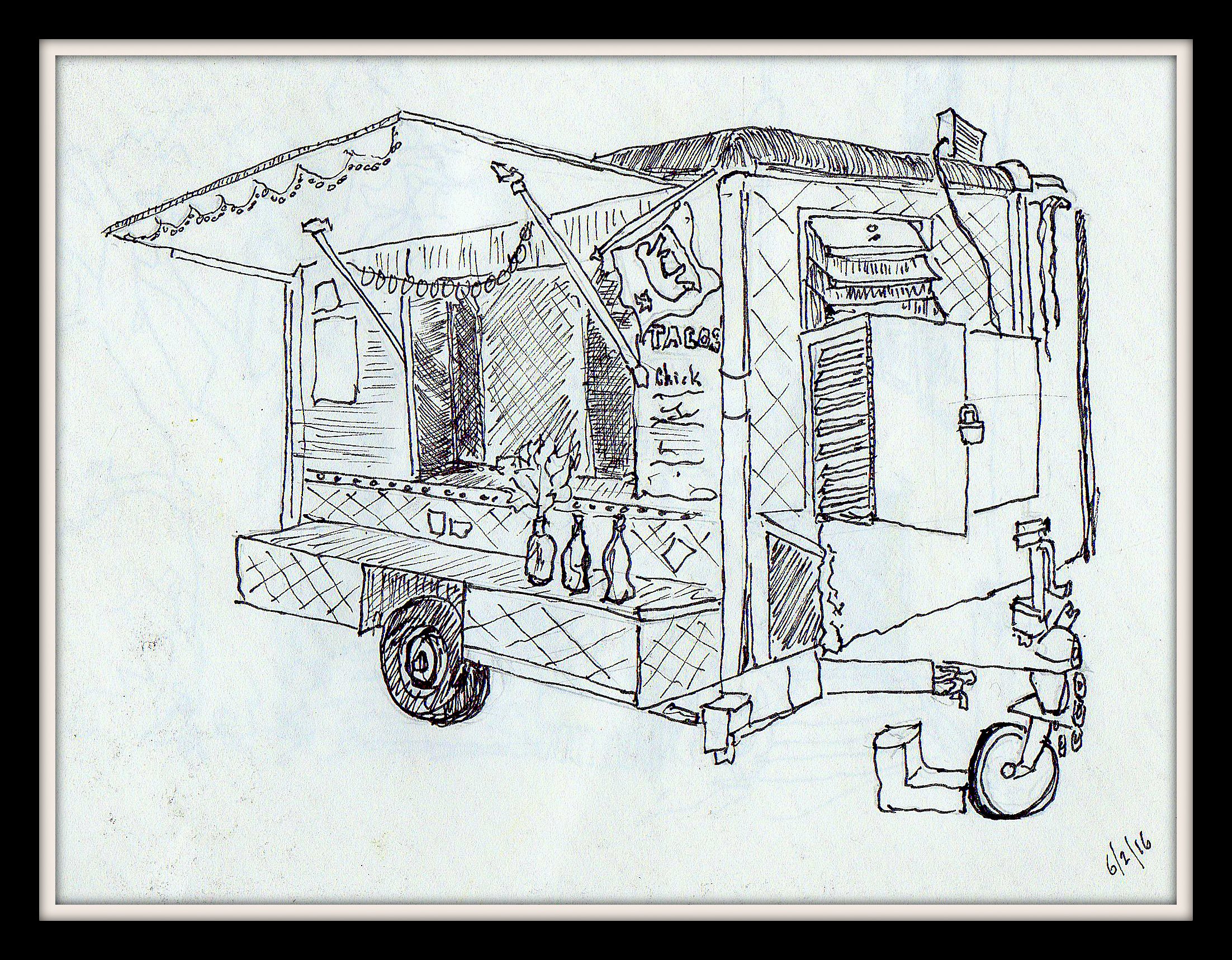
Street sketch: taco cart
Street sketch
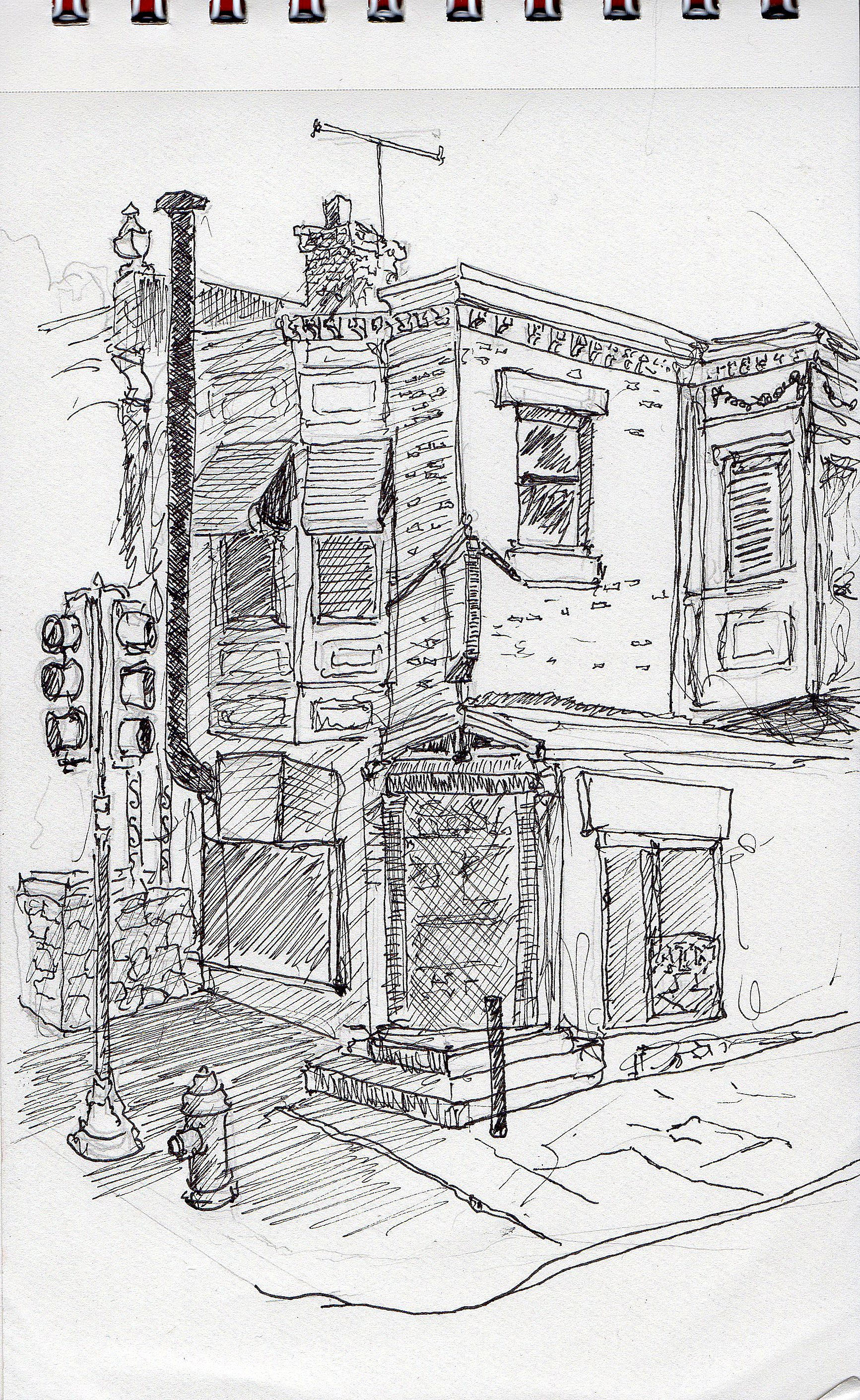
54th & Pine, Philly. Not very good at this yet… gonna take a while, but spending an hour or two drawing has the same effect for me as meditation. And it raises the level of my attention– to everything I see. Nothing like it. Eyeballing this, unless you have architectural perspective training, is not easy. I do use perspective guidelines, but complex structures are a challenge… like the fucking oriel bays so common in West Philly. Every bay has two additional vanishing points, besides the right angle facades of the building, and while the upper vanishing point can be ignored with two or three story buildings, unless you’re drawing them from close up, the bays bring that into play too… cause if eye level is sitting or standing above the street–you’re seeing the bottom of those bays. Makes pretty simple buildings, quite complex, figuring out the perspective.
I’m not after geometrical perspective, but even to play with it, play with distortions, you have to have a pretty good grasp of perspective. I’m 40 plus years out of art school, so having to start all over. Going through Joseph D’Amelio’s Perspective Drawing Handbook, and finding it helpful.
Add to that, that while I’m more than competent with close in details of texture and form, with pencil or pen and ink. Draw a feather… or a pine cone: no problem. But this is a different order of drawing for me.
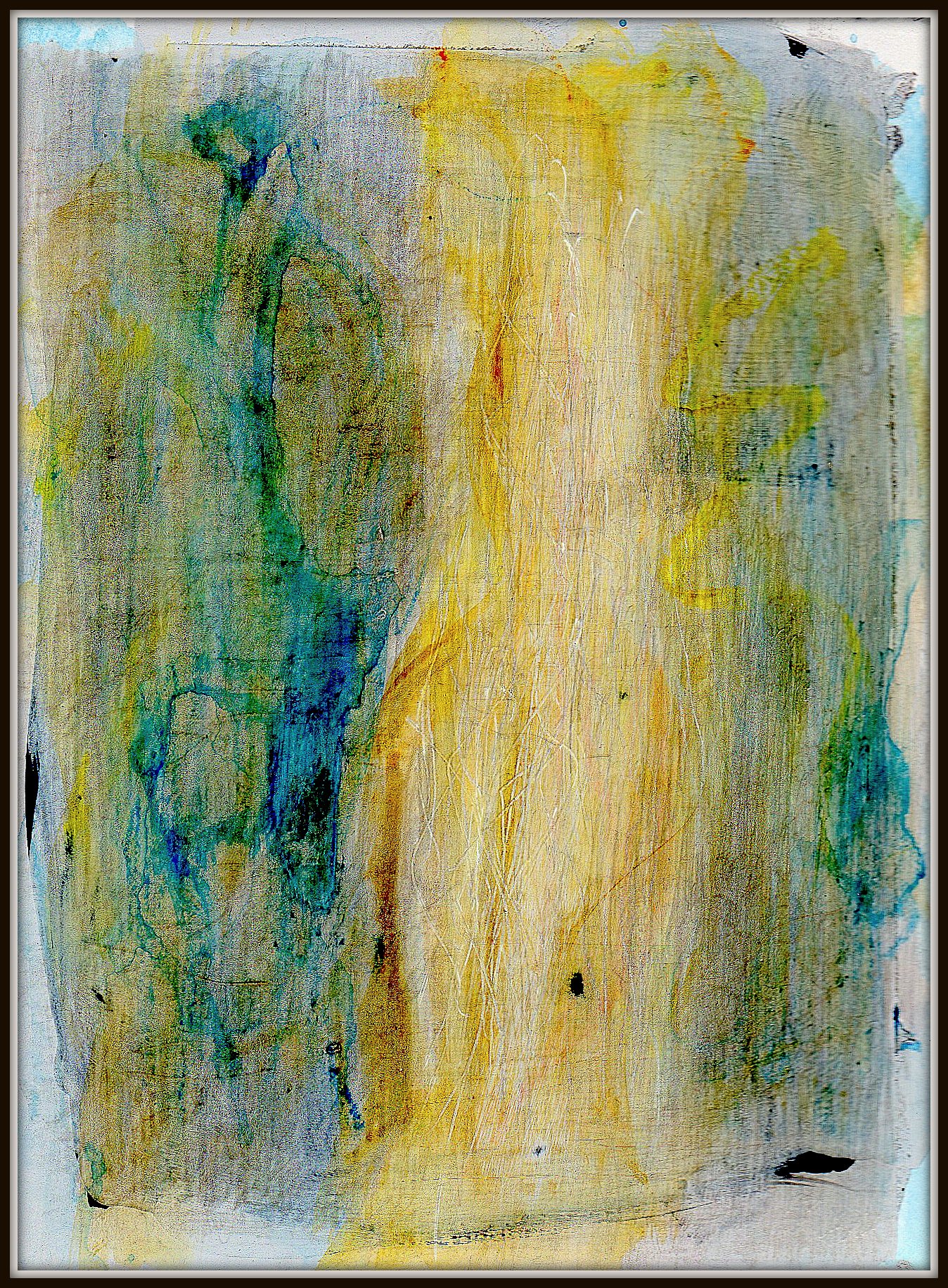
#522
26″ x 30″ Acrylic on Masonite. Not altogether happy with this, but sometimes don’t want harmonious colors. Sometimes I want colors that make your eyes hurt. This been sitting on my easel for weeks. Sometimes, I can paint over and start again, or set a piece aside. This was like a clogged drain. Better to finish it and renew the flow.


View GALLERY
#421 Metalpoint
6″ x 4.5″ Silver, Gold, toned ground over layer of black gesso, with neocolor wash.


View GALLERY HERE.
#520 Metalpoint
6″ x 4.5″ Silver, Gold, Aluminum with Neocolor wash, white gel pen on layered ground, toned gray over black gesso, some scratch through. I build on the patterns created by the underlying layers.
View GALLERY HERE.
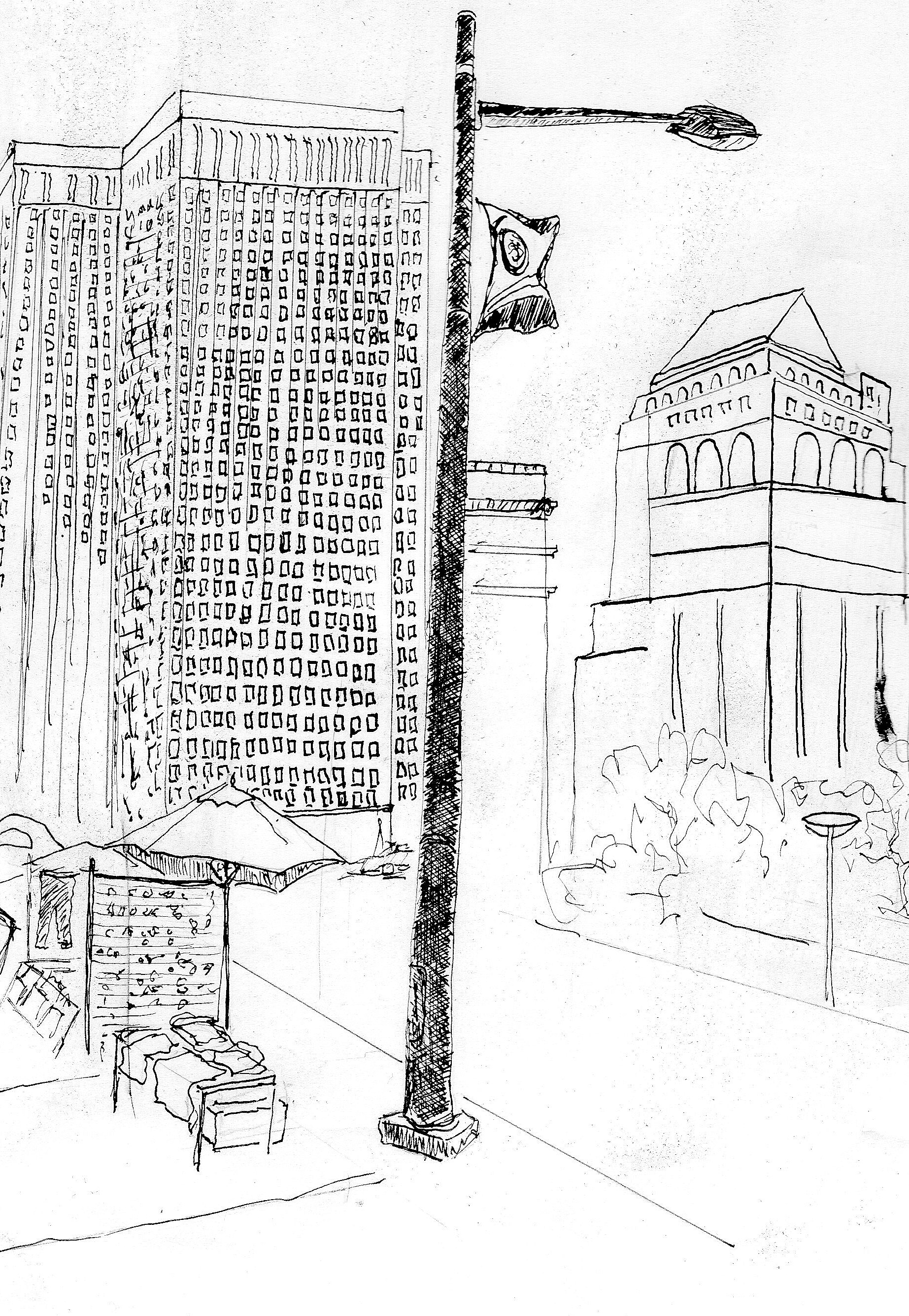
Street sketching – Pine Street 5/26/16
The Impossibility of Realist Art
This is a comment to the post below–rebloged from Alien Ecologies.
The ‘realism’ of the artist was never that of the scientist, even when their work drew on geometrical perspective, was colored by optics, and anatomically rendered. The pictorial plane never truly “represented.” What was suggested there has always been both more and other than the named subject, even when following conventional rules and stripped of other worldly intentions (see Hubert Damisch: A Theory of /Cloud/ for a case study of development of internal resistance to pictorial realism from Correggio to Cezanne).
The moment an artist accepts what they know to be true–and let’s that realization influence what they do (even more so when meticulously following realist conventions, because the contradiction between the claim to representation, and the dependence on these conventions is all the more disturbing), there will be a desire to deal with the fact of that contradiction–in the work itself. This is not a flight from reality–material or otherwise, but commitment to it. There is no art without the “meta.’ Naive realism simply chooses to let illusion stand for the real, without calling attention to it. I would go so far as to suggest that this contradiction, the failure of representation, is the generative engine that drives change. I think that can be said for abstract, ‘non-representational’ art as well, with the fault lying, not between the claim to a ‘subject’ that exists in the material world and the pure fabrication that is the art, in the failure to entirely reduce the aesthetic object to the picture plane, or surface form and matter of 3 dimensional works. There is just no way to exclude the viewer, who is no mere observer, but actively participates–enters the work and moves through it–creating something like a virtual reality that changes with every viewer, across cultures and spans of time.
Age of Abstraction 2.0?
The Dark Forest: Literature, Philosophy, and Digital Arts

“I always decide in favor of feeling rather than calculation.”
– Kandinsky
As Hilton Kramer suggested in his rendition of the those modernist artists after 1913:
For both Mondrian and Kandinsky, the artistic base from which they made their fateful leap into abstraction was landscape painting, but their respective approaches to landscape were, again, very different. Whereas Mondrian’s was that of an ascetic determined to strip nature of its mutable attributes, Kandinsky’s was that of a mystical lyricist for whom nature is an enchanted realm of poetry and symbolism. Yet for both, the leap into abstraction was at once guided and sanctioned by their faith in the metaphysics of the occult, which in the end emancipated them from the mundanity of the observable world.1
This notion of the disappearance of Nature, the natural as introduced by Enlightenment philosophe’s and the rationalists before them as the mechanistic, and observable, objective…
View original post 485 more words