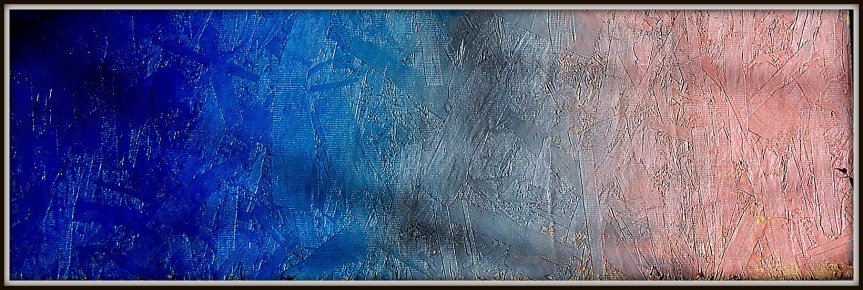

View GALLERY HERE.
11×34.5″ Acrylic on chipboard… just cause I love the patterns of the chipboard

How do you think a form of capital that is already thinking you?
…….– Matteo Pasquinelli
Delphi Carstens under the Rim Dweller section of Maggie Robert’s site gives a nice history of the notion of Hyperstition which emerged out of that strange and uncanny entity CCRU. Carstens describes this most uncanny guest as a engine for the creation of abstract machines: “Functioning as magical sigils or engineering diagrams hyperstitions are ideas that, once ‘downloaded’ into the cultural mainframe, engender apocalyptic positive feedback cycles. Whether couched as religious mystery teaching, or as secular credo, hyperstitions act as catalysts, engendering further (and faster) change and subversion. Describing the effect of very real cultural anxieties about the future, hyperstitions refer to exponentially accelerating social transformations.”
This sense that hyperstitional interventions give rise to the future is at the core of this (non-) concept. She’ll quote Nick Land from an email interview…
View original post 2,912 more words
ABOUT:
We are a group of people in and around the Philadelphia area. We are trained street medics, nurses, EMT’s, wilderness first responders, artists, herbalists, trauma counselors and generally people interested in the health and well being of our communities. Members of this collective have been involved with providing medical support at direct action, activist camps, street protests, and disaster relief situations. Please take a look at our Points of Unity to learn more about our values and the ways in which we organize.More resources for taking care of yourself and others coming soon!
POINTS OF UNITY:
+ We affirm that demystifying and democratizing health care skills and reducing our dependence on profit-driven medicine and police-involved emergency response is vital to building long lasting movements for Liberation in our lifetime.
+ We acknowledge that the idea of “safety” is relative and complicated
+ We believe in building interdependent ways of being with one another that do not replicate the oppression that isolates us in the first place. We see our work as acknowledging and resisting intersecting systems of oppression — both in the world and in our relations with one another.
+ We believe in the principles of harm reduction and practice and support diverse forms of healing that are consistent with each individuals understanding of their own needs and values.
+ We believe our liberation is tied to that of others and we take on this work in solidarity with collective resistance.
+ In all these above points we stand in solidarity with the evolving international traditions of street medics.
CODE OF CONDUCT:
1. We do no harm. We make every reasonable effort to give treatment that will not negatively affect the health or wellbeing of our patients. If no such treatment is available, no treatment whatsoever is given.
2. We work only within our own individual scope of practice, while trusting and respecting the abilities of the other medics in their work. We explicitly inform patients of our own qualifications and limitations.
3. We obtain clear and explicit consent from our patients and anyone affected by our care for every action we take as medics, including any physical contact or while performing any procedure. If a patient in an emergency situation is unable to offer consent for treatment, as through a lack of consciousness, we strive to take whatever action we believe is most essential to their wellbeing. We respect patients’ right to refuse any treatment, advice or transport to any medical facility.
4. We maintain our work areas as Safer Spaces, and actively challenge the perpetuation of any form of social domination or oppression. This includes, but is not at all limited to sexism, racism, transphobia, ableism, classism, ageism, and other forms of oppression. We cultivate an awareness of our own privilege and work to create a welcoming, safe and comfortable space for all, while directly calling attention to any actions of other medics that perpetuate oppression.
5. We respect and actively protect the privacy of our patients’ and the confidentiality of their treatment to the greatest extent possible. Without our patients’ consent, we do not allow photography, videography, audio recording, or any other non private record of our patients’ care.
6. We practice exceptional sanitation and hygiene in our work as medics and in our working areas. This includes using appropriate protocols of Standard Precautions and Body Substance Isolation (BSI) in caring for patients through gloves and other means, as well as thoroughly washing and/or sanitizing hands, surfaces, supplies and containers when they may be contaminated. If a medic suspects that they may currently host any readily transmissible disease, they do not act as a medic until the risk of transmission is abated.
7. We maintain a continuity of care for all of our patients. We do not leave or cease caring for any patient until a treatment is completed, except to transfer the patient’s care to another medic of equal or greater qualification – or to prioritize the immediate and urgent care of a different patient in emergent need, when no other assistance is available.
8. We organize ourselves horizontally, without institutional hierarchies of command, experience, credentials, ability or level of involvement. Every medic has equal power in all decisions affecting them.
9. When acting as medics, we remain neutral. The primary role of a marked medic is to provide care for the injured or ill. We do not attempt to direct the actions or personal choices of anyone else for any tactical or political purpose. We do not participate in any ideological or political action while marked as a medic..
10. While working as a medic, we recognize our responsibility to maintain a positive and calm atmosphere.While on duty, our interactions with patients’, other medics, and passersby are guided by trust, respect and solidarity, in the same way that those qualities are essential to our own standing in the community. Rather than telling others to do something, we ask them. We request rather than command. Patients in our care are treated respectfully and are spoken to or with. We do not gossip about or judge any patients in our care.
11. We all benefit from an orderly, clean working space, and we all contribute to keeping it in that condition. If we reorganize any materials in a medical space, we make every reasonable effort to inform the other medics of those changes.
12. We do not use intoxicating substances while on duty and we do not tolerate the use of intoxicants or smoked tobacco in any medical space.
13. We are all capable of learning and improving our skills, and recognize that we all make mistakes. Each of us remains accountable to any guidance or correction, and we receive the input or critique of other medics respectfully, with good faith that our common goal is to provide the best possible care.
14. We understand that when anyone is marked as a medic, they are considered to be on active duty, and their behavior is accountable to this code of conduct. Should we wish to act outside of the principles in this code, we remove all markings or other indications of our role as a medic beforehand. If any medic acts outside of this code, they may be held accountable to the other members of this group, local medical protocols, and to the respective community.
In a world where 1 in 7 people are displaced, your kindness is just condescension.
Dispossessed is an identity of disempowerment, but it is a powerful identity. Borders may temporarily hold back the flow of humans adrift, but in a world where we are so tightly and dizzyingly interwoven, physical boundaries are far less obstructive than the lasting confinement of imposed narratives. Such is the double-edged power of stories: They can hold us together — and they can distort, isolate, and divide. The dispossessed: The tag’s impediment persists even after the bearer has crossed a border or town limits, settled in, become a neighborhood cop, a high school teacher, a daughter’s girlfriend, or a boat captain living next door. Unless the world finds compassion for this new communality, learns to make sense of one another’s voices, its humanity will perish.
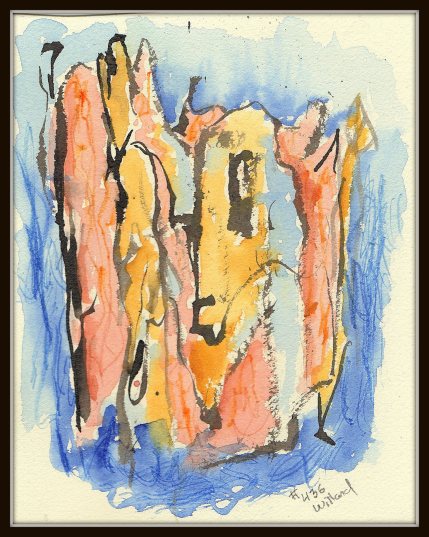
View GALLERY HERE.
5×7 watercolor, ink — working out problems I’m having with an acrylic painting I’m working on.
Donald Donald in his Origins of the Modern Mind: Three Stages in the Evolution of Culture and Cognition (1993) once argued the australopithecines were limited to concrete/episodic minds: bipedal creatures able to benefit from pair-bonding, cooperative hunting, etc., but essentially of a seize-the-day mentality: the immediacy of the moment. The first transition away from the instant, the present, and toward a more temporal system of knowledge acquisition and transmission was to a “mimetic” culture: the era of Homo erectus in which mankind absorbed and refashioned events to create rituals, crafts, rhythms, dance, and other prelinguistic traditions. This was followed by the evolution to mythic cultures: the result of the acquisition of speech and the invention of symbols. The third transition carried oral speech to reading, writing, and an extended external memory – store seen today in computer and advanced machine or artificial Intelligence and extrinsic data-memory technologies.
At the same time that our external…
View original post 2,636 more words
Post Preamble: This is another in my very irregular series: Good Question of the Week. (which is not weekly by any means).
I have discovered there is a limit to the length of an answer on the Craftsy.com website.
Students ask questions in an email-like sidebar and I get notified when there’s something to discuss. Today, I found out the hard way there must be a character limit to the entry field. Because this (long winded) answer simply wouldn’t go through until I broke it into three replies.
Anway, enough inside baseball.
Here’s the question for anyone that might be interested:
Student Question:For sketching I think that line adds a freshness to the drawing but mine always turn out far too cartoony…which I don’t like. I Love the direct approach but I tend to leave that more for “real” paintings. How do I lose the cartoony effect? (ed. note:…
View original post 757 more words


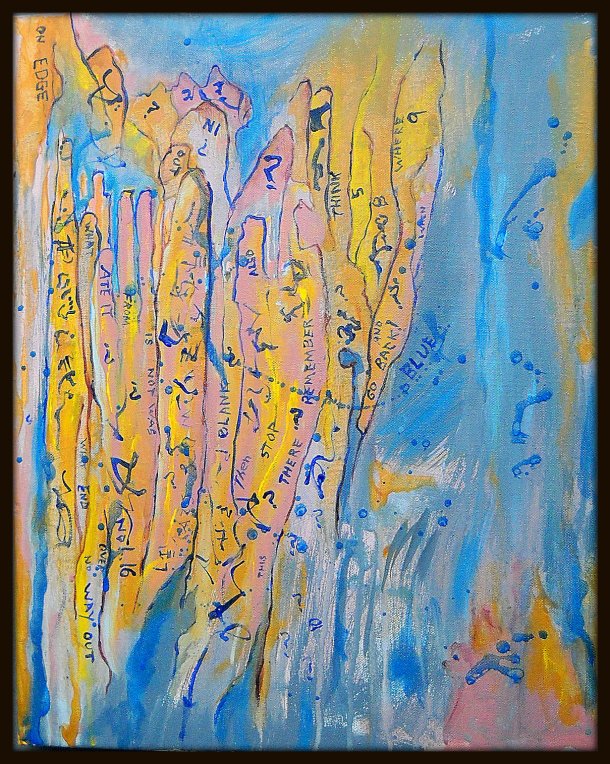

 Jacob Russell's Magic Names