Theory Matters

larvalsubjects's avatarLarval Subjects .

In my intro philosophy courses I would say that one of my main priorities is to persuade my students that ideas matter.  The argument is drawn from Plato and is very simple.  Many actions– I say many, not all because any number of things can lead us to act –are based on our beliefs.  A belief is simply any statement that can be true or false.  Knowledge, if it exists, is one variety or species of belief; whereas opinion is another species of belief.  I keep it basic at this point.  “Opinion” is not synonymous with “subjective”, but is rather a conviction or belief that we hold to be true without knowing the demonstration for that belief.  In short, as problematic as it is, I take Plato’s thesis from Theatetus that knowledge is “justified true belief” when introducing this claim.  Thus, for example, I have the opinion that the…

View original post 2,450 more words

5 Watercolor Painting Hacks Perfect for Beginners

maxmallie's avatarMax Mallie's Blog

In Transit

Artist Kathryn Keller Larkins risks everything by embracing gigantic dimensions and a radically limited palette. She?s no longer a novice artist, but she still has some of the best tips for beginners to try.

kathryn keller larkins, artistsnetwork, beginners

Through Security by Kathryn Keller Larkins

Larkins’ work is distinguished by many things. It?s distinguished by her decision to use a highly restricted palette, to start. She uses primarily Winsor & Newton. Her paintings are dominated by grays and blacks, which she then augments sparingly with soft colors. These often serve as accents. They lift the work away from an insistent monochrome and suggest a world of color.

The effect is distancing — perhaps even alienating in some way — as though color has become little more than a memory in some sort of dystopian future. That?s why its use adds to the highly charged atmosphere of her work.

“I like how the eye begins…

View original post 405 more words

Philosophy in Fragments

larvalsubjects's avatarLarval Subjects .

Somehow it seems like the professionalization of philosophy, which began in the 19th century, was a disaster.  I suppose there’s something suicidal in saying such a thing.  If there weren’t such a thing as professional philosophy, then I wouldn’t have a job.  I’ll grant that.  However, when I look at what professionalization has wrought, I wonder if it hasn’t been catastrophic.  Through professionalization, the questions of philosophy have become rarified and abstract, generating all sorts of fascinating philosophical riddles and puzzles, yet one is left– especially the outsider –with the general question “why does it matter?”  At the end of the day, what difference does any of this make?  How pathetic is it that we endlessly pour over Chinese Rooms and what Mary learned and brains in a vat?  This is what we’ve been reduced to?  Grue?  I can, of course, tell a story about why this or that matters…

View original post 1,029 more words

Neuroscientific Exploration of Strange Relations: Between The Fantastic and the Paranormal

S.C. Hickman's avatarThe Dark Forest: Literature, Philosophy, and Digital Arts

Tzvetan Todorov in his classic study of the fantastic, The Fantastic: A Structural Approach to a Literary Genre once defined it this way:

Which brings us to the very heart of the fantastic. In a world which is indeed our world, the one we know, a world without devils, sylphides, or vampires, there occurs an event which cannot be explained by the laws of this same familiar world. The person who experiences the event must opt for one of two possible solutions: either he is the victim of an illusion of the senses, of a product of the imagination – and laws of the world then remain what they are; or else the event has indeed taken place, it is an integral part of reality – but then this reality is controlled by laws unknown to us.1

The fantastic occupies the duration of this uncertainty. Once we choose one answer…

View original post 1,819 more words

From Spirit Park to Spirit Dark

Andrew Seal's avatarthechangingpalette

Spirit Dark after Guernica, in progress

Spirit Park

The evolution of today’s post:

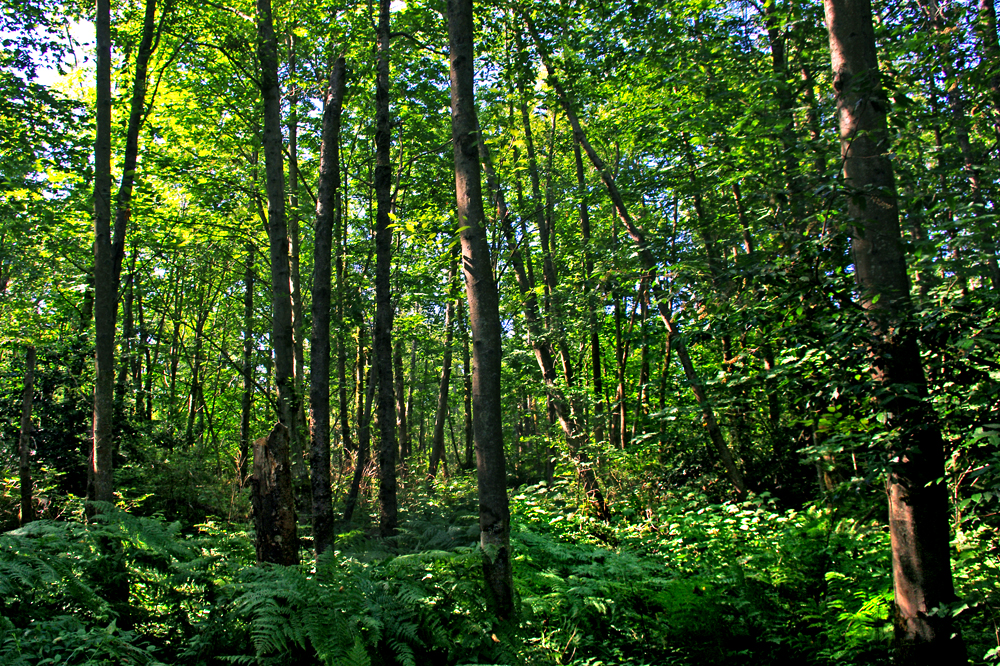
The Pacific Spirit Regional Park in Vancouver is a beautiful jewel in our city, a place of peace and tranquility that I have posted about many times, and as recently as this week’s Photo Challenge from The Daily Post. On our last visit there one of my photos inspired me…

…to set up a number of sheets of newsprint on the studio wall and see where it took me with charcoal, crayon and paint.


I was happy that the image was progressing well and was close to being finished…

…and then yesterday morning came the news from Spain of the horrific terrorist attack killing and injuring countless innocent men, women and children from all over the world, enjoying a summer’s evening in Las Ramblas in Barcelona.  The images were heartbreaking, and one particularly…

View original post 176 more words

Pick a Different Way of Working — Max Mallie’s Blog

Your Signature Style and Your Secret Style Many artists have a signature style or favorite subject for which they are well known. Rarely is it the case, however, that the acclaimed body of work is the only type of artwork these artists produce. Dawn Emerson, Cuong Nguyen and Andrew McDermott are three artists who are […]

via Pick a Different Way of Working — Max Mallie’s Blog

The Art is Not in the Painting: part 3

#690 Flowers in the ruins of the Prison State
Three (toward a personal aesthetics)
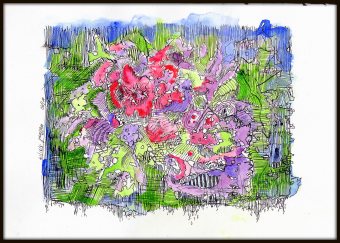
I stood for a time letting my eyes take in the zinnias in bloom. Took them in. Into my body, into the structure of my cells, the chemistry of my body. I let my gaze fly easily from one to another, like the insects, the little flies disguised as bees, from flower to flower, to the leaves that embraced them in their green cloak—returning again and again to an orange blossom that drew me to it. This will be a painting, I thought, but not a painting anyone would recognize as zinnias. It will be a painting that I will make with my eyes, guiding brush or pen, moving from point to point on the page. It will be a painting those little bee-flies will help me make. We will make it together: flowers, bees, the fold of green, the press of my feet on the sidewalk telling me it was time again. Time returned, telling me to move on. Till the next time.
——

One
The art work is an eidolon. It exists in the memory and experience of those who have seen the object that engendered it. It is not the physical object. The eidolon is as powerful as the number of people who have viewed, read or heard it, and carry it with them. The power of the eidolon is that of a shaper. It alters and shapes perceived reality. Its power is cumulative and collective.

Two
The artist views a face, a garden, a city street, patterns in broken pavement, an image in a dream: hears tone and timber in a voice, birdsong, wind: feels in their own body how bodies move — or all of this and more in the torrent of words that surround them. This is the compliment of what might become the eidolon, but is not yet. It is, for now, only a private vision, a kind of pain, unease, something that does not want to remain private, where it will become a disease, a symbiant that may fade and die—or kill its carrier… or find voice and body, form and duration in the thing we misname, as ‘art.’ It first becomes the eidolon as the artist takes it in, standing aside even as they make it, to see, listen, move beside it as it moves from their body, into what its becoming. The artist may feel this as healing—but what it heals, what it saves them from, is the unborn thing, the art that found no becoming in the world, where it gathers power and being in the view of others.


View my web portfolio here ART BY WILLARD
For photos on this blog:CLICK HERE, and scroll down.