I was going over a Lifeprint ASL lesson, and was stopped cold with an imaginary question… I mean, question that only an act of imagination would answer.
I heard a voice when I read when I was a kid–maybe because i learned to read sitting on my aunts lap when she read to me–it was not my voice, it was the voice of the book.
Someone who has never heard, learns to read English (or other spoken language) as a second language. Reading, at first–for a native signer, would be translation from sign–until they were fluent readers.
This is what I was trying to imagine–what form do the written words take, when you have never heard them? Deaf readers achieve a reading, and writing fluency well beyond any that it’s like, when one is first learning to read a second language–it’s not translation. But what then is the relation to signing?
This is a startling thought… that there must really be comprehension that is meta-language–meaning, that finds itself in word, or signs, but is not identical with word or sign. A primacy of meaning before language.Why does this seem so incredible to me?
Does this suggest that there is a language beyond language, that underlies all other forms of communication: I think of how animals communicate. I think of music: dancing… of all the arts.
Category: Goby’s Journal
Making do with failures
WIP, when a watercolor is a dud, but has some nice colors–make a collage!
 View more work at SaatchieArt, and on my web portfolio: ART BY WILLARD For photos on this blog, click MY ART on the right panel and scroll down.
#838
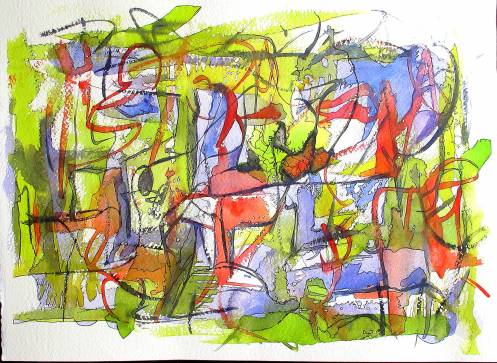
11″x 15″ watercolor, pen & ink. On Fabriano 140lb coldpress. Yellow-orange, blue-violet, yellow-greet triad.
Art is a rupture in the established order; a work of art is a tear in the net we cast over the perceived world– while the ‘Art World,’ in the guise of celebrating the rupture, works tirelessly to stitch it back in place. The Art World uses a capitalist idea of success to train artists to heel, like dogs on tight leash.
There is nothing more anti-art, than the capitalist Art World.
View more work at SaatchieArt, and on my web portfolio: ART BY WILLARD For photos on this blog, click MY ART on the right panel and scroll down.
#823
11″ x 11″ Acrylic, Ink. Brush and pen.
A tribute to graffiti artists–whose art is mated to destroying the value of property. The capitalist, Gallriest-Gatekeepers, and their non-profit mural arts sidekicks, try to defang them, prettify them, sell them to investors, but they slip out the door of the Great Western Art Narrative, to appear again on walls above the street–nameless as ninja warriors.
Paint this over fascist Rizzo’s face on 9th Street!

View more work at SaatchieArt, and on my web portfolio here ART BY WILLARD For photos on this blog, click MY ART on the right panel and scroll down.
Why it is useless to praise an artist for their work…

… and is almost always harmful in more ways than indicated below.
Unshakable confidence in pursuing one’s calling is not incompatible with deep and persistent self-doubt.
An artist’s expression of doubt may not, and probably does not, indicate the need for encouragement to continue in their work–it can be more existential, more a doubt at the heart of one’s very Being.
A gap can open between the sense of authenticity of the work, and of the self–and a growing feeling of achievement in the work, may be accompanied by a proportionate intensification of self doubt–as though the maker were not worthy of what they have made. Dismissing the value of the work, may not be about the work at all, but a defensive movement–a form of self-preservation.
There can be a paradoxical need to find in every work, a failure, a never ending failure, that both impels and insures continued creativity, and enables the artist to survive in a world, where, if they are “successful”– their work will be more valued than their lives.
This is likely true for any person who follows an authentic calling.
Photo of funeral pyre
#785
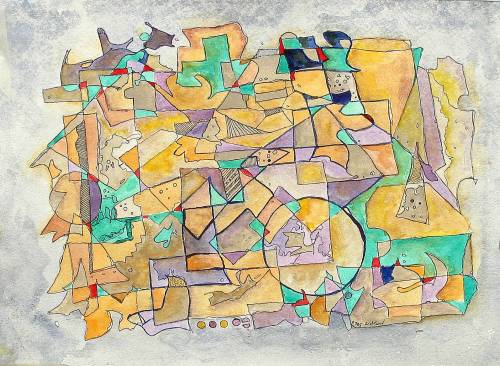
11″ x 15″ Watercolor, ink.
Artists as diverse as Pollock, Klee, Rauschenberg and Piranesi in his Prison etchings–as well as most two dimensional art before the Renaissance– use a dispersed visual field, rather than focal point composition. This is characteristic of most of my work, as well. In focal point composition, there are one or more fixed points, or centers, which invite the eye to radiate out, placing the rest of the field in relation to each specific point of view. In a dispersed field, there are no fixed points, but rather a network of pathways, like organic rhizomes, inviting the viewer to wander freely through the visual field.
 View more work at SaatchieArt,
on ArtFinder, and
on my web portfolio here ART BY WILLARD
For photos on this blog, click MY ART on the right panel and scroll down.
#780
40″ x 26″ Acrylic on canvas. PAINTED OVER
View more work at SaatchieArt,
on ArtFinder, and
on my web portfolio here ART BY WILLARD
For photos on this blog, click MY ART on the right panel and scroll down.
There was a time, wasn’t there… when poets, in their rooms at night, artists without patrons, would console themselves in the belief that–though the world would go on without them–there would be this thing…like a great house, or a city shaped like the future, to take up their work, and give it a place and a home. A room at the top of the stairs, like the one where they sat, but filled with light, windows, doors that opened to rooms like cathedrals, crowded with those who would be their descendents, their righful heirs?
Posterity
What does it mean for us, now that the masters of death, in their corporate towers, have declared that it will all come to nothing, that the glaciers will melt and the seas will rise and they too, in their gated and armed fortress, will no more survive than the masses they have starved and bombed and drowned and burned… and all that we have made, the great buildings, the art, the music–all of it, gone?
I wonder if it would make more sense, Zen like, if what we make, we make in ashes in the rain… write our novels on Magic Slates, lifting the film, erasing, what we write a page at a time–or mantras in colored sand.
Why do we fool ourselves? Why do we pretend that any of this matters? Is it, perhaps, that it has always been like this? Always, the end of the world already here.. so quiet, we didn’t hear its coming?
#778, and Judging Value in Ones Own Work
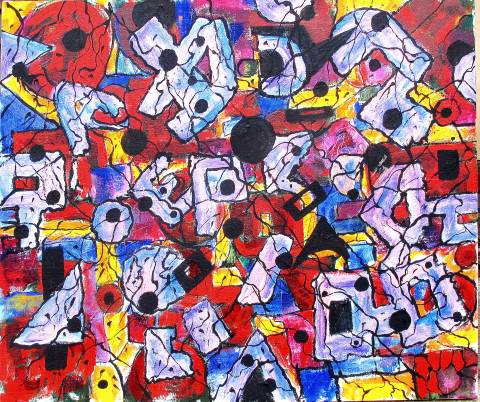
#778 follows the text. 22″ x 26″ Acrylic on stretched canvas.
Subjectivity in judging art. How does one judge one’s own work?
I see ‘the viewer,’ not as singular, but as a collective–a whole cultural constellation filtered through each individual, so while each sees as an individual, we also see through the eyes and mind lent to us by their culture, in a particular historical moment.
Subjectivity is complex and inclusive, which means it’s possible to develop our capacity to make judgements, which, while not being “objective,’ are much larger than what one usually means by “subjective.” Such judgements are not fixed verdicts–as they change (or rather, what they point to changes), as culture changes, but good critics–rare as they are–know this.
John Berger. Hubert Damisch.
My question speaks to this. In assessing the value of one’s work, doesn’t there cling to our judgement, a remnant of belief (trust, would be a better word)… that we are able to discern a value that is not so limited, that is not chopped and diced into disconnected individual ‘subjectivities,’ the way we are taught to see ourselves in late capitalism, value and meaning that is inclusive, an emergent vision of some part of what it means to be human in the world?
 View more work at SaatchieArt,
on ArtFinder, and
on my web portfolio here ART BY WILLARD
For photos on this blog, click MY ART on the right panel and scroll down.
Fighting for our Lives!
Fifteen years ago, we published the following text introducing anarchism to the general public as a total way of being, at once adventurous and accessible. We offered the paper free in any quantity, raising tens of thousands of dollars for printing and even offering to cover the postage to mail copies to anyone who could not afford them. In the first two weeks, we sent out 90,000 copies. It appeared just in time for the “People’s Strike” mobilization against the IMF and World Bank in Washington, DC; the pastor at the Presbyterian church that hosted anticapitalist activists in DC preached her Sunday sermon from the primer as she spoke to her congregation about the demonstrations. Over the following decade, Fighting for Our Lives figured in countless escapades and outreach efforts; read this story for an example. In the end, we distributed 650,000 print copies.
Fighting for Our Lives has been out of print for several years, as we’ve focused on other projects such as To Change Everything. We’ve now prepared a zine version for our downloads library. From this vantage point, we can appreciate both the text and the project itself as ambitious and exuberant attempts to break with the logic of the existing order and to stake everything on establishing new relations. We’ve learned a lot in the years since then—but we haven’t backed down one millimeter.
Vacant Lot: 52nd & Locust (3)

 Jacob Russell's Magic Names