
Author: wjacobr
Visual artist, poet, novelist, activist & Street Medic, living in North. Penn Name: Jacob Russell
My blog is a confluence of art, writing, politics.
my Art portfolio: Art-by-Willard.com
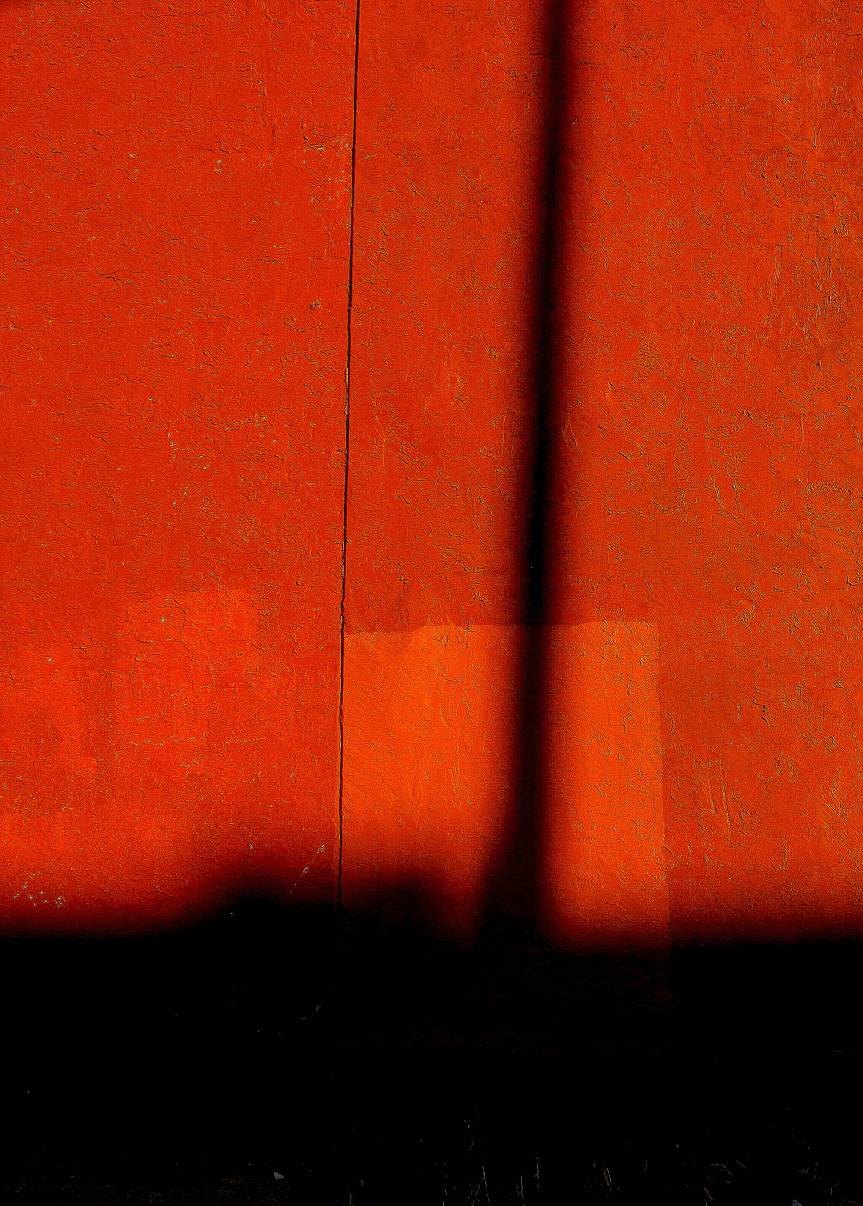
Vacant Lot: 52nd & Locust (2)

Vacant Lot: 52nd & Locust (1)
How does an artist judge their own work?
This is how I would answer that question.
What most consistently matters to me is where this piece is taking me, so my liking, or judging a work to be good, is never entirely about that work–but something I see before me, something that doesn’t yet exist–or hasn’t been realized (as in, made real). That may be something I don’t see until later, after I’ve made–maybe–many many more pieces. Finding the almost hidden signs that mark the trail. I find it most satisfying when those are the pieces that others are drawn to — like, ah! they get it!
Imagine having the entire oeuvre of an artist before you, seeing each piece in the order of its making for the first time, and trying to suss out what will come next, or what will represent the apex of their life work, never knowing if that point will ever be achieved, whether the next piece will be a detour, a dead end, from which the artist never returned, but continued to turn out work that failed ever again to realize the promise of what they had done before–it’s like that, only I’m the artist. THAT describes the character of my anxiety about my own work. Nothing that anyone else will see till my work is over.
There’s a Yeat’s quote, along those lines–I believe he writing about William Blake. “In the beginning of important things—in the beginning of love, in the beginning of the day, in the beginning of any work, there is a moment when we understand more perfectly than we understand again until all is finished.”
#319 Reworked: Self-Portrait in the Spirit World
31″ x 36″ Acrylic on stretched canvas. I thought I’d finished this in 2015, but was not satisfied with it. Seeing work by Tatiana Leony, an Igor Shcherbakov on Saatchieart (whose work is amazing–I encourage you to seek it out), helped me to see this with new eyes… or maybe, with my Third Eye.

View more work at SaatchieArt,
on ArtFinder, and
on my web portfolio here ART BY WILLARD
For photos on this blog, click MY ART on the right and scroll down.
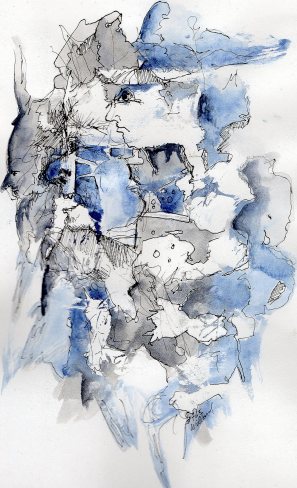
#765
12″ x 9″ Watercolor, pen & ink. Mood piece Blue & Gray
View my web portfolio here ART BY WILLARD
For photos on this blog:CLICK HERE, and scroll down.
#764
11″ x 10.5″ Pen & ink, watercolor
 View my web portfolio here ART BY WILLARD
For photos on this blog:CLICK HERE, and scroll down.
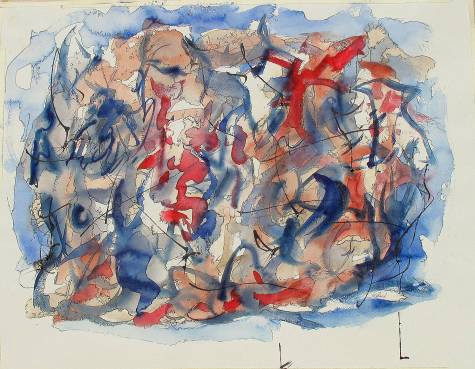
#763
17″ x 22″ Watercolor, pen & ink
 View my web portfolio here ART BY WILLARD
For photos on this blog:CLICK HERE, and scroll down.
#762 Primary Colors in the Thicket of Depression
36″ x 20″ Acrylic on canvas
 View my web portfolio here ART BY WILLARD
For photos on this blog:CLICK HERE, and scroll down.
On Depression, Revolution, Anarchy

It’s difficult for a person to hear themselves when they’re depressed. That’s why listening is more effective than any advice you might give, and why telling them you love them, or how much they are valued–only makes things worse.
In being heard, in being listened too, it becomes possible to hear one’s own voice–to hear, as others hear, the deprecating voices… and recognize what they are saying as distortions of the truth. It’s how we find our own way back.
The deprecating voices are external images of self that we have assimilated. No external voice will lead us out of their traps, because it’s our susceptibility to them that caught us in those webs, and to find freedom again to breath on our own, resistance has to rise from the depths of our own being. No one can do it for us, and no one else can show us how.
Keep that in mind when you offer reassurance, and are refused. The refusal is not a symptom of the malady.
Listen! Listen with such depth of attention that the person you would help, hears in their refusal, their own assertion of a will-to-health, and the means to restoration of their freedom
I think there is an analogy here to what we have to do to free ourselves from oppressive social forces.
No one ‘out there’ can save us. No Moses can come to lead us out of Pharos’s Egypt. There are no ready-made maps or instruction books or revolutionary plans. The first step, always–the beginning we need to return to, endlessly–by turning to one another, in such intensity, with such attention, such listening, that we will hear, and summon together, the creative power that has always been there: the power to create a new world–a world worthy of the struggle it will take to build it.
 Jacob Russell's Magic Names